The unicorn
What a billion-dollar valuation actually means
Description
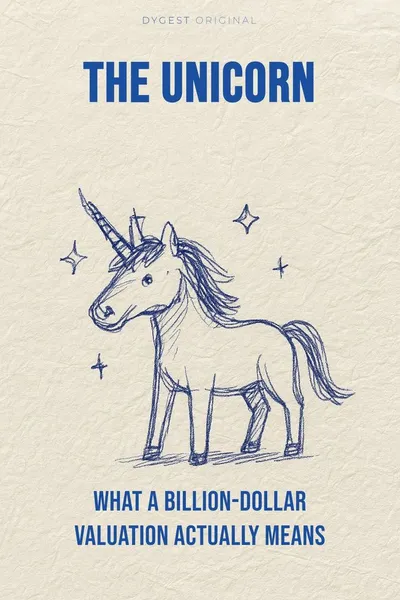
In November 2013, a venture investor named Aileen Lee published a TechCrunch piece called Welcome to the Unicorn Club. Lee counted the US software companies that had reached a billion-dollar private valuation she called them unicorns because they were supposedly rare and magical. She found thirty-nine. The word caught on, the category became a fixture of startup coverage, and the unicorn valuation became the symbolic milestone every ambitious founder aimed for.
By 2021, at the peak of the last major VC cycle, there were more than a thousand unicorns globally. The supposed rarity had collapsed. The specific number — a billion dollars — had not changed, but the number of companies hitting it had multiplied by thirty in less than a decade. The unicorn had become ordinary, which meant the threshold had drifted from any real signal about the underlying company. A billion-dollar company in 2013 typically had real revenue, real users, a real IPO path. A billion-dollar company in 2021 was sometimes that and sometimes a company that had raised one round at a price the market eventually refused to validate.
What a billion-dollar private valuation actually represents has become contested. The valuation is a function of specific startup-financing dynamics preferred stock, liquidation preferences, late-stage pricing, accounting treatment of private transactions rather than a direct reflection of the underlying business. Understanding what the unicorn designation means and does not mean is prerequisite to reading the contemporary startup ecosystem. The word has become both more common and less meaningful than the people using it usually realize.
The question we're asking: what does a billion-dollar private valuation actually mean, and why has the term unicorn become increasingly detached from reality?
What we'll see: the original concept, the mechanics that produce the valuation, the inflation of the category, and what the term actually signals now.
Table of contents
01The original concept
When Lee coined the term in 2013, a billion-dollar private valuation was genuinely unusual. Thirty-nine across the entire US venture-backed software industry was small. The companies that had reached the threshold Twitter, Uber, Airbnb, Dropbox, Palantir shared features. Substantial revenue or user scale. Category-defining or category-dominating positions. Five years old or older. By any reasonable measure, genuinely important companies.
The billion-dollar threshold emerged organically from VC fund economics. A fund targeting a twenty-five percent IRR needs returns roughly three times capital deployed. For a typical fund of a few hundred million, this meant portfolio companies that could exit at several hundred million or more. A billion was not a random threshold; it was approximately the valuation at which a successful early investor's stake, after dilution, could produce a meaningful fund-level return. The number rounded well and produced a memorable designation.

02The mechanics that produce the valuation
A private company's valuation is not observed from a public market. It is determined by the price of the most recent round multiplied by the fully-diluted share count. If a Series D investor buys new shares at a price implying a billion-dollar value, the company is technically a unicorn. What the calculation leaves out: the investor's shares are almost never the same as the shares founders and earlier investors hold. Late-stage rounds typically involve preferred stock with specific protections liquidation preferences, ratchets, downside guarantees that make the investor's position substantially more valuable than the common stock. The headline valuation treats all shares as equivalent, which overstates company value.
Liquidation preference is the most important mechanism. A one-times non-participating preference means preferred holders get their money back in a sale before anyone else. A two-times preference means twice their money back. If a company raises at $1B with a two-times preference and then sells for $1B, preferred holders take the original investment plus its match, and common shareholders founders and employees get what is left. Often, much less than the nominal valuation suggests. The unicorn valuation does not represent a consensus price; it represents a specific deal structure that looks different from different perspectives inside the cap table.
03The inflation of the category
The trajectory from thirty-nine unicorns in 2013 to over a thousand in 2021 was driven by several compounding factors. First, the massive expansion of late-stage VC during 2014-2021. Private equity, sovereign wealth funds, and corporate investors entered the late-stage tech market in numbers, creating a capital pool willing to fund high valuations in exchange for preferences. That pool did not exist in 2013 at anything like the scale it reached by 2019, and its presence pushed up valuations across the ecosystem.
Second, interest rates. The zero-rate environment of 2010-2021 pushed institutional investors to take on more risk for target returns. Venture, and late-stage private investment especially, benefited enormously from the search for yield. Allocations by pension funds and endowments increased substantially, funding the VC funds that deployed capital at rising valuations. When rates rose in 2022, the dynamic reversed sharply, and the unicorn category contracted.
04What the term actually signals now
By 2026, the unicorn designation means substantially less than it did in 2013. A company with a billion-dollar private valuation may have genuine revenue and a plausible IPO path. It may also have raised a single round at that price two years ago and be trading at a third of that valuation on secondary markets. The designation does not distinguish between these cases. Sophisticated investors now look past the unicorn label at specific metrics revenue, growth rate, burn rate, retention to assess what the company is actually worth. The label persists because it is convenient, but the informational content has thinned out.
Several sub-categories have emerged to try to restore meaning to the designation. Decacorn refers to companies valued at $10 billion or more — a threshold that has inflated more slowly than the unicorn threshold and still signals something about scale. Centaur refers to companies with $100 million in annual recurring revenue, a metric about the business itself rather than the capital structure. Zombiecorn refers to unicorns that have stopped growing, cannot go public, and cannot be acquired at their private valuation — they persist on their last round's price without any clear path forward. The proliferation of sub-categories is itself a sign that the original category has lost its diagnostic value.
05Conclusion
The unicorn as a concept matters because it has become one of the main public proxies for startup success, and because it has distorted the relationship between public perception of the tech industry and the underlying business reality. Founders, employees, investors, and business media all now routinely read the unicorn designation as a marker of meaningful achievement, without parsing the specific mechanics that produce the valuation. This produces downstream distortions in how the industry allocates talent, how the broader economy understands the technology sector, and how founders frame their own career ambitions. Understanding what the label does and does not mean is prerequisite to reading the ecosystem accurately.
Related books