The Super Bowl halftime show
When sports became a music event
Description
For most of its early history, the halftime break in the Super Bowl was a routine fifteen-minute interval featuring marching bands, color guards, and the kinds of musical performances that television networks treated as filler between the more important content on either side. The first Super Bowl, held in Los Angeles in January 1967, had a halftime show featuring two college marching bands. The early 1980s halftime shows featured Up With People, a wholesome touring musical group that performed at four Super Bowls between 1976 and 1986 and that few Americans could remember the name of even at the time. The format was, by industry standards, an obligation rather than an event. The audience watched it because it was on. The advertisers paid for it because they had to.
The Super Bowl halftime show that operates today is a different kind of cultural object. The performances are roughly thirteen minutes long, watched by audiences of well over a hundred million people, choreographed at a scale comparable to major touring concerts, and discussed in the press for weeks before and after the broadcast. Major recording artists actively pursue the slot. Production budgets, when they are disclosed, run into the millions of dollars per show. The halftime performance has become, in any meaningful sense, the most-watched musical event in the world each year, and the artists who perform on it are operating within an attention economy that no other live music platform can quite match.
The transformation between the marching-band era and the contemporary stadium spectacle is traceable to a specific moment and a specific business decision. The NFL, faced in the early 1990s with declining halftime audience retention, decided to redesign the show around major recording artists rather than amateur performers. The redesign worked at a scale the league had not predicted. The halftime show has since become one of the most carefully managed pieces of mass-attention real estate in American culture, with each year’s show generating its own economic and cultural arguments about race, body, politics, and what an American mass audience is willing to watch.
The question we’re asking: how did the Super Bowl halftime show become what it is, what does the slot now produce culturally and commercially, and what does the format reveal about American mass attention?
What we’ll see: the marching-band era, the Michael Jackson pivot, the controversies that shaped subsequent show design, and what the format now is.
Table of contents
01Marching bands and Up With People
The early Super Bowl halftime shows were artifacts of an older television culture that treated the break as filler. The 1967 show featured the University of Arizona Symphonic Marching Band and the Grambling State University Marching Band. The 1972 show featured Ella Fitzgerald and Carol Channing. The 1976 show, the bicentennial year, was performed by Up With People, an internationalist youth singing group founded in 1965. The show’s producers were the same people who produced the rest of the broadcast, with no particular distinction made between halftime and the rest of the airtime.
The audience numbers, in retrospect, told the story. The halftime break consistently lost roughly twenty percent of the football audience, who used the interval to refill drinks, prepare food, or change channels. The advertisers paying for halftime spots were paying for a smaller audience than they were paying for at any other point in the broadcast. Other networks had noticed. In 1992, when Fox aired a counterprogrammed In Living Color special during halftime, the broadcast drew over twenty-five million viewers, a number that humiliated NBC’s halftime show ratings. The NFL had a structural problem, and the network executives were aware of it.

02The decade of mass-pop spectacles
The years after the Jackson show produced continuous escalation in production scale and artist profile. The 1996 show was a Diana Ross extravaganza that ended with Ross being lifted off the stage by helicopter. The 2001 show, the first after September 11, was an Aerosmith and NSYNC co-headline that drew over eighty million viewers and established the format the league would follow for the rest of the 2000s: major pop and rock artists, layered performances, integration with the game’s broader broadcast narrative.
The corporate sponsor for halftime, Pepsi, became as important to the show’s branding as the artist. Pepsi’s sponsorship lasted from 2013 to 2022, and the show was officially titled the Pepsi Super Bowl Halftime Show. The artist was selling the audience. The sponsor was paying for proximity to the audience. The NFL was operating the marketplace.
03Controversies that shaped what the show can be
The halftime show’s expansion has been punctuated by controversies that have shaped what the format can and cannot include. The most consequential was the 2004 show, headlined by Janet Jackson with Justin Timberlake as guest, during which Timberlake tore off a portion of Jackson’s costume during the performance, briefly exposing her breast on national television. The event, which the participants attributed to a wardrobe malfunction, produced an immediate Federal Communications Commission investigation, a $550,000 fine against CBS, and a cultural argument about indecency that the country worked through for years afterward.
The fallout was structurally consequential. The NFL responded by tightening its control over halftime production, requiring artists to submit setlists and choreography for approval, instituting tape-delay protocols, and shifting bookings toward established artists who could be trusted with the high-stakes broadcast. The 2005, 2006, and 2007 shows featured Paul McCartney, the Rolling Stones, and Prince established figures whose performances were unlikely to produce wardrobe incidents. Jackson herself was effectively blackballed from major American televised performance for nearly a decade, while Timberlake’s career proceeded without interruption. The racial and gender dynamics of the incident’s consequences were discussed at length in subsequent years.
04What the format has become
The contemporary Super Bowl halftime show operates on a scale and with a level of cultural attention that no other annual American event quite matches. The 2024 show, headlined by Usher, drew over 130 million viewers. The 2025 show, headlined by Kendrick Lamar, drew over 133 million. The numbers continue to grow even as the rest of broadcast television loses audience to streaming and other platforms. The halftime slot has become a kind of remnant of the mass-broadcast era, one of the few cultural events that still operates at genuinely national scale, and the artists who perform on it are operating in an attention environment that no other booking can replicate.
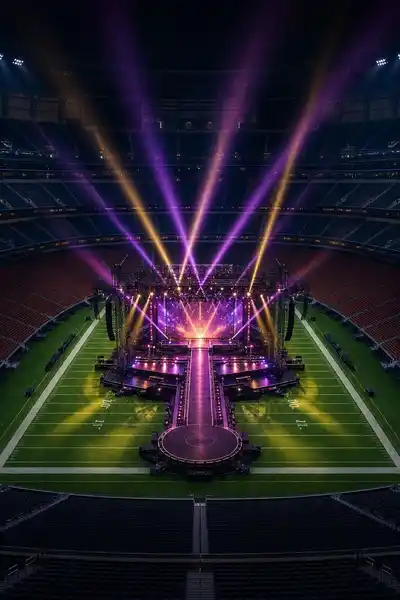
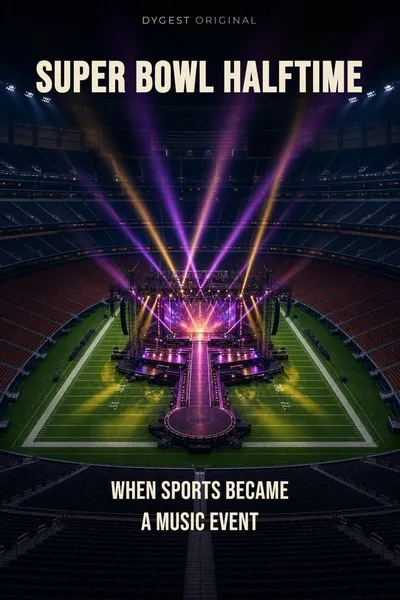
The production scale has continued to escalate. Recent halftime shows have featured hundreds of dancers, custom-built stage architectures that are assembled and broken down in the eight-minute commercial breaks before and after the performance, drone-based aerial cinematography, and integrated visual designs that involve every camera angle the broadcast supports. The complexity of the production requires a logistics operation comparable to a touring concert compressed into thirteen minutes, and the production companies that specialize in halftime have developed expertise that does not exist elsewhere in live entertainment.
05Conclusion
The Super Bowl halftime show will continue to evolve in the years ahead, with the format constantly negotiating between the artists’ interests, the league’s control, the sponsors’ positioning, and the audience’s expectations. The structural elements that distinguish the contemporary show from its marching-band predecessors the major-artist headliner, the spectacle production scale, the corporate sponsor integration were all in place by the mid-1990s. What has changed since has been the scale at which those elements operate, not the elements themselves.
Related books