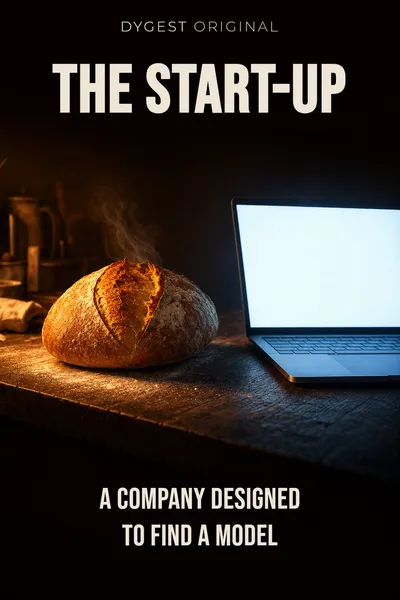
The Start-up
A company designed to find a model
Description
A bakery that opens on a corner and a company that opens in a co-working space can look, from the outside, like the same thing. Two or three people, an idea, some money borrowed or scraped together, long hours, and the same nervous hope that customers will show up. Both are new. Both are small. Both file the same kind of paperwork. And yet almost everyone who works in one of these places knows, without being able to explain it precisely, that they are not doing the same job. The baker wants to sell bread on that corner for the next twenty years. The other founder wants something stranger and harder to name.
The confusion is worth clearing up, because the word start-up gets stretched to cover almost any young company, which drains it of the one thing that made it useful. A start-up is not simply a small business that happens to be new, or a business run by people under thirty, or a business that uses an app. It is a specific kind of organization, built for a specific and unusual purpose, and that purpose is the source of both its enormous upside and its brutal failure rate. Most start-ups, by every serious count, do not survive.
Steve Blank, the entrepreneur who spent years trying to pin down what these companies actually are, landed on a definition that reads oddly at first: a start-up is a temporary organization designed to search for a repeatable and scalable business model. The key word is search. A baker already knows the model. A start-up, by definition, does not — and going looking for one turns out to be a very different act than running a business that already works.
The question we’re asking : What actually separates a start-up from any other young company — and why does that difference decide how it lives and dies?What we’ll see : How a single word rewired what founders were building, and why the thing that defines a start-up is also the thing that kills most of them.
Table of contents
01Chapter 1 — Not a small business in a hoodie
Start with the thing a start-up is most often mistaken for: the small business. A small business is an operation built around a model that already exists and is understood. Someone opens a dry cleaner, a plumbing firm, a restaurant. The person doing it may be taking a real risk, working punishing hours, and betting savings on the venture — but they are not inventing the fundamental logic of the thing. Dry cleaning works. Plumbing works. The recipe for the business is known, and the job is to execute it well enough, in a specific place, to make a living.
The goals differ in a way that goes deeper than size. A small business owner typically wants a stable, profitable operation that supports a family and, ideally, keeps supporting one for a long time. Growth is welcome but not the point; a second location might be nice, but a corner bakery that stays a single beloved corner bakery is a success, not a disappointment. The measure of the thing is whether it sustains itself and the people who run it.

02Chapter 2 — The word that changed in the 1990s
The word itself is older than the meaning we now attach to it. People described new ventures as start-ups through much of the twentieth century, but the term meant roughly what it sounded like: a company that was just starting up. It carried no special theory of how such a company should behave, no built-in expectation of explosive growth or spectacular failure. A start-up was simply a business in its first stretch of life.
What changed was the arrival of a specific engine behind certain new companies. From the 1970s onward, and with real force through the 1990s, the venture capital industry built around Silicon Valley developed a distinct kind of bet: put money into a young company not to earn steady dividends, but in the hope that a small number of these companies would grow enormous and return many times the original investment. That funding model quietly redefined what the companies taking the money were supposed to do. They were not meant to be stable and profitable soon. They were meant to grow fast, find something huge, or fail trying.
03Chapter 3 — Searching, not executing
Return to Blank's definition and sit with the verb: a start-up searches for its business model. This sounds like semantics until you notice how completely it changes what the daily work is supposed to be. In a company that already has a model, good management means execution — hitting targets, refining a known process, doing the thing reliably and a little better each quarter. In a start-up, the model itself is the unknown, so the work is not execution but discovery, and discovery looks like a lot of educated guessing followed by fast checking.
This is why the healthiest start-ups behave less like small businesses and more like laboratories. The founders hold a set of assumptions — about who the customer is, what problem is worth paying to solve, how the product should reach people, what they will pay. Every one of those assumptions is really a guess. The job is to test them cheaply and quickly, keep the guesses that survive contact with reality, and abandon the ones that do not. When founders talk about pivoting, this is what they mean: not flakiness, but the deliberate junking of a guess that failed the test.
04Chapter 4 — Why most of them die
Once the start-up is understood as a search rather than an operation, its notorious failure rate stops looking like a scandal and starts looking like arithmetic. The figures vary by how you count, but the shape is consistent: something in the range of two-thirds to three-quarters of venture-backed start-ups never return meaningful money to their investors, and the great majority of all new companies of this ambitious kind do not survive to become the self-sustaining machines they set out to build. This is not a sign that the people involved are unusually foolish. It is the expected result of the thing they are doing.
A search for something that may not exist has a built-in mortality rate, and no amount of talent removes it entirely. If a start-up is a bet that a repeatable, scalable model is out there waiting to be found, then a lot of those bets are simply wrong — the model is too small, the customers will not pay enough, the timing is off by five years, a bigger company gets there first. Failure, in this frame, is not the malfunction of the method. It is the cost of the method, priced in from the start. The venture funding that shaped the category assumes exactly this: it needs most of its companies to die so that the rare survivor can be enormous.
05Conclusion
Come back to the two companies on their corners. The baker and the founder in the co-working space still look alike from the street, still work the same long hours, still hope the customers come. But they are doing opposite jobs. One is executing a model that already works, hoping to keep it running. The other is spending money and years searching for a model that may not exist, on the wager that finding it would be worth all the searches that come up empty.
Related books