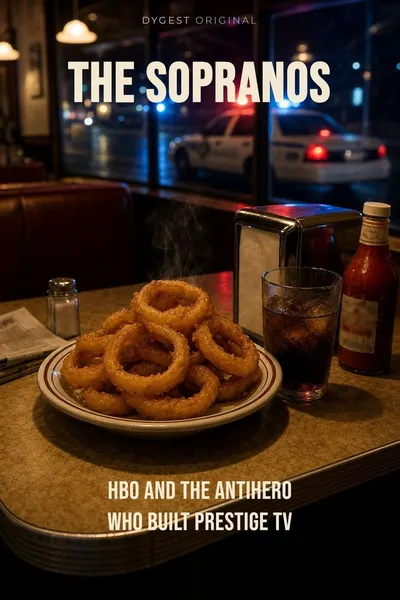
The Sopranos
HBO and the antihero who built prestige TV
Description
In January 1999, HBO aired the pilot of a series about a New Jersey mob boss named Tony Soprano who was seeing a psychiatrist for panic attacks. The premise had been pitched to nearly every major American network before HBO bought it. Fox had passed. CBS had passed. ABC had passed. Network executives had been clear about what would not work: a protagonist who was a murderer, a wife who knew, and a therapy plot that asked viewers to take a mob boss’s interior life seriously. The creator, an unknown writer named David Chase who had spent two decades on network drama, had spent eight years failing to get the project made. HBO, which had been looking for original programming to justify its subscription premium, took a chance on a thirteen-episode order.
The Sopranos ran for six seasons over eight years. It ended in 2007 with a cut to black at a New Jersey diner that became, almost immediately, one of the most argued-over endings in the history of television. By the time it ended, the show had reshaped what American television could be and how it could be financed. It had made HBO the central institution in American drama, opened the door for the second-generation cable shows that followed The Wire, Mad Men, Breaking Bad and established a critical category, prestige TV, that the industry would spend the next twenty years trying to manufacture. The Sopranos was not the first cable drama, but it was the show that proved the category could carry audience, awards, and revenue all at once.
The cultural reading of the show has shifted over the years in ways that are worth tracking. The early reception treated it as a brilliant gangster show that happened to be on cable. The middle reception identified it as the founding text of the antihero genre. The late reception, after the ending and the long retrospective that the streaming era has enabled, has settled into something more specific: that the show was a careful piece of American social criticism dressed up as a mob narrative, and that what it was actually doing, behind the violence and the family dinners, was diagnosing the late 1990s American middle class at the peak of its anxiety about its own decline.
The question we’re asking: what did David Chase actually build at HBO, what did the show diagnose about American life, and what did it leave to the television that came after?
What we’ll see: the pitch nobody wanted, the form Chase developed, the antihero structure the show codified, and the legacy.
Table of contents
01Eight years of network rejections
David Chase had spent his career in network television, writing for The Rockford Files and Northern Exposure and accumulating Emmys. He had also accumulated a growing frustration with the formal limits of broadcast drama. The structural requirements of network television sympathetic protagonists, plots that resolved within the hour, advertisers who needed audiences relaxed enough to be sold to had narrowed what he could write. His own therapist had told him stories about a patient who ran a small criminal enterprise, and Chase found the image of a powerful man in psychiatric distress compelling enough to build a series around.
The original pitch was for a film. Chase drafted a screenplay in 1995, sent it around Hollywood without finding a producer, then converted it into a television pilot. Fox bought the pilot but passed on the series order, citing the violence and the therapy structure as problems for advertisers. CBS and ABC declined. HBO, which had only produced one breakout hit with Oz, ordered thirteen episodes in 1997. The decision was driven partly by HBO’s chairman Chris Albrecht and partly by executive Carolyn Strauss, who recognized that the constraints networks had imposed were exactly the constraints HBO did not have.

02The form Chase built
The structural innovation Chase produced was the use of a long-form television format to do the kind of character work that film and television had previously kept separate. Network television had built characters but rarely changed them; films had changed characters but did so in two hours. The eighty-six hours that The Sopranos eventually accumulated allowed Chase to do something neither form could quite manage: to track a single complicated character across nearly a decade, in unusual psychological detail, with the careful examination of family and work that the time allowed.
The therapy structure was the central device. The opening scenes of nearly every season had Tony in Melfi’s office, talking through some emotional problem his mother, his daughter, a panic attack, a dream and the conversations functioned as a structural backbone for the rest of the episode. The therapy sessions were not the moral center of the show; Tony was not learning much, and Melfi was uncertain whether she was helping or enabling. The sessions were a formal license to take a man like Tony seriously as an interior subject, which the gangster genre had not, before The Sopranos, required.
03The antihero and the audience that liked him
The cultural innovation of The Sopranos was that it asked the audience to follow a protagonist who was, in any honest reading, a bad man. Tony killed people. He extorted small business owners. He cheated on his wife. He bullied his children when he could not control them. The show did not pretend otherwise. It also gave him panic attacks, family devotion, comic timing, a relationship with ducks in a swimming pool that became one of the most memorable images of the first season, and enough interior life that audiences found themselves rooting for him in ways that made many viewers uncomfortable.
The antihero structure was not new in literature, but it was new at the scale The Sopranos produced. The combination of charisma, violence, and psychological depth that Gandolfini gave to the character created a sustained tension in the audience that no previous American television show had really tried to maintain. The viewer had to keep choosing, week after week, whether to forgive the protagonist his crimes in order to keep watching, and the show did not make the choice easy. It documented the violence carefully. It documented the suffering of the victims. It refused the heroic exits the genre had traditionally provided.
04Endings, legacies, and the long retrospect
The series finale, aired on June 10, 2007, ended with a black cut in the middle of a scene at a New Jersey diner. Tony was looking up at the entrance. The camera was on his face. The screen went black. The audience reaction was immediate and divided. Many viewers thought their cable had failed. Others read the cut as Tony being killed by an unseen assassin. Chase has declined, in interviews over the past eighteen years, to confirm any reading. The cut has been analyzed in academic journals, debated in podcasts, and remade in homage by writers across the industry.
The legacy is structural as much as artistic. HBO became the most influential institution in American television, with The Wire, Six Feet Under, Deadwood, Boardwalk Empire, Game of Thrones, and Succession all running through a system the Sopranos had built. The prestige cable model — long-form, expensive, character-driven, with high production values and limited episode counts — became the template Netflix, Amazon, and Apple would copy a decade later.
05Conclusion
David Chase has worked sporadically since the show ended, including a 2021 prequel film, The Many Saints of Newark. He has continued to refuse to clarify the diner ending. James Gandolfini died in 2013 at the age of fifty-one. The Sopranos has settled, in the long retrospect, into the position the show seemed to want: the founding text of a category of American television that did not exist before it and has not been seriously rivalled since.
Related books