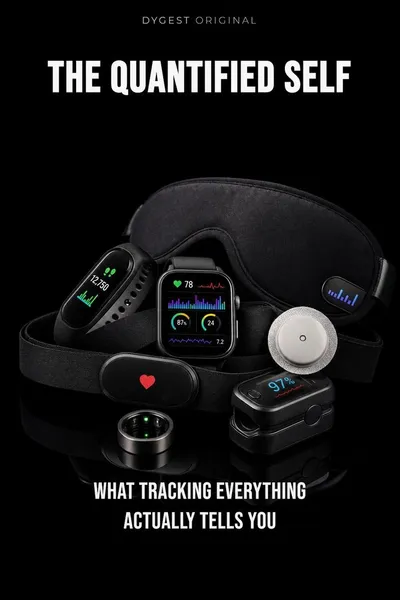
The quantified self
What tracking everything actually tells you
Description
In 2007, two editors at Wired magazine — Gary Wolf and Kevin Kelly — coined the phrase the quantified self in a blog post that imagined a future in which humans would routinely measure their own physiology, behavior, and mood, and use the resulting data to understand themselves. The community that grew around it included engineers, researchers, and a small subculture of enthusiasts who tracked everything from heart rate variability to mood. The first Quantified Self meet-up, held in 2008 in Pacific Heights, drew a few dozen people. By 2011, there were Quantified Self groups in dozens of cities worldwide.
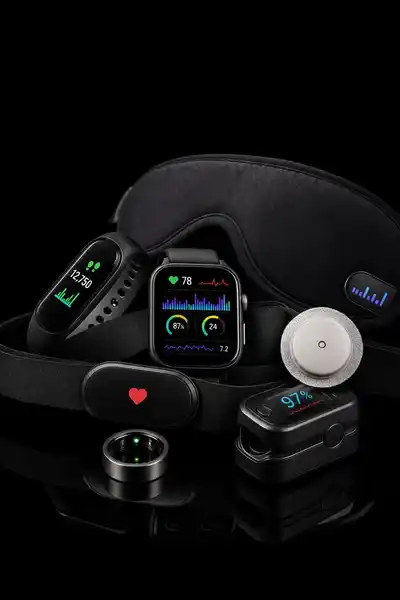
The decade and a half that followed produced something Wolf and Kelly had not quite anticipated: the quantified self stopped being a subculture and became a mass consumer product category. The Fitbit, launched in 2009, was the first widely successful step counter. The Apple Watch, introduced in 2015, brought continuous heart rate monitoring mainstream. The Oura Ring, launched in 2016, made sleep and recovery tracking small enough to wear continuously. By the 2020s, an estimated 30% of US adults were using a fitness tracker or smartwatch regularly, generating a volume of data about their bodies that previous generations had no way to capture.
The honest assessment of what all this measurement has produced is more nuanced than either the early enthusiasts or the recent skeptics tend to acknowledge. The data exists. Some patterns are visible that previously were not. But the relationship between having more data and making better decisions — or even feeling better — has turned out to be less clean than the original framing suggested. The quantified self movement was built on the premise that self-knowledge would produce self-improvement. The decade of evidence on what tracking actually does to behavior and well-being is mixed in ways that complicate that premise.
The question we're asking: what has fifteen years of self-tracking actually shown about behavior change and self-knowledge?
What we'll see: Wolf and Kelly's original framing, the consumer wearables generation, the data-versus-wisdom problem, and what the research now says.
Table of contents
01A blog post in 2007
Gary Wolf was a Wired contributing editor; Kevin Kelly was its founding executive editor. Their 2007 post argued that falling sensor costs and the rise of mobile computing meant ordinary people would soon be able to gather data about themselves at a level previously available only to research subjects. The data, they argued, would enable a kind of personal science: rigorous self-experimentation, n-of-1 trials, and the discovery of patterns specific to individual physiology that would not show up in population-level research.
The early Quantified Self meet-ups took the framing seriously. Show-and-tell presentations focused on specific experiments individuals had run on themselves: tracking the relationship between caffeine intake and sleep quality, measuring the effect of meditation on heart rate variability, mapping mood against weather and time of day. The presentations were earnest, technical, and often illuminating. The community attracted engineers, scientists, and the occasional artist. The framing was not consumer-product oriented. It was closer to amateur science.

02The wearables generation
The Apple Watch launched in April 2015 with heart rate monitoring, activity tracking, and notifications. Apple initially positioned it as a fashion accessory, but health features quickly became the dominant marketing thread. The Series 4, in 2018, added an electrocardiogram, the first FDA-cleared consumer ECG. The Series 6, in 2020, added blood oxygen monitoring. By 2024, the device measured heart rate, heart rate variability, blood oxygen, ECG, sleep, exercise, falls, and finer body composition metrics through paired devices.
The Oura Ring took a different approach: a small ring that measured heart rate, body temperature, and movement during sleep, with software that produced a daily readiness score. The Whoop strap, marketed primarily to athletes, focused on continuous monitoring with an emphasis on training load and recovery. Other devices extended the tracking surface. By the early 2020s, a single user could plausibly generate hundreds of data points per day about their own physiology and behavior.
03The data-versus-wisdom problem
The original Quantified Self premise was that more data would produce better decisions. The decade of consumer wearable use has tested that premise, and the result is more mixed than the framing suggested. Several large meta-analyses of fitness tracker interventions have shown modest behavior change effects — typically a few hundred extra steps per day, sometimes a small weight loss — that often diminish after the first few months. The novelty effect is substantial. The durable behavior change effect is small.
The interesting finding from behavioral research on self-tracking is that the relationship between data and behavior is mediated by self-efficacy and motivation in ways the early movement did not anticipate. Users who already feel agency over their behavior often benefit from tracking data because it confirms or refines their existing approach. Users who are feeling stuck or struggling often find tracking data demoralizing — a constant reminder of the gap between intention and action. The same data can motivate one user and discourage another. The pattern has been called the quantification paradox: more measurement does not produce more change.
04What the evidence actually supports
Despite the mixed picture on broad behavior change, certain specific applications of self-tracking are well supported. Continuous glucose monitoring in patients with type 1 and type 2 diabetes has been transformative, producing measurable reductions in HbA1c and hypoglycemic episodes. Atrial fibrillation detection through wearable ECGs has identified meaningful disease in selected populations. Step counting in sedentary adults, paired with goal-setting and feedback, has produced modest exercise increases sustained over months in some trials. These applications are narrow, evidence-based, and clinically actionable. The broader claim that tracking improves general health for the average user is harder to support.
The research on self-tracking and weight loss is informative. A 2022 meta-analysis pooling 39 randomized trials found that self-monitoring interventions produced statistically significant weight loss but with substantial heterogeneity across studies. The effect was largest when self-monitoring was combined with structured behavior change support and was smaller when the wearable was used alone. The implication is that the tracker is not the intervention; the intervention is the structured coaching, with the tracker providing feedback within that structure. Wearables in isolation do less than the marketing implies.
05Conclusion
The quantified self moved from a few dozen enthusiasts in Pacific Heights to a market segment generating tens of billions of dollars in revenue. Along the way, the original premise — that systematic self-measurement would produce self-knowledge and better decisions — was partly tested and partly betrayed. Tested in the sense that the data now exists at a scale the early movement could not have imagined. Betrayed in the sense that the data has not, on average, produced the transformation the framing implied. The relationship between knowing something about yourself and changing it turns out to depend on factors the trackers cannot measure.
Related books