

The palm oil problem
What's in every product and why
Description
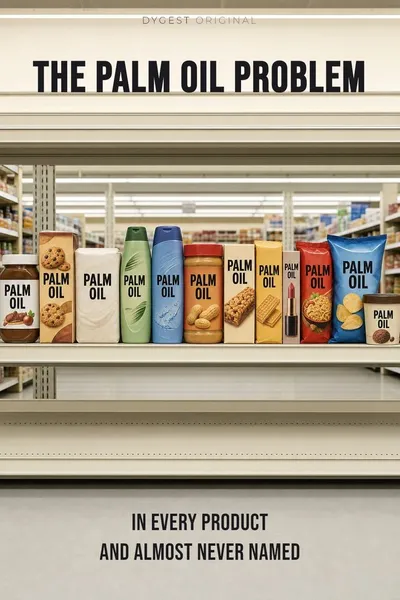
n the lowland tropical forests of Southeast Asia, particularly across the islands of Sumatra in Indonesia and Borneo, which is divided between Indonesia and Malaysia, a substantial proportion of the primary forest cover that existed in 1990 has been replaced by plantations of a single tree species. The tree is Elaeis guineensis, the African oil palm, a species that originated in West Africa and was introduced to Southeast Asia by Dutch colonial agriculture in the early twentieth century. The tree produces a reddish fruit cluster whose pulp and kernel yield two commercially valuable oils that have become, across the past four decades, the most-used vegetable oils in the global food and consumer-products economy. Palm oil and palm kernel oil now appear in approximately half of all packaged consumer products sold in supermarkets — including processed foods, soaps, cosmetics, detergents, candles, biofuels, and pharmaceuticals — typically under one of approximately 200 different ingredient names that obscure the underlying source. The global production of palm oil grew from approximately 14 million tons per year in 1990 to approximately 80 million tons per year in 2024, with Indonesia and Malaysia accounting for approximately 85 percent of the global supply.
The environmental and social consequences of this expansion have been substantial. The forest clearing to establish palm plantations has been one of the principal drivers of deforestation in the developing world across the past three decades, with approximately 27 million hectares of Indonesian and Malaysian forest having been converted to palm plantation across the period of the boom. The loss of habitat has produced substantial population declines in several endemic species, with the Bornean orangutan and the Sumatran tiger having become critically endangered substantially due to palm plantation expansion. The peatland conversion that has accompanied palm development has produced substantial carbon emissions, with the drained peatlands releasing carbon that had been stored for thousands of years. The smoke from peatland fires across the Indonesian dry season has produced substantial regional air pollution that has been linked to tens of thousands of premature deaths annually across Southeast Asia.
The case has become one of the standard examples in modern environmental economics of how a single commodity can substantially reshape an entire ecosystem and how the consumer demand that drives the reshaping operates substantially without consumer awareness. The palm oil that appears in approximately half of supermarket products is rarely identified clearly on labels, and most consumers do not know that the products they regularly purchase contain it or that the production of the underlying commodity has been one of the principal drivers of tropical deforestation across their lifetime. The disconnect between consumer behavior and ecological consequence has been one of the central challenges of contemporary environmental policy, and the palm oil case is one of the more dramatically documented instances.
The question we’re asking: what is palm oil and why has its production expanded so substantially, what have the environmental and social consequences been, and what does the case reveal about how global supply chains operate?
What we’ll see: the agricultural economics of the crop, the expansion across Southeast Asia, the environmental and social consequences, and what survives.
Table of contents
01The agricultural economics
The oil palm has agronomic characteristics that have made it substantially more productive than the alternative oil crops. The yield per hectare of palm oil — approximately 3.7 tons of oil per hectare per year on well-managed plantations — is substantially higher than the yields of any other major vegetable oil crop. Soybean oil yields approximately 0.4 tons per hectare. Sunflower oil yields approximately 0.7 tons per hectare. Rapeseed oil yields approximately 0.8 tons per hectare. The implication is that producing a given quantity of vegetable oil through palm cultivation requires approximately one-tenth the land that producing the same quantity through soybean cultivation would require. The land-use efficiency has been one of the central economic drivers of the expansion of palm production across the past four decades.
The labor and capital characteristics have also been favorable. The trees begin producing commercially viable fruit approximately three years after planting and continue for approximately twenty-five years. The harvesting can be conducted year-round in equatorial climates, providing more stable employment than temperate seasonal harvests. The processing infrastructure is substantial but not technologically demanding.

02The expansion across Southeast Asia
The expansion of palm cultivation across Indonesia and Malaysia has been substantial. Indonesia has approximately 16 million hectares of land under palm cultivation, with most of the expansion having occurred across the past three decades. Malaysia has approximately 5.7 million hectares. The two countries together account for approximately 85 percent of the global supply. The economic significance for the producing countries has been substantial, with palm oil representing approximately 7 percent of Indonesian GDP and approximately 5 percent of Malaysian GDP, and providing employment for several million workers across the two countries.
The political economy has been complicated. Plantation development has typically required converting land under traditional ownership or under primary forest. The Indonesian forest concessions issued by the central government have been one of the principal mechanisms of expansion, with companies receiving rights to develop forest land that indigenous communities have not always recognized as legitimately transferable. The resulting land conflicts have been one of the most documented social consequences, with several thousand documented conflicts across the past two decades.
03The environmental and social consequences
The deforestation associated with palm expansion has been substantial. The 2020 study by Watch the Forest, using satellite imagery analysis, documented that approximately 24 million hectares of Indonesian forest had been lost across the period 2001-2019, with palm plantation establishment being one of the principal drivers. The forest types that have been most substantially affected include the lowland tropical rainforest and the peat swamp forest, both of which support substantial biodiversity and substantial carbon storage. The implications for species conservation have been substantial, with the IUCN classification of the Bornean orangutan, the Sumatran orangutan, and the Sumatran tiger as critically endangered being substantially driven by palm expansion.
The peatland conversion has been one of the most environmentally consequential aspects of the expansion. The peat soils of Indonesia and Malaysia contain substantial quantities of carbon, accumulated across thousands of years of slow plant decomposition under waterlogged conditions. The conversion of peat to palm plantation requires drainage of the soil, which produces oxidation of the stored carbon and substantial CO2 emissions. The Indonesian peat fires that occur substantially every year across the dry season — particularly during the El Niño years when the rainfall is reduced — produce some of the largest single-event greenhouse gas emissions in the global system, with the 2015 Indonesian fires producing approximately equivalent emissions to the entire annual emissions of Japan.
04What survives, and what the case shows
The Roundtable on Sustainable Palm Oil, established in 2004 by the WWF and major industry participants, has been the principal industry-led initiative. The certification system identifies palm oil produced under specified standards, with certified palm oil accounting for approximately 19 percent of global production. The certification has produced improvements in specific operations but has been criticized for inadequate enforcement and for the limited proportion of total production that meets the standards.
The corporate response from companies that use palm oil has been substantial. Most major multinationals — Unilever, Nestlé, Procter & Gamble, PepsiCo — have committed to certified or deforestation-free palm oil. Implementation has been uneven, with documented cases of problematic sourcing continuing in the supply chains of companies that have made public commitments. The structural challenge — that the supply chain is complex enough that even committed companies have difficulty verifying the actual sourcing — has continued to operate.
05Conclusion
The palm oil expansion continues to operate at the scale that the past four decades of growth have established. The certification systems continue to develop. The corporate commitments continue to be implemented unevenly. The consumer products that contain the commodity continue to be widely purchased without substantial consumer awareness of the underlying sourcing.