The Opioid Crisis
A legal pill. A national catastrophe.
Description
Introduction
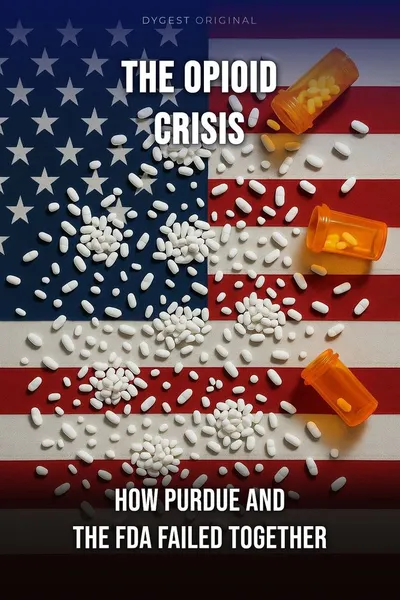
In 1996, Purdue Pharma launched OxyContin, an extended-release formulation of oxycodone, a synthetic opioid. The company marketed it aggressively to primary care physicians across the United States, claiming that its time-release mechanism made it less prone to abuse than shorter-acting opioids. Sales representatives were dispatched to doctors' offices with starter coupons offering patients their first prescription free. Within five years, OxyContin was generating more than $1 billion a year in revenue. It was also, in communities across Appalachia, the Midwest, and rural New England, fueling a wave of addiction that would take decades to name and longer to address.
The opioid crisis is the deadliest drug epidemic in American history. Between 1999 and 2021, roughly 500,000 Americans died from opioid overdoses a figure that exceeds the country's combat deaths in World War II. The crisis unfolded in three overlapping waves: prescription painkillers in the late 1990s and 2000s, heroin in the early 2010s when prescriptions became harder to obtain, and illicitly manufactured fentanyl from the mid-2010s onward. Each wave was deadlier than the last. Fentanyl, a synthetic opioid roughly 100 times more potent than morphine, is now present in the drug supply so broadly that it has become the leading cause of death for Americans between the ages of 18 and 45.
The opioid crisis was not an accident of human weakness or a failure of individual willpower. It was the product of specific decisions — by pharmaceutical companies, by regulators, by physicians, and by policymakers that interacted with structural conditions in American society to produce a catastrophe. Understanding how it happened is not the same as knowing how it ends.
The question we're asking: how did a legal, regulated, physician-prescribed medication become the starting point for an epidemic that has killed half a million Americans?What we'll see: the marketing campaign that seeded the crisis, the communities it hit hardest, the policy failures that allowed it to accelerate, and why fentanyl changed the terms entirely.
Table of contents
01The pill that was supposed to be safe
OxyContin's launch was preceded by a deliberate effort to shift medical opinion about opioid prescribing. For most of the twentieth century, opioids were prescribed cautiously, primarily for cancer patients and end-of-life care, on the basis that addiction risk was high. Beginning in the late 1980s, a small number of pain specialists began arguing that this caution was misplaced — that opioids were being withheld from patients who genuinely needed them, and that addiction was rare in patients with legitimate pain. Purdue Pharma funded research, sponsored medical education programs, and cultivated relationships with professional pain societies to amplify this argument.
The claim that OxyContin's extended-release formula reduced abuse potential was, as Purdue's own internal documents would later reveal, not supported by the evidence the company possessed. The Food and Drug Administration (FDA) approved OxyContin in 1995 with label language stating that the drug's formulation was believed to reduce abuse potential language that Purdue's sales force used extensively in physician outreach. When patients discovered that crushing the tablet defeated the time-release mechanism, OxyContin became as immediately euphoric as any other opioid. Purdue knew this was happening and continued marketing the drug as low-risk.

02The places the crisis chose
The communities hit hardest by the first wave of the opioid crisis shared several characteristics. They were predominantly rural or small-town, with economies that had been built around manufacturing, mining, or timber and had shed those industries over the preceding decades. Unemployment was high, wages were stagnant, and the social infrastructure churches, civic organizations, local businesses that had organized community life around steady employment had eroded. These were places where physical labor was normative, chronic pain was common, and access to mental health services was limited.
The geography of early opioid prescribing followed the geography of economic decline with striking precision. Mingo County, West Virginia, one of the poorest counties in the state, received 3.3 million oxycodone and hydrocodone pills between 2006 and 2012 roughly 2,500 pills per resident per year. The numbers were not anomalous; they were replicated across Appalachia, rural Ohio, rural Maine, and Native American communities in the Southwest and Midwest. The drug supply went where the demand was being manufactured, and the demand was being manufactured by prescribing practices that had no legitimate medical justification at that scale.
03Fentanyl changes everything
Fentanyl entered the illicit drug supply in significant quantities around 2013 and changed the crisis in ways that policy responses designed for the prescription opioid era were not equipped to handle. Unlike heroin, which is derived from the opium poppy and requires agricultural supply chains, fentanyl is synthesized in chemical laboratories primarily in China, and later in Mexico from precursor chemicals that are themselves legally manufactured. It can be produced cheaply, in small physical quantities, and shipped globally. A kilogram of fentanyl contains enough of the drug to produce roughly 500,000 lethal doses.
Drug dealers began mixing fentanyl into heroin to increase potency and reduce costs. Then fentanyl began replacing heroin entirely. Then it began appearing in counterfeit prescription pills fake Xanax, fake Adderall, fake OxyContin sold to people who believed they were purchasing something else. The contamination of the broader drug supply with fentanyl meant that people who had never used opioids, or who used them only occasionally, faced a risk of fatal overdose that had not previously existed. A single pill purchased from an unknown source might or might not contain fentanyl. There was no way to tell without a test strip.
04What the crisis reveals about America
The opioid crisis is sometimes framed as a failure of regulation the FDA approved a drug on the basis of insufficient evidence, the DEA did not act on distribution data that clearly indicated diversion. Both are true. But the regulatory failures occurred within a broader context: an American healthcare system in which pharmaceutical companies can market directly to physicians, in which pain management became a measured quality indicator in hospitals during the 1990s, and in which the political economy of drug policy consistently prioritized enforcement over treatment.
The communities hit hardest were not random. They were places where the social fabric had been thinned by decades of deindustrialization, where good jobs had disappeared and the institutions that organized community life around those jobs had weakened with them. Addiction does not strike uniformly it concentrates in places where people have fewer reasons to be well and fewer resources to get better. The opioid crisis was seeded by pharmaceutical marketing, but it grew in soil that economic abandonment had prepared.
05Conclusion
In 1996, the year OxyContin launched, roughly 9,000 Americans died from opioid overdoses. In 2021, the number was over 80,000. The increase is not a straight line it bends sharply upward each time the drug supply shifts, each time a new substance arrives that is cheaper and more lethal than what preceded it. The arc of the crisis is still pointing in the wrong direction in many parts of the country, even as naloxone distribution and medication-assisted treatment have saved lives that earlier approaches would have lost.
Related books