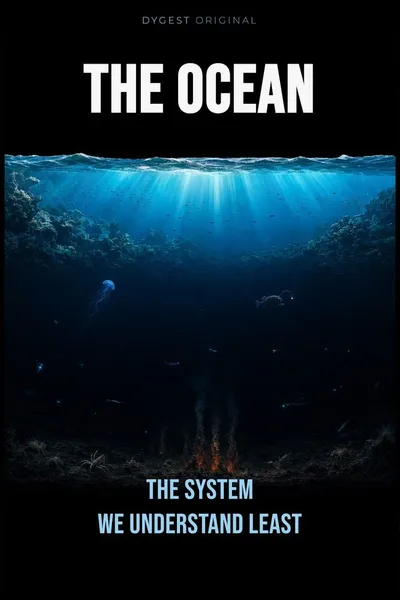
The ocean
The system we understand least
Description
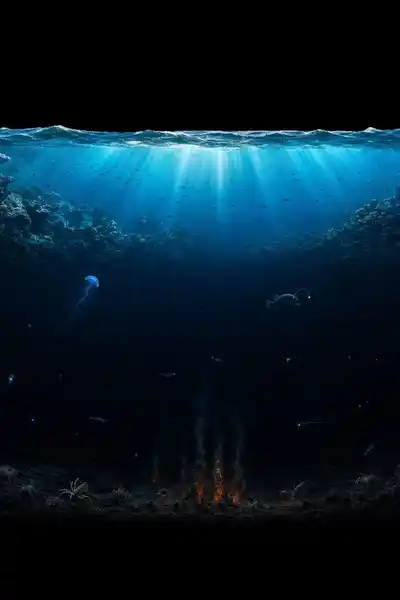
Oceans cover 71% of Earth's surface and contain 97% of its water. They regulate global climate, produce roughly half the oxygen humans breathe, support most of the biomass on the planet, and provide livelihood for billions of people. They are also the least-explored environment on Earth. More of the surface of Mars has been mapped in high resolution than of the ocean floor. The deep ocean — anywhere below about 200 meters, which is most of the ocean by volume — remains largely unstudied, and new species are discovered there every time humans conduct systematic surveys. The cliché that we know more about distant planets than about our own ocean floor is actually true by several quantitative measures.
The gap between the ocean's importance and our knowledge of it creates specific problems. We are affecting the ocean through emissions, pollution, overfishing, and physical modification faster than we can document what it contains or how it works. We know the ocean has warmed substantially and will warm more, but the specific ecosystem responses are hard to predict. We know fish stocks have declined, but the specific trajectories of most species are poorly measured. We know plastic pollution is ubiquitous, but the specific consequences are still being worked out. The ocean is being changed by humans at scale, and humans lack the knowledge to predict what those changes mean.
Understanding the ocean what it does, what is happening to it, and why this matters is prerequisite to thinking intelligently about climate change, biodiversity, food systems, and the broader question of what kind of planet humans are producing. The ocean is not a secondary consideration in these conversations; it is often the primary system through which the effects play out. The Mediterranean diet, the Anthropocene, climate change, biodiversity each of these topics has substantial ocean dimensions that are usually underweighted in popular discussion. Taking the ocean seriously is one of the conceptual adjustments required for coherent environmental thinking.
The question we're asking: what is the ocean doing, what is happening to it, and why does it matter so much?
What we'll see: the functions the ocean provides, the specific changes underway, the damage being done, and what sustainable use would require.
Table of contents
01What the ocean does
The ocean regulates global climate through its massive heat capacity. Water absorbs and stores heat far more effectively than air or land, and the ocean has absorbed roughly 90% of the excess heat accumulated from greenhouse gas emissions. Without this ocean heat absorption, atmospheric warming would have been far more dramatic than the 1.2°C observed. The ocean is, in effect, storing up heat that will continue to influence climate for centuries even if emissions stop, because that heat will gradually work its way back out into the atmosphere as the system seeks equilibrium. This thermal inertia is one of the reasons climate commitments from past emissions are larger than people typically recognize.
Ocean circulation redistributes heat globally. The thermohaline circulation driven by differences in water density from temperature and salinity — moves warm water from the equator toward the poles and cold water back, shaping the climate of continents along the way. The Gulf Stream keeps Northern Europe far warmer than its latitude would otherwise imply. The Atlantic Meridional Overturning Circulation (AMOC) is a specific component of this system that appears to be weakening due to freshwater input from melting ice. A sudden slowdown or collapse of the AMOC is one of the tipping points climate scientists worry about, because it could produce substantial regional climate shifts within years rather than centuries.

02The changes underway
Ocean temperature has risen substantially, particularly in surface waters. Marine heatwaves extended periods of anomalously warm temperatures have become more frequent and severe in specific regions. The 'blob' of warm water off the US West Coast in 2014-2016 caused massive die-offs of marine species. Similar events in the Mediterranean, the Coral Triangle, and other regions have produced specific ecological disruptions. The pace of ocean warming is accelerating, and specific regions are warming faster than the global average. Temperature is one of the primary constraints on where marine species can live, and changes at the pace currently underway are beyond what many species can adapt to.
Sea level rise has been discussed in the Climate change essential but bears specific mention here. The rise comes from two sources thermal expansion (warmer water takes up more space) and ice sheet melt (adding mass to the ocean). Both contribute roughly equally so far, but ice sheet melt is accelerating and will dominate future contributions. Coastal cities worldwide face specific challenges from rising seas, more frequent coastal flooding, and saltwater intrusion into freshwater aquifers. The adaptation response is starting but is not yet commensurate with the scale of change underway, and the specific distribution of costs falls hardest on low-lying developing countries that contributed least to the problem.
03The damage being done
Overfishing has been an ongoing crisis for decades. Roughly a third of global fish stocks are overfished; another 60% are fished at maximum sustainable yield. High-profile stocks (Atlantic cod, various tunas, Chilean sea bass) have collapsed and not fully recovered. Bottom trawling destroys deep-sea habitat that takes centuries to regenerate. Bycatch kills enormous numbers of dolphins, sea turtles, sharks, and seabirds. The fishing industry's capacity has grown faster than fish populations can reproduce.
Plastic pollution has been documented at every scale and location. Microplastics are ubiquitous in surface waters, sediments, and even deep-sea organisms. The five major gyres accumulate floating plastic in large patches. Ghost fishing gear continues to kill marine animals for decades after abandonment. Plastic ingestion and entanglement kill seabirds, sea turtles, and marine mammals every year. Long-term toxicological effects of microplastics are still being studied, but exposure is universal and unavoidable.
04What sustainable use would require
Fisheries management has produced specific success stories. The US has rebuilt numerous overfished stocks through strict science-based catch limits, and specific regions (Alaska, parts of New Zealand) manage their fisheries in genuinely sustainable ways. The techniques work the question is political will to implement them. Many countries continue to subsidize fishing capacity, which encourages overexploitation. Illegal, unreported, and unregulated (IUU) fishing accounts for substantial proportions of catch in some regions. A specific coordinated international effort to eliminate harmful fishing subsidies, strengthen enforcement, and apply science-based management more broadly would produce substantial recovery of global fish stocks.
Marine protected areas (MPAs) have grown substantially but remain uneven. Roughly 8% of ocean area is formally protected, but only about 3% is in strictly protected 'no-take' zones where all extractive activity is prohibited. The 30x30 target (protecting 30% of ocean by 2030) would be a substantial expansion. Effective MPAs produce measurable benefits higher fish biomass inside reserves, spillover effects that benefit adjacent fisheries, protection of specific ecosystems. The key word is effective; paper parks that exist on maps but are not enforced produce negligible benefits. Expanding actual effective protection at the scale needed is politically difficult and requires substantial resources.
05Conclusion
The ocean is simultaneously one of the most important systems on Earth for human wellbeing and one of the least understood. It regulates climate, produces oxygen, supports enormous biological productivity, and provides livelihoods for billions of people. It is also being changed rapidly through warming, acidification, pollution, and overexploitation, often in ways that will take centuries to reverse even if inputs stop. The specific gap between the scale of human impact and the scale of understanding is substantial and creates specific risks we are making changes whose consequences we cannot fully predict in a system too complex to model completely.
Related books