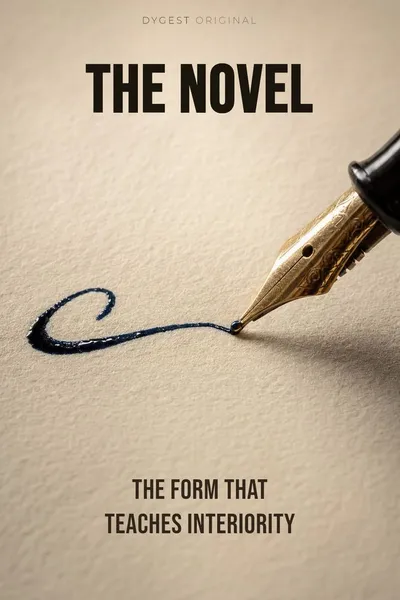
The novel
The form that teaches interiority
Description
The novel is a young form by literary standards. Epic, lyric, drama, and the various religious and historical genres all predate it by thousands of years. The novel arrived, depending on how strictly the term is used, somewhere between Cervantes in 1605 and Defoe a century later, and it took roughly two hundred years to settle into the shape we now recognise. What it eventually became a long prose narrative about ordinary people, told from inside their consciousness was something literature had not done before.
The defining trick of the novel is that it lets us spend hundreds of pages inside another mind. Not the mind of a hero or a god or an allegorical figure, but the mind of someone who could be anyone. We follow Emma Bovary's resentment, Anna Karenina's loneliness, Stephen Dedalus's self-consciousness, in a sustained way that no other art form really attempts. Theatre gives us speeches. Lyric poetry gives us moments. Cinema gives us behaviour. The novel gives us interior duration, the experience of being a person over time. That access is what the form is for.
The position of the novel in cultural life has shifted. In the nineteenth century it was the central form of mass entertainment as well as serious art, and the same readers who followed Dickens in monthly instalments would later read Middlemarch. That combination has come apart. Television and streaming have absorbed most of the audience for narrative entertainment. The novel persists, but as one form among several, addressed to a smaller and more specialised reading public. What remains, and what changes when the audience changes, is worth thinking about clearly.
The question we're asking: what the novel does that other forms don't, and how that role has changed.
What we'll see: Cervantes, the realist nineteenth century, modernist interiority, and the contemporary scene.
Table of contents
01Cervantes and the long prose form
Don Quixote, published in two parts in 1605 and 1615, is the conventional starting point and a good one. Miguel de Cervantes wrote a long prose narrative about an aging country gentleman who reads too many chivalric romances, decides he is a knight errant, and rides out into a Spain that no longer has any use for knights. The book is a parody of an existing genre, an examination of how stories shape the people who read them, and the first major work that uses an extended prose narrative for serious comic purposes. It also runs to nearly a thousand pages, which itself was a formal experiment.
The eighteenth century established what the novel could be. Defoe's Robinson Crusoe in 1719 told a first-person story of an ordinary man in extraordinary circumstances, written in a flat reportorial style that pretended to be memoir. Richardson's Clarissa, an enormous epistolary novel published in the 1740s, sustained psychological tension across thousands of pages of letters. Fielding's Tom Jones in 1749 demonstrated that a third-person narrator could organise a sprawling cast and a complicated plot into something coherent. Sterne's Tristram Shandy, in the 1760s, broke every convention these other writers were establishing, before the conventions were fully established.

02The realist nineteenth century
The nineteenth-century novel is the form at maximum reach. It was the dominant entertainment, the most ambitious art, and the medium through which the new urban industrial societies thought about themselves. Dickens in England, Balzac and Flaubert in France, Tolstoy and Dostoevsky in Russia, Eliot and the Brontës in England again, Hawthorne and Melville and James in America the period produced more major novelists in a hundred years than most centuries produce in any genre.
Realism was the shared project, more or less. The novelist's job was to render a society in detail — its classes, its money, its institutions, the texture of its streets and the shape of its conversations — and to follow ordinary characters through that society as they tried to make a life. Balzac's Comédie Humaine, with its ninety-some interlinked novels, was the most explicit attempt to map a whole society in fiction. Eliot's Middlemarch did something similar for a single English provincial town in the 1830s. Tolstoy's War and Peace did it for Russia at war with Napoleon. The scale was sometimes enormous and the ambition was always serious.
03Modernist interiority
Modernism, in the novel, was the moment when interior consciousness moved from being one of the things fiction did to being the main thing it did. The shift had been building. James, Dorothy Richardson, the late Conrad all of them were already writing fiction in which the inside of a character's mind mattered more than the outside events. What changed in the 1920s was that the interior took over the form completely, and the techniques for representing it became radical.
Joyce's Ulysses, published in 1922, is the canonical case. The book follows two characters through a single day in Dublin, 16 June 1904, and uses a different prose style for almost every chapter, ranging from straight narration to drunken hallucination to a parody of women's magazine prose to the long unpunctuated stream of Molly Bloom's thoughts at the end. The book is difficult by any measure and was banned for years on obscenity grounds. It is also one of the works that defined what twentieth-century fiction could try to do. Most novelists since have either been working in its shadow or actively avoiding it.
04After modernism
The novel after modernism had to deal with the fact that the most ambitious technical experiments had already been done. Fiction in the second half of the twentieth century took several routes. Some writers Beckett, Robbe-Grillet, Pynchon, the Latin American boom pushed the modernist experiments further. Others Bellow, Roth, Updike, the postwar British novelists went back to a more accessible realism, taking what modernism had taught about consciousness but using it inside more conventional narratives. Both routes produced major work. Neither could quite restore the central cultural position the novel had held in the nineteenth century.
Television was the main reason. The audience for long narrative entertainment had migrated to a different medium. The novel that survived was the one that did things television could not sustained interiority, prose as a primary aesthetic object, the kind of patient attention to a single consciousness that a one-hour episode cannot accommodate. The serious novel narrowed its scope, in a sense, while keeping its ambition. The mass-audience novel, the one Dickens had written, increasingly belonged to genre fiction thrillers, romance, science fiction which kept the older shape of the form alive at the cost of its critical respectability.
05Conclusion
The novel started as a commercial entertainment for a literate middle class, became the central serious art of the nineteenth century, was pushed by modernism into territory the form had never visited, and has since settled into a position that is smaller but still distinct. The audience for serious fiction is a fraction of what it was. Some of the most interesting recent fiction is being written for a readership the publishers themselves do not know how to reach.
Related books