
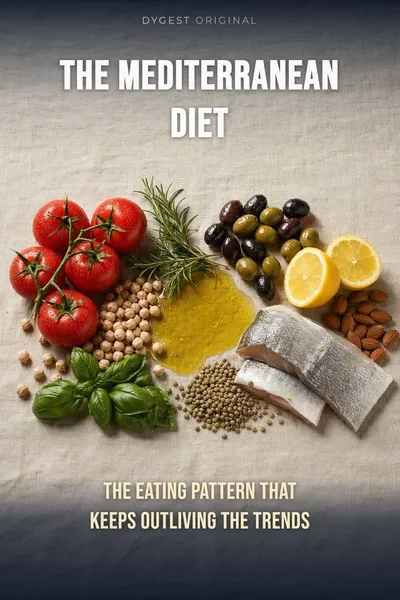
The Mediterranean diet
The eating pattern that actually holds up
Description
Nutrition science has been a mess for decades. Specific diets rise and fall with each decade's dominant theory: low-fat in the 1980s and 1990s, low-carb in the 2000s, paleo and keto in the 2010s, carnivore in the 2020s. Each wave comes with celebrity advocates, specific nutrition claims, and often contradicts the previous wave. The result is widespread public confusion about what to eat, and substantial cynicism about nutrition advice generally. Science keeps contradicting itself, nutrition headlines reverse weekly, and the underlying mechanisms of most of what is proposed remain poorly understood. Against this backdrop, one dietary pattern has accumulated more robust evidence than any competitor: the Mediterranean diet.
The Mediterranean diet is not really a diet in the prescriptive sense. It is a description of the traditional eating pattern of populations living around the Mediterranean Sea — southern Italy, Greece, Spain, parts of France and North Africa — that was first characterized scientifically in the 1960s by Ancel Keys in the Seven Countries Study. Keys observed that these populations had unusually low rates of cardiovascular disease despite consuming substantial amounts of fat, which contradicted the dominant low-fat hypothesis of the time. The pattern — high in vegetables, fruits, whole grains, legumes, nuts, olive oil, and fish; moderate in wine, dairy, and poultry; low in red meat and processed foods — has been studied intensively for the sixty years since.
What has emerged from this research is unusual: a dietary pattern with consistent, replicated evidence for reducing cardiovascular disease, diabetes, dementia, and all-cause mortality. The PREDIMED trial (2013), one of the largest nutrition trials ever conducted, randomized Spanish adults to a Mediterranean diet supplemented with extra-virgin olive oil or nuts versus a low-fat control diet. The Mediterranean groups showed roughly 30% reduction in major cardiovascular events — an effect size that would be considered transformative for any pharmaceutical intervention. Subsequent analyses have confirmed benefits across specific outcomes. The Mediterranean diet is probably the single best-evidenced dietary recommendation in nutrition science, and understanding why it works and what its limits are is worth the effort.
● The question we're asking: what is the Mediterranean diet, what does the evidence actually show, and why does it work when other diets don't?
● What we'll see: the traditional pattern, the evidence base, the likely mechanisms, and the practical implications.
Table of contents
01The traditional pattern
The Mediterranean diet as studied by Keys was specifically the eating pattern of Crete and southern Italy in the 1950s and 1960s, before industrialized food systems arrived. The pattern involved abundant plant foods (vegetables, fruits, whole grains, legumes, nuts), olive oil as the primary fat, moderate fish and seafood, moderate dairy (mostly cheese and yogurt), moderate poultry and eggs, wine with meals in moderation, and relatively little red meat and almost no processed foods. Meals were typically shared, eaten slowly, and embedded in specific social contexts that shaped how and how much people ate.
The specific macronutrient distribution is not extreme in any direction. Fat intake is moderate to high (30-40% of calories), mostly from olive oil and nuts. Carbohydrates are moderate (40-50%), mostly from whole grains, legumes, and vegetables. Protein is moderate (15-20%), from mixed sources. This is strikingly different from many modern diet recommendations that emphasize extreme values of one or another macronutrient. The Mediterranean pattern is balanced rather than restrictive, which is probably part of why it's sustainable long-term for most people.

02The evidence base
The Seven Countries Study, launched by Ancel Keys in 1958, was the foundational epidemiological study. Keys followed cohorts of middle-aged men across Finland, the Netherlands, the US, Japan, Greece, Italy, and Yugoslavia, documenting diet patterns and cardiovascular outcomes over decades. The Cretan cohort, with the most Mediterranean-style diet, had the lowest rates of cardiovascular disease and the longest life expectancy. The study established the basic correlation between Mediterranean eating patterns and cardiovascular health that subsequent research has extended.
The PREDIMED trial, published in 2013 and updated with extended follow-up since, was the randomized controlled trial that provided causal evidence. Roughly 7,500 Spanish adults at high cardiovascular risk were randomized to a Mediterranean diet with extra-virgin olive oil, a Mediterranean diet with nuts, or a low-fat control diet. After roughly five years, the Mediterranean groups had roughly 30% reduction in major cardiovascular events (heart attack, stroke, cardiovascular death). The trial was ended early for clear benefit. Subsequent analyses showed benefits across specific outcomes including diabetes incidence, cognitive decline, and breast cancer.
03The likely mechanisms
The mechanisms by which the Mediterranean diet produces its benefits are multiple and overlapping. Cardiovascular benefits probably come from several sources: reduced LDL cholesterol from olive oil replacing saturated fat, reduced inflammation from omega-3 fatty acids and polyphenols, improved endothelial function, reduced oxidative stress, and better blood sugar control. No single mechanism accounts for the entire effect; the combination of multiple small improvements across multiple pathways probably produces the substantial aggregate benefit.
Reduced systemic inflammation is probably a major mechanism. Modern Western diets, particularly those high in ultra-processed foods, refined carbohydrates, and industrial vegetable oils, produce chronic low-grade inflammation that contributes to essentially every chronic disease of aging. Mediterranean-style eating reduces inflammatory markers measurably — C-reactive protein, IL-6, and other markers fall on the diet. This reduced inflammation probably contributes to the cardiovascular, cognitive, and metabolic benefits simultaneously. Anti-inflammatory effects are the common thread across the specific benefits, which is part of why the diet produces improvements across apparently unrelated systems.
04The practical implications
The practical implementation of Mediterranean eating is simpler than most diet prescriptions because it does not require detailed calorie counting, macronutrient tracking, or restrictive rules. The general principles are: make plant foods the base of most meals, use olive oil as your primary cooking and dressing fat, eat fish at least twice per week, include nuts and legumes regularly, limit red meat and processed foods, prefer whole grains to refined ones, keep dairy moderate (mostly cheese and yogurt rather than milk), and drink wine only in moderation if you drink at all. These principles are flexible enough to adapt to different cultural food preferences while preserving the underlying pattern.
The specific challenges of adoption in non-Mediterranean contexts are real. Fresh produce of high quality is not equally available everywhere. Extra-virgin olive oil of real quality is expensive relative to industrial vegetable oils. Fish of appropriate quality and freshness is harder to source in inland areas. Specific Mediterranean ingredients (good tomatoes, fresh legumes, specific herbs) require effort to source. These barriers are real but not insurmountable; the general pattern can be followed with reasonable cost and effort in most developed countries, though less perfectly than in the populations Keys originally studied.
05Conclusion
The Mediterranean diet is the single best-evidenced dietary pattern in nutrition science. It has been studied for sixty years across diverse populations using both observational and randomized designs, and the evidence consistently shows substantial reductions in cardiovascular disease, diabetes, cognitive decline, and all-cause mortality. The mechanisms involve multiple overlapping pathways — reduced inflammation, improved vascular function, better microbiome composition, avoidance of industrial processed foods — that together produce benefits across multiple body systems. No current dietary pattern comes close to matching this evidence base.
Related books