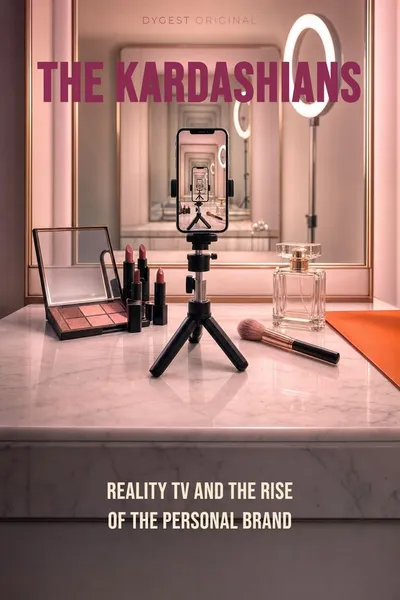
The Kardashians
Reality TV and the rise of the personal brand
Description
In October 2007, the E! network aired the first episode of a reality television series called Keeping Up with the Kardashians. The show centered on a Los Angeles family Kris Jenner, her ex-husband Robert Kardashian’s children Kourtney, Kim, Khloé, and Rob, and her younger daughters Kendall and Kylie Jenner whose claim to public attention was thin enough to be hard to summarize. Kris had been married to Robert Kardashian, a defense attorney best known for his role on the O.J. Simpson legal team. Kim had recently been the subject of a sex tape leaked weeks before the show premiered, an event the family and their producer, Ryan Seacrest, had decided to monetize rather than to deny. The first episode drew about a million viewers, modest by network standards. E! ordered a second season anyway.
What followed, over the next fifteen years, was the most successful long-form experiment in the history of the personal-brand economy. The show ran for twenty seasons across two networks, ending its E! run in 2021 before migrating to Hulu under a new title. The family members became progressively more famous than the show itself, with Kim, Kendall, and Kylie eventually building independent business empires cosmetics, shapewear, apparel, modeling, social media that, in aggregate, made the family one of the wealthiest in American entertainment. Kylie Jenner, the youngest, was briefly the youngest self-made billionaire in American history before Forbes revoked the designation. The family had, by any measure, monetized their celebrity at a scale and with a sophistication that had not previously been demonstrated.
What the Kardashians actually built, beneath the tabloid coverage and the cultural condescension, was a new structural form of American celebrity. The older model of fame a person becomes famous for something specific, then trades on the fame to sell other products was replaced by a different logic: a person becomes famous for being famous, the fame itself becomes the product, and the merchandise spinning off the fame is the secondary revenue. The Kardashians did not invent the form. They demonstrated, more clearly than any previous family, how it could be operated at scale, and the demonstration has shaped how subsequent generations of American public figures organize their public lives.
The question we’re asking: what did the Kardashians actually build over fifteen years, what economic and cultural form did they pioneer, and how does the family business look after a decade and a half?
What we’ll see: the show’s launch, the structural shift to personal-brand monetization, the social-media inflection point, and the broader cultural argument the family represents.
Table of contents
01From defense lawyer’s family to E! reality show
The Kardashian family’s pre-fame trajectory was a Los Angeles upper-middle-class story. Robert Kardashian had been a Beverly Hills attorney. His marriage to Kris Houghton produced four children before ending in divorce in 1991. Kris then married Bruce Jenner the Olympic decathlete who would later, as Caitlyn Jenner, become one of the most discussed transgender public figures in the United States and had two more children. The family’s most significant pre-2007 public moment was Robert’s involvement on O.J. Simpson’s defense team during the 1995 trial.
The transition to reality television required a catalyst. In February 2007, a sex tape Kim Kardashian had made in 2003 was released by an adult entertainment company. The release was a moment that, in earlier American celebrity culture, might have destroyed a young woman’s public prospects. Kris Jenner recognized the moment as an opportunity rather than a catastrophe. Within months, the family had signed with Ryan Seacrest Productions and was filming the pilot of what would become Keeping Up with the Kardashians.

02The structural shift the family demonstrated
The economic argument the Kardashians made implicitly, across the first decade of the show, was that the value of celebrity could be detached from any specific accomplishment and operated as a standalone asset. The traditional Hollywood model assumed that a person built fame through a specific output a film, an album, a sport and then traded the fame for related opportunities. The Kardashians had no such specific output. Kim’s most-discussed pre-show event had been the sex tape. The other family members were not, before the show, public figures with concrete achievements. The fame itself was the product, and the products that followed the cosmetics, the clothing, the apparel were extensions of the fame rather than reasons for it.
The demonstration was, in retrospect, the more important part of the family’s contribution to American commercial culture. The model the Kardashians made operational required several conditions to be in place: a continuous-content distribution platform (the show itself, later social media), a willingness to treat private life as inventory, and a sophisticated understanding of how attention could be converted to product revenue. Kris Jenner, the family’s matriarch and primary business manager, was unusually clear-eyed about the architecture. She negotiated the family’s contracts, oversaw the brand extensions, and managed the public personas of her children with the kind of professional rigor that the entertainment industry had not previously seen applied at family scale.
03Instagram, Kylie, and the second platform shift
The first decade of the Kardashian show coincided with the launch and growth of Instagram, and the family’s transition from cable television to social media was the second major structural shift in their business. Instagram launched in 2010. By 2014, several family members had Instagram accounts with audiences larger than the show’s broadcast viewership. By 2018, Kylie Jenner had more Instagram followers than the United Kingdom had citizens. The audience the family had built through the show could now be reached directly, without the network as intermediary, and the revenue model shifted accordingly.
Kylie Jenner’s business arc became the cleanest illustration of the new model. In 2015, at the age of seventeen, she launched Kylie Cosmetics, initially selling a small line of lip kits through a direct-to-consumer website. The product was promoted entirely through her Instagram account and through tagged appearances by her sisters. The launch sold out in seconds. The company, which Forbes valued at over a billion dollars by 2019, had effectively no traditional marketing expenditure. The brand-attention machine that the family had built over a decade of television produced an audience large enough that conventional advertising became unnecessary.
04What the personal-brand model has produced
The Kardashian model has become, in the years since the show’s peak, the operating logic of a substantial portion of American public life. Influencer marketing, which barely existed as a category before 2010, has become a multi-billion-dollar industry. Direct-to-consumer brands built around individual personalities are now a standard category of consumer business. The structural innovation the Kardashians demonstrated that personal attention can be operated as a permanent asset and converted into product revenue at scale has been replicated by thousands of public figures, with varying degrees of success.
The cultural implications have been substantial and contested. The fame economy that the Kardashians helped establish has produced a generation of young Americans who orient their public lives around personal-brand logic, often without the resources or attention to operate the model successfully. The aspirational image the family projected — wealth, beauty, continuous self-presentation has been associated, in subsequent research, with measurable effects on body image, financial decision-making, and patterns of social comparison among younger audiences. The model is operationally sophisticated. The downstream effects on the audience are still being measured.
05Conclusion
The Kardashian-Jenner family continues to operate its various businesses, with the Hulu show in continuous production and the family’s collective net worth estimated in the high single-digit billions of dollars. Kris Jenner, now in her late sixties, remains the primary business manager. Kylie, the youngest, is approaching thirty and operating the largest of the family’s individual businesses.
Related books