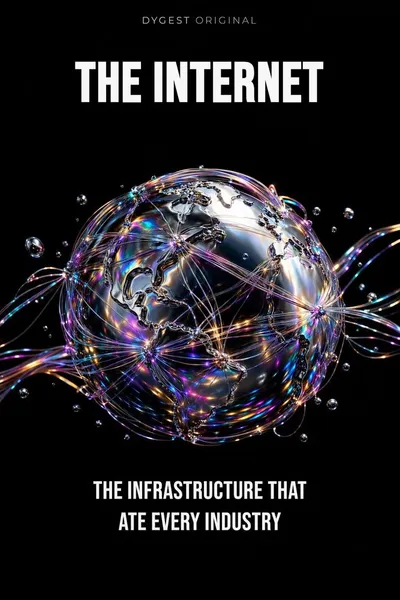
The internet
The infrastructure that ate every industry
Description
The internet is the rare technology that became invisible the moment it became indispensable. We talk about platforms, apps, clouds, and feeds, and rarely about the routers, fiber strands, and protocols underneath. When something works reliably enough to disappear into daily life, the cultural conversation tends to move on to whatever sits on top of it. The internet is not a service or a product. It is an infrastructure layer, comparable to the electrical grid, on which an entire civilization of services has been built. The substrate keeps being mistaken for what runs on top of it.
In roughly fifty years, the internet went from a Pentagon research project connecting four computers in California to a planetary system carrying more than five billion users and the bulk of global commerce, communication, media, and finance. The growth pattern was not linear. There were several distinct eras, each with its own architecture, dominant business model, and political settlement. Decoding the internet means separating those eras and seeing how each one built on, and partly cannibalized, the one before.
What makes the internet worth taking seriously now is that the political settlement around it is breaking. The open, global, mostly American-shaped network of the 2000s is fragmenting along regulatory and geopolitical lines. The economic settlement, in which a handful of platforms intermediate most of the digital economy, is being challenged by antitrust authorities on multiple continents. The next layer of infrastructure is being designed right now, by governments, large companies, and standards bodies negotiating in public.
The question we're asking: what is the internet, really, and how did a research network become the substrate of the modern economy?
What we'll see: the military-academic origins, the web era and its winners, the platform consolidation that ate every industry, and the fragmentation underway now.
Table of contents
01 From ARPANET to a network of networks
The origin story is usually compressed into a sentence about the Pentagon wanting a network that could survive a nuclear strike. The actual history is less dramatic. The Advanced Research Projects Agency, founded in 1958 in response to Sputnik, funded ambitious computer science research in the 1960s, and one of those projects was a way to let computers at different universities share resources. The first ARPANET link went live in October 1969, between UCLA and the Stanford Research Institute. The survivability story was a real engineering concern, but the day-to-day motivation was simpler academics wanted to use each other's computers without flying across the country.
The decisive moment came not in 1969 but in 1983, when ARPANET switched to a new protocol suite called TCP/IP. Designed by Vint Cerf and Bob Kahn through the 1970s, TCP/IP did something unusual. It did not assume a single network. It assumed many networks of different kinds, owned by different organizations, and specified a way for them to interoperate. The protocol was deliberately minimal it moved packets from source to destination and left almost everything else to the endpoints. That minimalism is why the internet exists. A more opinionated protocol would have required everyone to agree on more, and they would not have.

02 The web era and the indexing of everything
By the late 1980s, the network existed but was hard to use. Tim Berners-Lee, working at CERN in 1989, proposed a hypertext system that would let researchers link documents across the network using a consistent addressing scheme. The first web page went live in 1991. The proposal had three components a URL to name things, HTTP to fetch them, and HTML to format them and the radical move was to give those specifications away. CERN released the technology into the public domain in 1993, which is why the web is the web rather than a competing set of proprietary systems.
The browser turned the web into a mass medium. Mosaic, released in 1993, was the first browser to display images alongside text on the same page, and pointing and clicking through linked documents was intuitive enough that ordinary users could grasp it without training. Netscape took it commercial and seeded the dot-com boom. The browser wars between Netscape and Microsoft Internet Explorer through the late 1990s were consequential. Microsoft won by bundling its browser with Windows, which prompted a landmark antitrust case, and by the early 2000s the web was a default consumer technology.
03 The platform era and the eaten industries
The 2000s and 2010s produced a recognizable pattern across industry after industry. A platform appeared that aggregated supply and demand more efficiently than the existing intermediaries, used the resulting network effects to grow until it dominated, and rearranged the economics around itself. Retail was first. Amazon began selling books online in 1995, expanded to general merchandise, and built a logistics and cloud computing business that became larger than the storefront. By the 2020s, a substantial fraction of American retail searches started on Amazon rather than Google, and small retailers either sold through the platform or competed against it on its terms.
Media was eaten next, and harder. The advertising-supported model that funded newspapers, magazines, and broadcast television depended on those institutions being scarce intermediaries between audiences and advertisers. The internet eliminated the scarcity. Craigslist absorbed classified advertising. Google and later Facebook absorbed display and search advertising by offering measurable results at a fraction of the price. American newspaper advertising revenue collapsed from roughly 49 billion dollars in 2005 to around 9 billion by 2020. The content kept being produced, but the funding mechanism shifted to platforms that captured most of the economic surplus.
04 Fragmentation and the next layer
The open global internet of the 2000s was partly a political artifact. It existed because the United States, which controlled the early infrastructure and the dominant companies, was committed to keeping it open and the rest of the world had not yet decided otherwise. That alignment broke down through the 2010s. China built a parallel internet — the Great Firewall blocking foreign services, domestic platforms filling the same niches as Google, Facebook, and Amazon, and a regulatory regime that treats the network as an instrument of state policy. The Chinese internet is not a smaller version of the global one. It is a different system with comparable scale, different rules, and different winners.
Europe took a different path. Rather than build parallel infrastructure, it built parallel regulation. The General Data Protection Regulation in 2018, the Digital Markets Act and Digital Services Act entering force from 2023, and a series of antitrust fines targeted at the dominant American platforms reflect a deliberate attempt to set the rules of the digital economy from outside the companies that dominate it. The early evidence suggests both meaningful changes to consent flows and a regulatory tax that reinforces the position of large incumbents able to absorb it.
05 Conclusion
The internet is now old enough that we can see its shape clearly. It was a research network that escaped the lab, an open protocol stack that absorbed commerce without being redesigned, a document system that became a software platform, and a software platform that became the substrate of the modern economy. Each transition retained the layers below it, which is why the network has absorbed so many revolutions without breaking. Most large systems become rigid as they scale. The internet has remained mutable at its upper layers while staying stable at its lower ones, and that combination is what made the platform era possible.
Related books