The Industrial Revolution
The transformation that made the modern world
Description
For roughly ten thousand years, from the first agricultural settlements to the middle of the eighteenth century, the material standard of living of ordinary people barely changed. A peasant in Han China, a laborer in imperial Rome, and a tenant farmer in seventeenth-century France lived recognizably similar lives. They worked the land, ate roughly the same calories, and produced roughly the same output per hour. Occasional golden ages — the Song dynasty, the Roman peace, the Dutch Republic — produced local prosperity, but the underlying rate of material progress stayed close to flat for the duration of recorded history.
Starting around 1760 in the English Midlands, and spreading over the next two centuries across most of the world, this changed. A combination of technical inventions, institutional arrangements, and demographic conditions produced the first sustained increase in output per worker in the history of the species. The increase compounded. Within a hundred years, the average British worker was producing roughly four times what his grandfather had. Within two hundred years, roughly twenty times. The gap between preindustrial and industrial standards of living became the largest single quantitative fact about human economic history.
What actually happened, why it happened in that place at that time, and what it means for the world that came after are among the most contested questions in modern scholarship. The Industrial Revolution is a phrase that papers over enormous disagreements — about whether it was a revolution at all, about whether the causes were primarily technical, institutional, cultural, or geographic, about whether it was a good thing in net. What is not in dispute is that something happened in Britain between 1760 and 1830 that had never happened before, and that the entire modern world is downstream of it.
● The question we're asking: why did sustained economic growth begin in eighteenth-century Britain and remake the world that followed?
● What we'll see: the preconditions, the technical sequence, the social costs, and the long argument about what it all meant.
Table of contents
01The preconditions
The question why Britain has been argued for two centuries without a settled answer. Britain had several features that other candidates lacked. Accessible coal deposits near both iron ore and navigable waterways made energy and raw materials cheap to combine. Relatively high wages for ordinary workers made labor-saving machinery economically attractive in a way it was not in lower-wage societies. The political settlement after 1688 protected property rights and limited royal confiscation in ways that encouraged long-term capital investment. A large colonial empire provided both captive markets and suppliers of raw cotton, sugar, and other inputs. None of these alone is sufficient. The combination, most economic historians now agree, probably is.
The agricultural revolution that preceded the industrial one deserves particular attention. Between roughly 1700 and 1760, British agriculture became substantially more productive through enclosure of common lands, new crop rotations, selective breeding of livestock, and consolidation into larger commercial farms. The productivity gains freed a large fraction of the population from subsistence farming for the first time in history. The freed workers became the labor pool that staffed the early factories. Without the agricultural revolution, nobody would have been available to work the mills, and the industrial revolution as we know it could not have happened.

02The technical sequence
The textile industry was the leading sector. Cotton had been imported from India for decades, but spinning and weaving was labor-intensive and expensive. Between 1733 and 1785, a sequence of inventions — Kay's flying shuttle, Hargreaves's spinning jenny, Arkwright's water frame, Crompton's mule, Cartwright's power loom — transformed cotton production from a cottage industry into the first industrial sector. By 1820, the Manchester mills were producing cotton cloth at a cost per yard that had fallen by roughly ninety percent over the preceding half century.
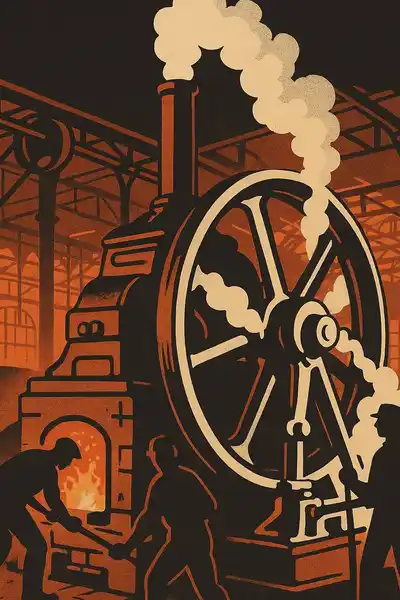
The steam engine was the generalizing technology. Thomas Newcomen had built a working atmospheric engine in 1712 for pumping water out of mines. James Watt's improvements, patented in 1769 and 1781, made the engine substantially more efficient and extended its usefulness beyond pumping. By the 1830s, steam engines were driving factories, locomotives, and ships across Britain and the continent. The significance of the steam engine was that it uncoupled industrial production from the geographic constraints of water power. Factories could be placed where labor, materials, and markets were, rather than where geology permitted.
03The social costs
The contemporary accounts of early industrial life are uniformly grim. The factory system concentrated workers in conditions worse than anything rural poverty had produced. Twelve-to-sixteen-hour workdays were standard. Child labor was endemic — children as young as five worked in textile mills, mines, and match factories, in conditions that routinely killed or maimed them. Housing in Manchester, Birmingham, and the industrial cities was overcrowded, unsanitary, and prone to cholera and typhus epidemics that killed tens of thousands. Life expectancy in industrial cities was lower than in the countryside the workers had left, and in some decades lower than at any previous point in recorded British history.
The wages debate — whether real wages rose, fell, or stagnated during the first decades of industrialization — has occupied economic historians for over a century. The contemporary consensus is that real wages rose slowly and unevenly through the first seventy years, with substantial regional variation, and that broad-based increases in living standards only became clear after roughly 1840. The productivity gains accrued disproportionately to capital for several generations. Workers captured a share eventually, but the delay was long enough to justify the nineteenth-century argument that capitalism was failing the people it depended on.
04The long argument
What the industrial revolution means has been argued since before it was over. The classical liberal defense, from Smith through Mill, treated industrial capitalism as a system that produced general prosperity through individual gain, and saw its eventual improvements in working-class life as vindication despite the early costs. The Marxist critique, formalized in Capital and developed through the twentieth-century socialist tradition, treated industrial capitalism as a system of exploitation that concentrated wealth by design and would eventually collapse under its own contradictions. Both framings have evidence. Neither has fully won the argument.
The twentieth century's development experience produced a more nuanced picture. State-led industrialization in Japan, Korea, and eventually China achieved the material transformations much faster than the British experience suggested, with less of the specific social pathology. Market-led industrialization in smaller economies produced mixed results depending on institutional quality. Forced industrialization under Soviet planning achieved some gains at enormous human cost and eventually failed on its own terms. The century taught that there are many paths to industrialization, each with tradeoffs, and none is free.
05Conclusion
The industrial revolution matters because it is the dividing line between the world that existed for most of human history and the world we currently live in. Every political argument about economic policy, every question about climate, every debate about what work should look like and who should benefit from it, takes place downstream of what began in Britain in the eighteenth century. The institutions, conflicts, and unresolved questions of the contemporary world are direct descendants of what happened in Manchester and Birmingham and the valleys of Lancashire.
Related books