The Enlightenment
The century that invented the modern mind
Description
Open a newspaper in 2026 and almost every live political argument runs on vocabulary that did not exist before the eighteenth century: human rights, separation of powers, freedom of conscience, government by consent of the governed, the claim that you can criticize a king, a pope, or a scripture and still be a decent citizen. These are not neutral descriptions of reality. They are the working assumptions of a specific project, launched in the 1680s and consolidated between 1715 and 1789, which its participants called the Age of Lights.
The standard high-school summary flattens this into a tidy cultural period — powdered wigs, salons, encyclopedias, a French Revolution at the end. That framing is correct and useless. A more honest description is that a loose international network of writers, scientists, pastors, and a few princes spent a century arguing that reason, evidence, and individual conscience should replace tradition, revelation, and inherited authority as the grounds for belief and government. They did not fully win, they did not fully lose, and the argument they started is still the argument we are having.
The working claim of this primer is simple. The Enlightenment is not a period to be remembered but an operating system still running underneath most of the modern world, patched, forked, contested, and in places breaking down. To understand why someone in 2026 can demand a trial by jury, a peer-reviewed study, or a secular school curriculum, you have to see where those demands were manufactured, by whom, against what, and at what cost.
● The question we're asking: if the Enlightenment is supposedly a closed chapter of European history, why does every live political argument still run on its vocabulary?
● What we'll see: what the word promised, the three scenes that produced it, the American founding as its most ambitious field experiment, and the critiques still shaping how we read it.
Table of contents
01Sapere aude: what the word actually promised
The word that captures the whole project is Kant's. In 1784 he defined Enlightenment in two Latin words and one German sentence: sapere aude, dare to know, and Enlightenment is humanity's emergence from its self-incurred immaturity. Notice the phrasing. Not immaturity imposed by tyrants or priests — self-incurred. Kant's indictment was aimed at the willing submission of ordinary people to any authority that spared them the work of thinking: a pastor to tell them what to believe, a doctor what to eat, a prince what to obey. The point was not to abolish them. It was to stop treating their word as the end of the conversation.
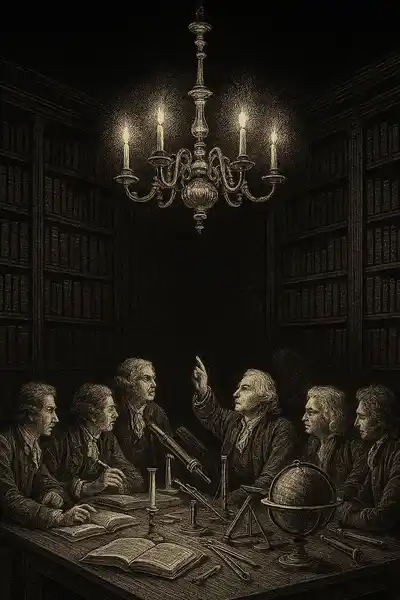
Kant was articulating, a little late, a posture already active across Europe for a hundred years. Its real opening date is 1687, when Newton published the Principia and showed that the same mathematics described the fall of an apple and the orbit of the moon. Educated Europeans drew the implicit lesson within a generation: if the physical universe turns out to be a single rational system accessible to a careful mind with a notebook, then human society and politics might be accessible the same way. The Enlightenment is the long, uneven attempt to apply Newton's method outside of physics.

02Three scenes, not one movement
Treating the Enlightenment as a single French performance is the most common mistake in English-language summaries. There were at least three distinct scenes, each with its own mood and legacy. The French scene is the loudest because it ended in revolution. But the English and Scottish scenes arrived earlier, ran quieter, and arguably shaped the modern world more deeply, because they exported their results into institutions that survived.
England started first. John Locke's Two Treatises of Government appeared in 1689, a year after the bloodless overthrow of James II. Locke's argument was staggeringly radical: governments exist to protect life, liberty, and property, derive their authority from the consent of the governed, and can be replaced when they violate that trust. His Essay Concerning Human Understanding argued that the human mind starts as a blank slate and builds its knowledge from experience. Those two books, political and epistemological, set the terms for the whole century. You cannot read Jefferson, Madison, or even Rousseau without first reading Locke.
03The American field experiment
The most ambitious Enlightenment project ever attempted did not happen in Europe. It happened between 1776 and 1789 on the Atlantic seaboard of North America, where colonial lawyers, planters, and printers decided to build a country on the foundations they had read in Locke, Montesquieu, Hume, and Smith. Jefferson's library at Monticello, which later seeded the Library of Congress, held every major Enlightenment text in the original languages. Franklin spent nearly a decade in the Paris salons before returning to help draft the Constitution. Madison worked through Montesquieu while preparing the Federalist Papers.
The Declaration of Independence looks like a legal brief against George III. Underneath, it is a compressed Enlightenment manifesto. We hold these truths to be self-evident is Lockean epistemology. All men are created equal, endowed with unalienable rights, is Lockean natural law. Governments derive their just powers from the consent of the governed is Locke verbatim. When a government becomes destructive of these ends, it is the right of the people to alter or abolish it, is Locke's right of revolution. Jefferson was not improvising. He was applying a framework worked out in Europe for three generations.
04The critics, from the start to now
The Enlightenment has been under attack, continuously, from the moment it began. The first great critic was inside the movement: Rousseau, who started as a contributor to the Encyclopédie and ended convinced that reason, science, and civilization had corrupted an originally innocent humanity. His Discourse on the Sciences and Arts of 1750 argued that progress had made people more unequal and less free. The ambivalence Rousseau introduced — that emancipation might produce new forms of unfreedom — runs through every serious critique of the Enlightenment since.
The Counter-Enlightenment emerged in the German-speaking world with Hamann, Herder, and the Romantics, arguing that reason alone cannot reach what matters most in human life: language, tradition, the texture of a people and a place. Burke made a conservative version of the same case in England after 1789, watching the French Revolution turn Enlightenment principles into the Terror and concluding that inherited institutions hold wisdom individual reason cannot match. Horkheimer and Adorno later extended the critique from the left in Dialectic of Enlightenment, arguing that instrumental reason, detached from any substantive goal, had produced Auschwitz rather than human liberation.
05Conclusion
The eighteenth century produced a set of working assumptions that now feel like common sense: that knowledge should be public, that government should be accountable, that individuals have rights that precede the state, that religious belief is a private matter, that scientific claims should be testable, that criticism is a civic duty rather than a crime. None of these were common sense in 1680. All were fought for, against entrenched opposition, by people who often paid with their careers, their freedom, or their lives. They feel obvious now because the fight was largely won — not completely, not everywhere, not without hypocrisy, but enough to reshape the modern world.
Related books