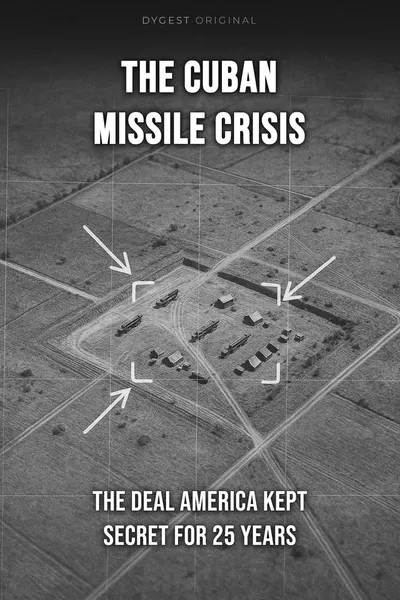
The Cuban Missile Crisis
The deal America kept secret for 25 years
Description
The version of the Cuban Missile Crisis that most Americans learned in school goes roughly as follows. In October 1962, the United States discovered that the Soviet Union was installing nuclear missiles on Cuba, 90 miles off the Florida coast. President John F. Kennedy imposed a naval blockade, went on television to demand the missiles be removed, and stared down Nikita Khrushchev through thirteen days of escalating tension. Khrushchev blinked. The missiles came out. The United States had won by holding firm. It was, in this telling, the cleanest American foreign-policy victory of the Cold War.
Two facts that were not part of the public story in 1962 have since become part of the historical record. The first is that Kennedy cut a secret deal with Khrushchev. In exchange for the Soviet withdrawal from Cuba, the United States agreed to withdraw its own Jupiter nuclear missiles from Turkey — which had been pointed at Moscow since 1961 — within five months. The deal was kept secret for roughly twenty-five years. The public narrative of Kennedy's uncompromising firmness was, by design, incomplete.
The second fact is that the crisis came much closer to nuclear war than the public was told. On October 27, 1962, a Soviet submarine officer named Vasili Arkhipov refused to authorize the launch of a nuclear torpedo at a U.S. Navy carrier group. His decision, made during a moment when the submarine had been out of radio contact with Moscow for days and believed a war had started, almost certainly prevented a nuclear exchange. His name was not public until 2002. Understanding what actually happened during those thirteen days, rather than the cleaned-up version that shaped a generation of American self-understanding, is one of the more useful exercises in Cold War history.
● The question we're asking: what actually happened during the thirteen days of October 1962, and why did the cleaner public story omit both the secret deal that resolved the crisis and the submarine officer who almost certainly prevented nuclear war?
● What we'll see: the Jupiter missiles in Turkey that triggered the Soviet deployment, the thirteen days from inside ExComm, the Soviet submarine that came within a three-man argument of launching a nuclear torpedo, and the secret Jupiter-for-Cuba deal that stayed classified for a generation.
Table of contents
01 The context the missiles arrived in
The crisis didn't start in October 1962. It started the previous year, when the United States deployed Jupiter intermediate-range ballistic missiles in Turkey. The Jupiters were nuclear-armed, targeted at Soviet cities, and positioned about fifteen minutes of flight time from Moscow. They were obsolete by the standards of the early 1960s — slow to fuel, vulnerable on the ground, probably of limited strategic value — but their location on the Soviet border gave them political weight far beyond their actual military utility.
Khrushchev's decision to place Soviet missiles in Cuba was a response to several pressures. The Jupiter deployment in Turkey was a visible provocation. The failed American-sponsored Bay of Pigs invasion of Cuba in April 1961 had convinced Khrushchev that the United States would eventually try again to overthrow Fidel Castro. Strategic parity mattered. If the United States could put missiles on Turkey, Khrushchev reasoned, the Soviets could put missiles on Cuba. The geography was analogous; the deterrent logic was consistent.

02 The thirteen days
Kennedy convened what became known as ExComm — the Executive Committee of the National Security Council — which would meet more or less continuously for the next thirteen days. The initial consensus within ExComm was military. Most of the participants, including the Joint Chiefs of Staff, recommended an immediate air strike on the missile sites followed by a ground invasion of Cuba. This was the conventional response. It was also the response that would most likely have triggered a Soviet counter-strike somewhere — possibly against the Jupiter missiles in Turkey, possibly against West Berlin.
A smaller group within ExComm argued for a different approach. Robert McNamara, the Secretary of Defense, Robert Kennedy, the Attorney General, and George Ball, the Under Secretary of State, pushed for a naval blockade rather than a strike. A blockade — called a quarantine for legal reasons, since a blockade would technically constitute an act of war — would give the Soviets time to reconsider and give Kennedy political space to negotiate. The alternative of a strike, once launched, could not be taken back. Over several days of debate, the blockade position won.
03 The submarine and the man nobody knew
What almost no one in Washington knew on Black Saturday was that a Soviet submarine, the B-59, was being forced to surface off the Cuban coast by U.S. Navy destroyers dropping practice depth charges. The submarine had been out of radio contact with Moscow for days. Its air conditioning had failed, temperatures inside were around 50 degrees Celsius, and the crew was hypoxic from carbon dioxide buildup. The submarine carried a nuclear torpedo. Its captain, Valentin Savitsky, believed a war had started above and that his submarine was about to be destroyed.
Soviet launch protocol for the nuclear torpedo required the unanimous consent of three senior officers. Savitsky gave his approval. The political officer, Ivan Maslennikov, gave his approval. The third officer required was Vasili Arkhipov, the second-in-command of the entire four-submarine flotilla, who happened to be on board the B-59. Arkhipov refused. The three-way argument that followed has been reconstructed through crew testimony over the following decades. It was not brief. It was not calm. But Arkhipov held.
04 The secret deal and the edited memory
While the B-59 was being harassed to the surface, Robert Kennedy met with Soviet Ambassador Anatoly Dobrynin at the Justice Department. The meeting was secret. The substance of the conversation was the offer that resolved the crisis. In exchange for Soviet withdrawal from Cuba, the United States would withdraw the Jupiter missiles from Turkey within four to five months. The offer had one condition: the Turkish missile portion of the deal had to be kept entirely secret. The Soviets could not disclose it publicly.
Dobrynin relayed the offer to Moscow overnight. On October 28, Khrushchev broadcast his acceptance of a withdrawal on Radio Moscow. The public terms referenced Kennedy's earlier pledge not to invade Cuba, which had been made publicly, but said nothing about the Jupiters. The crisis resolved publicly on those terms. The Turkish portion was removed quietly in April 1963 as part of routine military redeployment. No announcement linked the two actions. The American public did not know the Jupiters had been part of the bargain.
05 Conclusion
In October 1962, the United States and the Soviet Union came closer to nuclear war than they ever had before or have since. President Kennedy resolved the crisis through a combination of public firmness and a secret deal that traded American missiles in Turkey for Soviet missiles in Cuba. On October 27, one Soviet submarine officer declined to authorize a nuclear torpedo launch, and almost certainly prevented a nuclear exchange. The public American narrative for twenty-five years omitted the trade and didn't know about the submarine.
Related books