The Cold War
The forty years that shaped everything after
Description
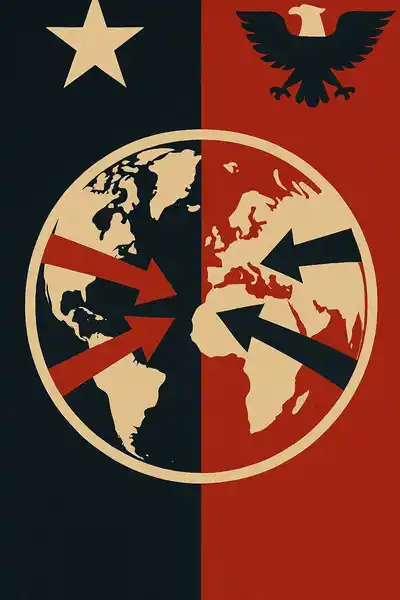
For forty-four years, from the end of World War II in 1945 to the fall of the Berlin Wall in 1989, the international order was organized around the rivalry between two superpowers that had been allies five minutes earlier and were now positioned as civilizational antagonists. The United States and the Soviet Union did not fight each other directly. They fought through proxies, economic pressure, intelligence operations, cultural influence, and an arms race that produced enough nuclear weapons to kill everyone on Earth several times over. The rivalry shaped every major geopolitical event of the period. When it ended, abruptly and more peacefully than almost anyone had predicted, the world that emerged was unrecognizable.
The Cold War is often narrated as a simple binary — free world against communist bloc, democracy against totalitarianism, market against plan. The narrative captures something real but flattens most of what actually happened. The period was also the era of decolonization. It was the era in which the European welfare state was built, partly as a response to the communist threat. It was the era in which the global economic order took its current form, organized around institutions — the IMF, the World Bank, GATT and then the WTO — that American power established and American ideology shaped. The Cold War was the frame. What got built inside the frame was considerably more complicated.
What the Cold War produced was the assumption that international politics would be organized around ideological conflict between blocs of states. Contemporary arguments about the US-China relationship, about whether the post-2022 confrontation with Russia is a new Cold War, about whether liberal democracy faces an existential ideological threat — all take place inside a framework the original Cold War established. Understanding the original is a prerequisite for the arguments about what has replaced it.
● The question we're asking: what was the Cold War, how did it end, and what did forty years of superpower rivalry actually produce?
● What we'll see: the origins in the postwar settlement, the structural dynamics of the conflict, the costs and byproducts, and the world it left behind.
Table of contents
01The postwar origins
The Soviet Union and the United States had been uneasy allies against Nazi Germany. The alliance was always tactical; the wartime cooperation had papered over profound disagreements about the postwar order. Those disagreements became impossible to ignore once the war ended. The Soviet Union, having suffered some twenty-seven million dead, was determined to build a security buffer in Eastern Europe against future invasion. The United States, the only major economy still functioning, was determined to build an international order that would prevent a return to the 1930s depression-and-war dynamics. The two projects were not compatible.
The dividing line crystallized quickly. The Soviet Union installed communist governments across Eastern Europe between 1945 and 1948. The United States, beginning with the Truman Doctrine and the Marshall Plan in 1947, committed to containing Soviet expansion through economic aid and military alliance. NATO was founded in 1949, the Warsaw Pact in 1955. Europe was partitioned along the line Churchill had called the Iron Curtain in his 1946 Fulton speech. The partition would hold for forty years.

02The structural dynamics
The central paradox of the Cold War was that the superpowers never fought each other, but the conflict produced extraordinary violence where their rivalry played out. The Korean War killed roughly three million people. The Vietnam War killed at least two million. Proxy wars in Angola, Mozambique, Nicaragua, Afghanistan, and dozens of other places killed millions more. The Cold War was not, for most of the world, cold at all. The peace between the superpowers was purchased through a great deal of war in the spaces between them.
The arms race dominated the strategic logic. By the late 1960s, the two superpowers together possessed roughly seventy thousand nuclear warheads. Submarines carrying ballistic missiles patrolled the oceans continuously. Bomber wings loaded with nuclear weapons remained in the air on rotating shifts. The costs were enormous — the United States alone spent roughly eight trillion dollars in contemporary terms on nuclear weapons and their delivery systems — and the accident rate was concerning enough that several incidents came close to triggering accidental nuclear exchange. The Cuban Missile Crisis in October 1962 was the most famous. It was not the only one.
03The costs and byproducts
The economic consequences shaped the modern world economy. The Marshall Plan, providing roughly $13 billion — around $150 billion in contemporary terms — to Western European economies between 1948 and 1952, was the first large-scale international aid program. Its success established the template for subsequent development assistance. The institutions that organized the postwar economy — Bretton Woods, the IMF, the World Bank, GATT — were American creations designed as much to contain the Soviet threat as to solve technical problems of international finance. The economic order the world currently operates in is substantially a Cold War product.
Decolonization took place under Cold War conditions and was substantially shaped by them. The European empires collapsed between 1945 and 1975, partly because the wars had exhausted the imperial powers, partly because nationalist movements had matured, and partly because the superpowers supported decolonization for their own strategic reasons. New states became targets of superpower courtship and often proxy conflict. The Non-Aligned Movement, founded in 1961 by Nehru, Nasser, Tito, and Sukarno, attempted to offer an alternative to bloc politics. Many postcolonial states ended up aligned with one superpower through economic dependency even if formally non-aligned.
04The ending and the aftermath
The Cold War's end is usually dated to the fall of the Berlin Wall on November 9, 1989, or to the formal dissolution of the Soviet Union on December 26, 1991. The more important question is why it ended, and on this historians do not fully agree. One account emphasizes the economic exhaustion of the Soviet Union, whose command economy could not match Western productivity and whose military spending crowded out consumer goods enough to undermine political legitimacy. A second emphasizes individual agency — Gorbachev's willingness to risk glasnost and perestroika, Reagan's willingness to negotiate once Gorbachev was in power. A third emphasizes the Eastern European civil society shift — Solidarity in Poland, Charter 77 in Czechoslovakia — which created political pressure Gorbachev chose not to suppress.
What followed was a period of American global preeminence that lasted, in confident form, for roughly fifteen years. Francis Fukuyama's argument that liberal democracy represented the end of history — the final stable political form — was published in 1989 and 1992, and captured the triumphalist mood. The mood did not survive. The 9/11 attacks, the Iraq War, the 2008 financial crisis, the rise of China, and the 2022 Russian invasion of Ukraine have progressively undermined the confidence that the post-Cold War order was stable or permanent. The end of history is looking, thirty-five years later, like a temporary interlude rather than a final condition.
05Conclusion
The Cold War matters because most of the institutional and infrastructural architecture of the contemporary world was built during it. The international organizations, alliance systems, nuclear arsenals, intelligence services, development agencies, cultural institutions — all are Cold War inheritances still structuring the world even as the conflict that built them has ended. Understanding what they were designed to do is necessary for understanding why they sometimes fit the current situation badly. The contemporary world is still operating on Cold War architecture, with all the misfits that produces.
Related books