The Clean Air Act
The law that actually worked
Description
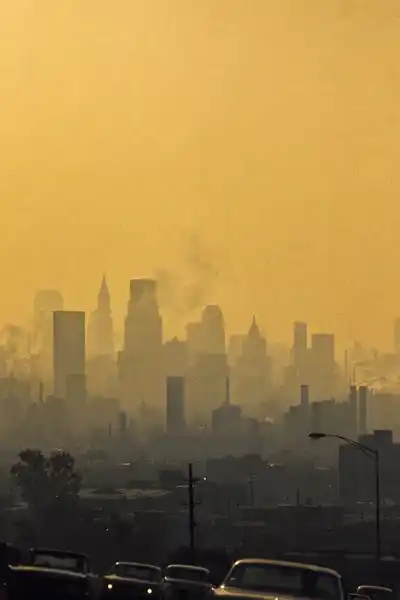
On the morning of 27 October 1948, a thick yellow fog settled over the steel town of Donora, Pennsylvania. Donora sat in a tight bend of the Monongahela River, with a zinc smelter and a steel mill that operated continuously. A temperature inversion trapped the smoke in the river valley. Within forty-eight hours, residents were collapsing in the streets and hospitals were overwhelmed. By the time a heavy rain cleared the air on 31 October, twenty people had died and roughly half of the town's 14,000 residents had been sickened. The Donora smog became the founding event of American air pollution policy.
Twenty-two years later, on 31 December 1970, President Richard Nixon signed the Clean Air Act amendments into law. The legislation, drafted largely by Maine senator Edmund Muskie, gave the new Environmental Protection Agency the authority to set national air quality standards, regulate emissions from cars and factories, and force states to develop implementation plans. The law passed the Senate 73-0 and the House 374-1. Over the following five decades, total emissions of the major air pollutants in the United States fell by roughly 80% even as the economy tripled.
The Clean Air Act is, by most measures, one of the most effective environmental laws ever passed by any country. It is the basis for most of what is known about whether environmental regulation can deliver economic benefits without crippling growth. The story of how it came to exist, and what it actually did, is also a story about a specific political moment that produced bipartisan environmental ambition. That moment did not last, which is part of why the Act is studied so carefully — it is the example most often invoked when arguing that environmental regulation can work.
The question we're asking: what made this particular environmental law work, and what does the data show about the costs and benefits?
What we'll see: Donora, Muskie's amendments, the cost-benefit numbers, and the conditions that produced the bill.
Table of contents
01A town in a fog
Donora in 1948 was an industrial town of the kind that defined American steel production for most of the twentieth century. The American Steel and Wire Company plant employed thousands. The Donora Zinc Works processed zinc ore using a smelting process that emitted sulfur dioxide, fluoride, and various heavy metals. The plants ran continuously and the smoke was a recognized fact of life. Crops in the surrounding hillsides were stunted or dead. The town's reputation for bad air had existed for decades before the disaster.
What turned ordinary pollution into mass casualty was a meteorological accident. A high-pressure system over the eastern United States in late October produced a temperature inversion — warm air sitting on top of cold valley air, preventing vertical mixing. The pollutants accumulated at ground level. By the third day, visibility had dropped to a few metres. The high school football game that Saturday was played essentially blind. The local doctors were running out of oxygen by Saturday evening.

02Muskie's amendments
Edmund Muskie of Maine had been chair of the Senate Subcommittee on Air and Water Pollution since 1963. He was a New England Democrat in a Senate that gave procedural power to southern conservatives. What he had was extraordinary patience and the willingness to spend years building a legislative case. Through the 1960s, he held hearings, commissioned studies, and gradually built a record showing that air pollution had health consequences and that regulation was technically feasible.
The political environment shifted decisively in 1969-1970. The Cuyahoga River caught fire in June 1969, becoming a national news story even though it had caught fire many times before. The first Earth Day, organized by Wisconsin senator Gaylord Nelson, drew an estimated 20 million participants in April 1970. President Nixon, who had little personal interest in environmental matters but considerable interest in political opportunity, positioned himself as the environmental president. He created the Environmental Protection Agency by executive reorganization in December 1970 and signed Muskie's Clean Air Act amendments two weeks later.
03The cost-benefit numbers
The 1990 amendments required periodic studies of the Act's costs and benefits. The first major study, published in 1997 and covering 1970-1990, estimated total compliance costs at roughly $0.5 trillion in present value, against benefits of roughly $22 trillion primarily from avoided premature deaths, illnesses, and IQ losses from lead exposure. The benefit-to-cost ratio was approximately 44 to 1. Subsequent studies covering 1990-2020 found smaller ratios in the range of 30 to 1, with benefits dominated by reductions in fine particulate matter mortality.
The numbers are unusual because the benefits are so large relative to costs. The major air pollutants are cheap to monitor and have well-characterized health effects. The technologies for reducing them catalytic converters, scrubbers, electrostatic precipitators, baghouses were already partially developed when the standards were set, and competition between manufacturers drove costs down rapidly. The health effects of breathing cleaner air operate continuously and at low concentrations, meaning even modest reductions produce large aggregate health benefits across hundreds of millions of people.
04Why this one worked
The Clean Air Act benefited from a political environment that does not exist anymore. The 1970 vote was 73-0 in the Senate. Such a vote on environmental legislation is now structurally impossible. The bipartisan coalition that produced the law included urban Democrats responding to constituent health concerns, Republican legislators from northeastern states with industrial pollution problems, and Nixon's administration. The acid rain trading programme was developed by economists in the George H.W. Bush administration and supported by the Environmental Defense Fund a coalition that has not been replicated for most subsequent environmental legislation.
The technical features of air pollution also made it tractable. The major pollutants were emitted by a relatively small number of large stationary sources and by a vehicle fleet whose technology was concentrated in a handful of manufacturers. Reducing emissions required engineering work — adding pollution control equipment, reformulating fuels, improving engines — but did not require fundamental changes in the structure of the economy. Coal-fired power plants kept operating. Steel mills kept producing steel. The pollution was reduced through end-of-pipe controls rather than through wholesale replacement of the underlying activity.
05Conclusion
The Clean Air Act is sometimes invoked as proof that environmental regulation works. It is, in the specific sense that air pollution in the United States today is much lower than it would have been without the regulation, and that the public health benefits substantially exceed the compliance costs. The data is unusually clean for a regulatory question, partly because the relevant pollutants are easier to measure than many environmental variables, and partly because the time series is long enough to make statistical inference meaningful. The Act has been studied more thoroughly than any other piece of environmental legislation.
Related books