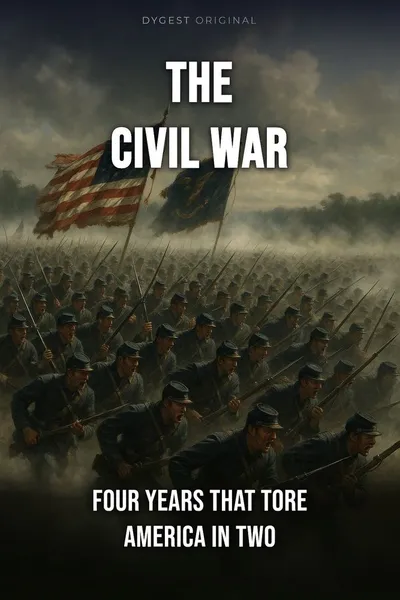
The Civil War
Four years that tore America in two
Description
Introduction :
On April 12, 1861, Confederate artillery opened fire on Fort Sumter, a federal garrison sitting in the harbor of Charleston, South Carolina. The bombardment lasted thirty-four hours. No Union soldier died in the shelling the garrison surrendered before anyone was killed. But the shot that started the American Civil War had been fired, and within four years roughly 620,000 soldiers would be dead, a number that exceeds American military losses in every other conflict the country has fought, combined.
The war had been coming for decades. It was, at its core, a conflict over slavery over whether the institution that had built the Southern economy and shaped the social order of eleven states could survive the westward expansion of a nation that had written "all men are created equal" into its founding documents. Southern states had been threatening secession since at least the 1830s. When Abraham Lincoln won the 1860 presidential election without carrying a single Southern state, seven of them left the Union before he was inaugurated. Four more followed after Fort Sumter.
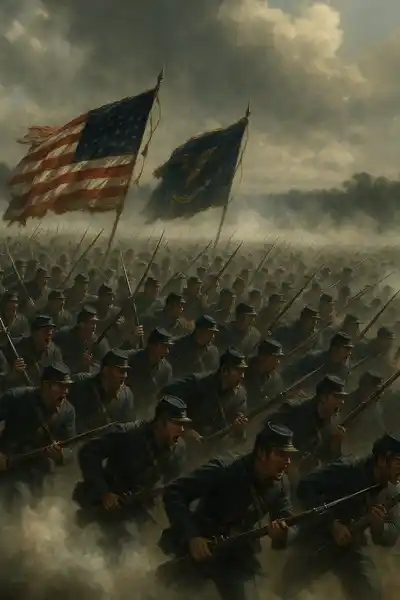
What followed was not the short, decisive conflict most Americans on both sides initially expected. It was a grinding, industrial-scale war that transformed the country's relationship to federal power, to race, and to its own national mythology. The question is not just what happened but why a victory on the battlefield translated so imperfectly into the society that was supposed to follow.
The question we're asking: how did a war fought to preserve the Union become a war over slavery, and why did winning it settle so little?What we'll see: the military and political logic of a conflict that remade the United States — and the reconstruction that failed to complete what the war had started.
Table of contents
01A country that couldn't agree on what freedom meant
The eleven states that formed the Confederate States of America in early 1861 were not a monolithic bloc. They disagreed about tariffs, about states' rights in the abstract, about the specific powers of their new central government. But on one question they were unified: slavery was the foundation of their economy and their social order, and they believed a Lincoln administration would eventually move against it. The Confederate constitution was explicit in a way the American original was not it named the preservation of slavery as a founding principle.
Lincoln himself was not, in 1861, an abolitionist in the sense his opponents claimed. His position was that slavery should not expand into new territories, not that it should be immediately abolished where it existed. He had said as much repeatedly. But Southern slaveholders understood the long game: a country that blocked slavery's expansion would, over time, become a country in which slaveholding states were a permanent political minority. The election of Lincoln was not just a policy threat. It was a proof that the balance of power had shifted.

02The war nobody thought would last
The Confederacy's military strategy was essentially defensive: hold enough territory long enough that the North lost the will to continue. Confederate generals Robert E. Lee above all were capable of spectacular offensive operations, but the fundamental logic was attrition on Southern terms. If the Confederacy could make the war expensive enough, Northern public opinion might force a negotiated settlement that preserved Southern independence.
The strategy nearly worked. In the summer of 1862, Confederate forces had invaded Maryland. By August 1864, with Ulysses S. Grant bogged down in a bloody campaign in Virginia and the fall of Atlanta still months away, Lincoln privately believed he would lose the November election. A Democratic victory would almost certainly have meant a negotiated peace. The war was not, at any point before early 1865, an inevitable Union victory.
03The moment slavery ended, on paper
The Emancipation Proclamation had been issued on January 1, 1863 not as a moral declaration but as a war measure. It freed enslaved people in Confederate states, which the Union did not actually control, and exempted border states where slavery persisted under Union jurisdiction. It was a document designed for military and political effect as much as for liberation. But its effect was nonetheless transformative: it made the destruction of slavery an explicit Union war aim, and it made the war impossible to end without addressing slavery's future.
The Thirteenth Amendment, ratified in December 1865, abolished slavery throughout the United States. The Fourteenth Amendment, ratified in 1868, granted citizenship to all persons born on American soil and guaranteed equal protection under the law. The Fifteenth Amendment, ratified in 1870, prohibited denying the vote on the basis of race. Taken together, they were the most significant restructuring of American constitutional law since the founding. They were also, within a decade, almost entirely unenforced in the states where they mattered most.
04What reconstruction failed to fix
The Civil War settled the question of whether the United States would remain a single nation. It did not settle the question of what that nation would be. The war's outcome determined the legal framework no slavery, equal citizenship, equal protection but legal frameworks require enforcement, and enforcement requires sustained political commitment. The generation that won the war proved more capable of military victory than of the slower, less dramatic work of building the society the victory was supposed to produce.
There is a pattern here that the Civil War illustrates with particular clarity: wars tend to resolve the questions they are fought over in military terms while leaving the underlying social questions open. The Confederacy was defeated. Slavery was abolished. But the conditions that had produced both the racial hierarchy, the economic system built on exploited labor, the political arrangements that enforced minority rule in the South proved far more durable than the institutions they had operated through. They adapted.
05Conclusion
On the morning of April 12, 1861, the Confederate general P.G.T. Beauregard sent a message to the Union commander at Fort Sumter asking him to surrender before the bombardment began. The commander declined. The guns opened at 4:30 in the morning. Thirty-four hours later, the garrison lowered the American flag. The country that raised it again, four years later, was a different country legally, constitutionally, and in ways that could not easily be undone even by those who tried.
Related books