The American mall
Victor Gruen and the suburb’s downtown
Description
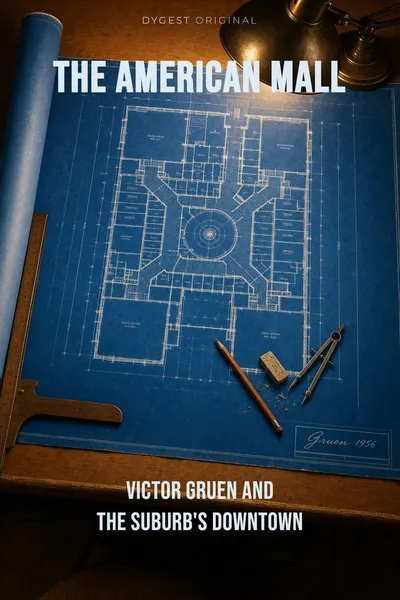
In October 1956, a building called Southdale Center opened in Edina, Minnesota, a suburb of Minneapolis. The building was a two-story, climate-controlled shopping complex with seventy-two retail stores arranged around a central courtyard that featured indoor trees, a fountain, sculpture, and a koi pond. The local press called it the world’s first enclosed shopping mall. The architect was a fifty-three-year-old Austrian Jewish refugee named Victor Gruen, who had fled Vienna in 1938 with eight dollars in his pocket and had spent the postwar years building a new architectural practice in Los Angeles. Southdale was his answer to a question the American suburbs had been raising since the late 1940s: where was the public space?
The question was not abstract. The American suburb that had been growing through the postwar housing boom was a built form unlike anything the country had constructed before. The houses were detached, separated by lawns, connected to each other only by streets designed for cars. There were no town squares, no main streets, no places where neighbors might encounter each other in the ordinary course of a day. The walking culture of European cities, which Gruen had grown up inside in Vienna, did not exist in postwar America. The civic gathering spaces of older American towns the courthouse square, the downtown commercial street were being progressively abandoned as middle-class shoppers moved out to the new subdivisions. Gruen, who saw the loss as a civic problem, proposed the enclosed mall as the solution.
What the American mall became, over the next sixty years, was substantially different from what Gruen had intended. The form succeeded commercially at a scale he had not predicted. It also failed civically at a scale he had not anticipated. By the late 2000s, the American suburban mall had become the cultural shorthand for a particular kind of American failure: a built form that had aspired to community and produced consumption, that had aspired to public space and produced privatized circulation, that had aspired to civic life and produced food courts. Gruen himself, by the late 1970s, was publicly disowning what his invention had become. The argument worth tracing is the gap between what the form was designed to do and what it actually did.
The question we’re asking: what did Gruen design, what did the American mall become, and what does the form’s rise and decline reveal about postwar suburban life?
What we’ll see: the Southdale opening, the spread of the form, the apotheosis and decline, and what the mall has left behind.
Table of contents
01A Viennese refugee and his suburb’s downtown
Victor Gruen had been born Viktor Grünbaum in Vienna in 1903. He had trained as an architect and built a small practice designing shop interiors, primarily for Jewish-owned retail in the city center. The Anschluss in 1938 made his continued life in Austria impossible. He emigrated to the United States and rebuilt his practice in Los Angeles during the war years. By the late 1940s, he was being commissioned for larger projects, including Northland Center in suburban Detroit in 1954.
Northland was the open-air predecessor to Southdale. It was a large outdoor shopping complex anchored by a Hudson’s department store, designed with pedestrian space, sculpture, and the kind of carefully composed walkways Gruen had been thinking about since his Vienna apprenticeship. Northland was a commercial success, but Minnesota winters made the open-air form impractical farther north. The Dayton Company wanted Gruen to design a fully enclosed version for the Twin Cities market, and the brief gave him license to design the suburb’s downtown.

02The form’s national expansion
The Southdale model spread rapidly through the late 1950s and the 1960s. The Dayton Company, which would later become Target, built more enclosed malls in other markets. Other developers Edward DeBartolo, A. Alfred Taubman, Melvin Simon — built their own variations, with the enclosed two-anchor format becoming a standard template by the mid-1960s. By 1970, the United States had over a thousand enclosed shopping malls. By 1985, the number had passed three thousand. The form had become the dominant commercial typology of suburban America, and the spaces it produced had become, in the absence of any alternative, the de facto public squares of the suburban generations.
The architectural elaboration of the form was substantial. The malls of the 1970s and 1980s grew to enclose multi-level atriums, indoor fountains, glass ceilings, and monumental interior spaces previously associated with European train stations. The Mall of America, opened in 1992 in the same Twin Cities suburb that had hosted Southdale, contained over four million square feet of retail space, an indoor amusement park, an aquarium, and a hotel. The form had reached an apotheosis Gruen, by then dead for two years, would not have recognized.
03Gruen’s disavowal and the form’s contradictions
Gruen himself watched the development of his invention with growing concern. By the early 1970s, he had returned to Vienna and was teaching architecture and writing critically about the trajectory of American suburban development. The malls that had been built across the United States were not, in his assessment, what he had designed. They were larger, more commercial, more enclosed, less integrated with surrounding communities, and they had failed to anchor the kinds of mixed-use developments he had originally envisioned. The retail tenants that filled them were chain stores, not local proprietors. The civic events he had imagined hosting were not happening. The mall had become a shopping machine, not a community center.
In a 1978 lecture in London, Gruen issued what has become the most cited statement of his late career: that he refused to accept paternity for the bastardized form American developers had built from his original idea. He compared the suburban mall to “land-wasting seas of parking.” The disavowal was a recognition that the form he had wanted to build, the suburb’s missing downtown, had not been built. What had been built was something else: a shopping environment that mimicked the architectural language of a downtown without doing the civic work a downtown was supposed to do.
04The mall’s decline and what remains
The American suburban mall has been in measurable decline for at least two decades. The peak of new mall construction was in the early 1990s. The 2000s saw the first widespread mall closures, primarily among the smaller regional malls that had served declining commercial corridors. The 2010s accelerated the trend, with the rise of e-commerce and the slow collapse of mid-tier department stores eroding the anchor-tenant model the form had been built around. By 2020, analyst estimates put the number of dead American malls — fully or partially closed — at over four hundred. By 2025, the number had grown to over six hundred.
The architectural afterlife has been varied. Some former malls have been repurposed as office complexes, churches, schools, or government buildings. The Highland Mall in Austin became a campus for Austin Community College. Some malls have been partially demolished and redeveloped as mixed-use complexes that return closer to what Gruen had originally envisioned: walkable streets, residential apartments, retail at the ground level. The new urbanist developments that have replaced certain failed malls represent the second attempt at the suburb’s downtown.
05Conclusion
Victor Gruen died in Vienna in 1980, having spent his last years arguing that the form he had invented had been corrupted into something different from what he had designed. His critique has aged well as a description of what the American mall actually became. The civic ambition he had carried with him from Vienna had not survived the encounter with American suburban development economics.
Related books