Television
The medium that shaped the postwar century
Description
On November 22, 1963, American television stations broke their regular programming to report that the president had been shot in Dallas. Over the four days that followed, ninety-three percent of American households watched the coverage, averaging about thirty-two hours per household. The broadcast networks carried essentially identical material the same anchors, the same images, the same shift from shock to mourning to the funeral. For a civilization-defining moment, roughly two hundred million Americans were looking at the same thing at the same time through the same small screens in their living rooms. No previous medium had been capable of this. No subsequent medium has quite matched it.
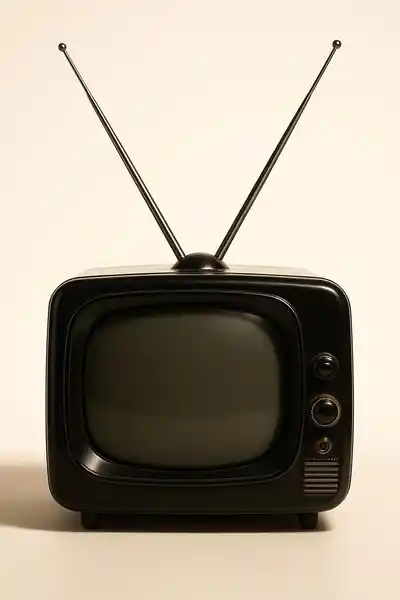
Television in its broadcast era was the first technology to produce a genuinely shared national audience. Newspapers had regional scope. Radio had come close but never fully eliminated geographic fragmentation. Cinema required leaving the house. Television brought moving images into the home, and because there were only three networks from 1948 to 1980, what everyone watched was close to the same material at the same moment. The medium's technical form and oligopolistic market structure combined to produce a cultural cohesion with no real precedent, which has not returned since the medium fragmented.
What television was, became, and what replaced it is the story of the most consequential mass medium of the twentieth century. The broadcast era, the cable revolution, the prestige-television turn of the 2000s, and the streaming present have each reshaped not just what people watched but how they shared attention with their fellow citizens. The transition from the three-network mass audience to the Netflix queue is, in some ways, the transition from a specific kind of twentieth-century society to something else.
The question we're asking: what did television actually do to the societies that adopted it, and what has happened as the medium has reinvented itself?
What we'll see: the broadcast era, the cable revolution, the quality-television turn, and the streaming present.
Table of contents
01The broadcast era
American commercial television began its mass-market phase in 1948. By 1960, forty-five million households had sets, covering eighty-seven percent. The industry structure that emerged three national networks (NBC, CBS, ABC) distributing content through local affiliates, funded almost entirely by advertising — was an accident of spectrum scarcity and federal regulation, but it produced specific cultural consequences. Because there were three networks, everyone watching at a given hour was watching one of three shows. The shared-audience character of the medium was baked into its structure.
The content reflected the advertiser-funded mass-market logic. Variety shows, sitcoms, westerns, crime dramas, game shows, news programs, all designed to offend no one and appeal to the largest possible audience. Ed Sullivan, I Love Lucy, The Twilight Zone, 60 Minutes. The programming was not uniformly middlebrow — there was genuine craft, and some of the era's work holds up but the economic incentive was toward the middle. The medium's reach produced its homogenizing tendency.

02The cable revolution
The cable revolution of the 1980s and 1990s ended the three-network oligopoly and began the long fragmentation. The technical change was cable infrastructure that could deliver many more channels than broadcast spectrum. The regulatory change was the FCC's progressive deregulation of cable. The commercial change was programmers who could build businesses around specific audience segments rather than the mass audience. HBO from 1972, CNN in 1980, MTV in 1981, ESPN in 1979. The Weather Channel, Nickelodeon, Lifetime. By the early 1990s, cable offered roughly sixty channels in the average household. By 2000, closer to a hundred.
The cultural consequences were substantial. The three-network mass audience was progressively replaced by segmented audiences. The national conversation broadcast television had produced weakened gradually across the 1980s and 1990s. Prime-time shares of top shows declined from the fifty-to-seventy-percent range of the 1970s to the twenty-percent range by the late 1990s. The meaning of a hit shifted. A 1970s hit was something most of the country was watching. A 1990s hit was something a substantial minority was watching. A 2020s hit is something a niche is watching. The medium progressively lost the shared-attention function that had been its defining feature.
03The quality-television turn
The period from 1999 to 2015 has sometimes been called television's second golden age, though the framing is contested by defenders of the first. The Sopranos, The Wire, Mad Men, Breaking Bad, Game of Thrones, The West Wing a set of extended-form serialized dramas critics argued were producing art on a scale film had rarely matched. Shows were longer than movies, more complex than most novels, and allowed character development across multiple seasons neither of the older forms could replicate. The quality-television claim was not that TV had become good for the first time but that it had become a site of artistic ambition the medium had previously not sustained.
The economic conditions were specific. HBO's premium-cable subscription model had freed a corner of the industry from advertiser-compromise dynamics. Netflix's original programming starting with House of Cards in 2013 extended subscription economics to a broader portion of the industry. Producers could pursue smaller but more committed audiences than broadcast allowed, and the economics worked because subscribers paid directly rather than being delivered to advertisers. The creative freedom was the precondition for the era's artistic ambition.
04The streaming present
The streaming era, which began around 2013 and has accelerated through the 2020s, has reshaped television into something structurally different. The core change is that viewing is no longer scheduled. There is no eight-o'clock-on-Thursday anymore. Viewers watch what they want when they want on whatever device. The shared-attention function television provided for seventy years has effectively ended. When millions watch a given show, they do so asynchronously, without the cultural focal point synchronized viewing produced.
The economic structure has been reshaped. Netflix, Amazon Prime, Disney+, Apple TV+, HBO Max, Paramount+ have competed with massive content budgets driven by subscriber-acquisition logic. The period from 2018 to 2023 was a peak-TV moment where aggregate spending reached historic highs, producing hundreds of series per year of which only a fraction could be watched by any single viewer. The subsequent period has involved retrenchment as streamers face unsustainable content investment without the subscriber growth they had projected.
05Conclusion
Television matters as a subject because its arc from shared mass audience to fragmented streaming present tracks the trajectory of twentieth-century shared culture itself. The medium was the primary technology through which modern democracies produced a common cultural experience, and the progressive fragmentation of the medium has paralleled the broader fragmentation of those democracies. The shared informational and cultural substrate that broadcast television once provided was one of the conditions under which American political and cultural life operated for roughly half a century. That substrate has largely dissolved, and the question of what replaces it or whether anything adequate replaces it is one of the more consequential open questions of the contemporary moment.
Related books