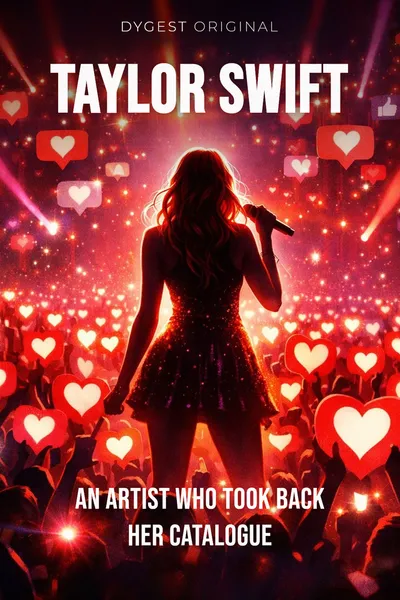
Taylor Swift
An artist who took back her catalogue
Description
In November 2020, Taylor Swift walked into a studio and started recording songs she had already released. Not new versions for a tour, not acoustic reworkings for a deluxe edition — note-for-note remakes of albums she had put out over a decade of her career, some of them among the best-selling records of the 2000s. The first of these re-recordings, Fearless (Taylor's Version), arrived in April 2021, followed by Red, then Speak Now, then 1989. Each carried a small parenthetical that turned out to be the whole point. She was, in the most literal sense, doing her old work over again.
The reason was not artistic restlessness. It was ownership. When Swift signed her first record deal at fifteen with the independent Nashville label Big Machine, she got to keep her songwriting credits but not the master recordings — the actual studio recordings that get licensed, streamed, and placed in films. Those belonged to the label. For most of music history, that arrangement was simply how the business worked, and most artists never thought hard about it until they wanted their catalogue back and found it wasn't theirs to want.
What makes the episode unusual is that Swift had the leverage to respond in a way almost no one before her could. She was popular enough, and productive enough, to build a rival version of her own past and ask the world to prefer it. Fans did. Radio did. Playlists did. A quiet clause buried in every recording contract suddenly became a story that millions of people followed album by album.
The question we’re asking : How does an artist reclaim work she wrote but never owned, and what does it take to pull it off?What we’ll see : How a teenage contract, a private-equity sale, and a decision to hit record again turned a routine industry clause into a public reckoning over who owns a song.
Table of contents
01Chapter 1 — The deal a fifteen-year-old signed
In 2005, Taylor Swift signed with Big Machine Records, a label a music executive named Scott Borchetta had just launched in Nashville. She was fifteen, an unknown with a stack of songs and an unusual insistence on writing them herself. The deal that followed was, by industry standards, ordinary. Swift retained her publishing — the rights tied to the composition, the melody and lyrics she authored — but the master recordings of everything she cut for the label belonged to Big Machine. Six albums came out of that arrangement, from her 2006 debut through 2017's Reputation.
This split between publishing and masters is old and, to most listeners, invisible. A song exists twice over: as a written work and as a specific recorded performance. Songwriters keep the first; whoever pays for the studio time usually keeps the second. For a new artist with no track record, handing over the masters was the price of getting a label to gamble on you at all. Recording is expensive, promotion is expensive, and labels have long argued that owning the recordings is how they recoup the risk of the ones that flop.

02Chapter 2 — The sale that changed everything
In June 2019, Big Machine was sold. The buyer was Ithaca Holdings, the company of the music manager Scooter Braun, in a deal reported at around $300 million. Braun's roster included Justin Bieber and Ariana Grande, and buying Big Machine meant buying its catalogue — which meant buying the master recordings of Swift's first six albums. The artist learned about it, by her account, when the news broke publicly, alongside everyone else.
Swift's reaction was immediate and public. She wrote that Braun represented years of what she described as manipulation and bullying, pointing to his management ties to figures she had clashed with, and said she had been given no real chance to buy her own work back before the sale went through. Borchetta and Braun contested her version, arguing she had been offered a path to ownership and had walked away from it. The dispute turned into one of the loudest public fights the music industry had seen, precisely because it dragged a normally private contractual matter onto center stage.
03Chapter 3 — Recording the same songs twice
The re-recording strategy hinged on a technicality in her old contract. Swift owned the compositions, and after a contractual waiting period she was free to record them again. Nothing stopped her from cutting a new "Shake It Off" that sounded, deliberately, just like the old one. The masters Shamrock owned would still exist, but if listeners chose the new versions, the old ones would slowly lose their commercial value — the streams, the sync licenses for ads and films, the radio play that turns a recording into money.
So she rebuilt her back catalogue. Fearless (Taylor's Version) came in April 2021, meticulously reconstructed to match the originals, down to the phrasing and the instrumentation, with a batch of previously unreleased songs "from the vault" as a bonus that only the new versions could offer. Red (Taylor's Version) followed that November, carrying a ten-minute version of "All Too Well" that became a cultural event in its own right. Speak Now and 1989 arrived in 2023 and 2024. Each release asked fans to swap their loyalty from a recording someone else owned to one she did.
04Chapter 4 — Who gets to own a song
Strip away the celebrity and Swift's fight is about a structure that has governed recorded music for a century. When the industry was built, making a record required capital most artists didn't have — studios, pressing plants, distribution, promotion. Labels supplied the money and, in exchange, took the masters. The arrangement made sense when a recording was a physical object that cost a fortune to produce and move. The artist got an advance and royalties; the label got the durable asset. That bargain became so standard that it read as natural rather than negotiated.
The masters are where the long-term money lives. A composition earns for its writer, but the recording is what gets streamed, licensed to a car commercial, dropped into a film's soundtrack, reissued for a fiftieth anniversary. Whoever owns the master collects on all of it, for decades. This is why catalogues from Bob Dylan to Bruce Springsteen to Neil Young have sold for hundreds of millions in recent years — investors are buying reliable income streams, not sentiment. The recordings outlive the moment that made them, and someone keeps cashing the checks.
05Conclusion
By 2024, four of Swift's six original albums existed in versions she owned, and the re-recordings had become the default for most listeners who came to her catalogue. The masters that had been sold twice for hundreds of millions were still property, still tradable, but worth less than they were the day she started recording again in that studio in 2020. She had not bought her past back. She had built a new one and persuaded the world to treat it as the real thing.
Related books