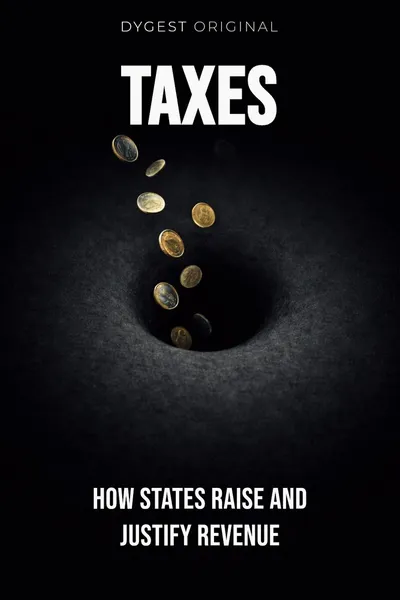
Taxes
How states raise and justify revenue
Description
Somewhere in the seventeenth century, Jean-Baptiste Colbert, finance minister to Louis XIV, is supposed to have said that the art of taxation consists in plucking the goose so as to obtain the most feathers with the least hissing. Whether he actually said it hardly matters; the line has survived because it captures something no government likes to admit out loud. Raising money is the easy part in principle — a state has the power to demand it. The hard part is doing so without the goose deciding the whole arrangement is intolerable. Every treasury on earth lives inside that tension, and always has.
We tend to talk about taxes as a number: a rate, a bracket, a line on a payslip we would rather not read. But the number is the last thing that gets decided. Long before anyone argues about whether the top rate should be 40 or 45 percent, a state has to answer a stranger question — what can it even see and grab? Income you earn, money you spend, property you hold, a company's profit, a barrel of oil crossing a border. Each of these is a different surface to tax, and each rewards a different kind of state with a different kind of society behind it.
That choice of surface is rarely neutral, and it is almost never technical alone. Where a government reaches for its revenue tells us who it can monitor, who it trusts, and who it is quietly willing to lean on harder than others. It also decides, once the money is collected, who ends up carrying the weight — which is often not who the law seems to name. Behind the spreadsheet sits a much older bargain about what people will hand over, and what they expect back.
The question we’re asking : Where does a state actually get its money, and how does it convince people to keep handing it over?What we’ll see : We follow the money from the surfaces a state can reach, to who really ends up paying, to the fragile agreement that keeps the whole thing standing.
Table of contents
01Chapter 1 — What a state can actually reach
Before a tax is fair or unfair, high or low, it has to be collectible. A state can only tax what it can measure, and for most of history it could measure very little. Medieval kings taxed land because land does not move and can be counted from a horse. They taxed salt, windows, hearths, doors — anything visible and hard to hide. The English hearth tax of the 1660s sent inspectors into homes to count fireplaces; people bricked theirs up to dodge it. The window tax that replaced it produced blocked-up windows still visible on old houses today. When you cannot see wealth directly, you tax its clumsy proxies, and people distort their lives to escape the proxy.

02Chapter 2 — The three doors: income, spending, wealth
Once a state can see, it has essentially three doors to reach the same underlying money, and it walks through all of them at once. It can tax money as it comes in, as it goes out, or as it sits. Income tax, corporate tax and payroll contributions catch the flow of earnings. Value-added tax, sales tax and excise duties catch spending. Property taxes, inheritance tax and the rarer wealth taxes catch accumulated stock. Every real system is a blend, and the blend is where the politics hides.
Each door has a distinct character. Income tax is easy to make progressive — you can carve it into brackets so higher earnings are taxed at higher rates, which is why it became the workhorse of the twentieth-century welfare state. Consumption taxes are the opposite temperament: efficient, hard to dodge, and quietly regressive, because a poorer household spends nearly all of what it earns while a richer one saves a chunk that never gets taxed on the way out. The VAT that funds much of Europe is beloved by treasuries precisely because it is broad and reliable, and distrusted by egalitarians for the same reason.
03Chapter 3 — Who really pays, once the dust settles
Here is where taxes stop behaving the way the statute promises. The law names who must hand over the money — the legal incidence — but economists care about a different question: whose wallet is actually lighter afterward, the economic incidence. The two are frequently not the same person, and the gap is where a great deal of tax politics quietly lives. Money does not stay where the law drops it; it slides toward whoever cannot easily push back.
Take a tax on a company. A corporation is a legal fiction; it cannot ultimately bear a cost, only pass it on. Depending on how competitive the market is, a corporate tax lands somewhere among shareholders in lower dividends, workers in slower wages, or customers in higher prices. Economists still argue about the split, but nobody thinks the burden simply stays with the abstract entity named on the form. The same logic runs through a payroll tax notionally split between employer and worker: much of the employer's share ends up shaved off wages, because that is the side of the bargain with less room to walk away.
04Chapter 4 — The quiet contract behind every receipt
Step back from the machinery and taxation reveals itself as something stranger than a transfer of money. It is one of the few moments where a modern state openly compels its citizens, and yet in most functioning countries people comply, year after year, at rates no police force could ever enforce. Enforcement matters at the margins, but the system runs on something closer to consent — a standing agreement, mostly unspoken, that the demand is legitimate and the exchange roughly fair. That agreement is the real tax base, and it is more fragile than any spreadsheet.
History keeps circling back to this. The phrase 'no taxation without representation' was not an accounting complaint; it was a claim that a demand for money without a say in it dissolves the obligation to pay. Revolts from the English Peasants' Revolt to the French Revolution's grievances to modern fuel-price protests tend to ignite not at the highest rates but at the point where the bargain feels broken — where money flows up and nothing recognizable flows back, or where some are seen to slip out of the arrangement entirely. The goose hisses loudest not when plucked hardest, but when it senses the plucking is rigged.
05Conclusion
Colbert's goose, real or invented, was never only about feathers. It was about the moment just before the hissing turns into something a king cannot ignore. Every treasury since has worked the same narrow margin: reach for the surfaces it can see, watch the burden slide toward whoever cannot push back, and hope the arrangement still reads as fair to the people funding it. The rate on the payslip is where the argument surfaces, but the argument itself runs far deeper, into what a state can observe and what its citizens are willing to grant.
Related books