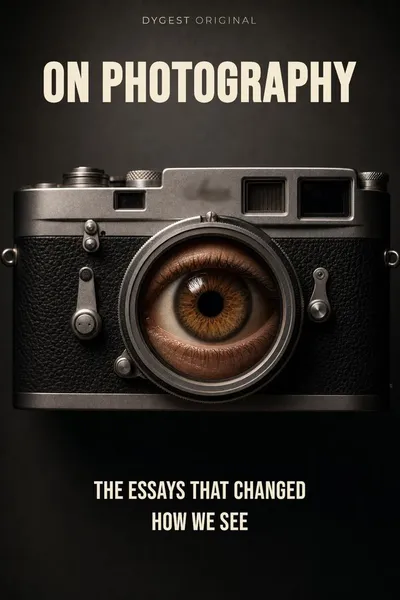
Susan Sontag’s On Photography
The essays that changed how we see
Description
Between October 1973 and June 1977, Susan Sontag published six essays in The New York Review of Books that argued, against the prevailing American culture of the era, that photography was a more morally compromised activity than its practitioners and consumers were generally willing to admit. The essays were published in book form by Farrar, Straus and Giroux in 1977 under the title On Photography. The book was forty years old when it was reissued in a Picador edition in 2001, and over fifty years old at the time of its most recent re-evaluations. It has remained, across that span, one of the central reference points for any serious thinking about how photographs operate in modern life what they do to the people who make them, the people who appear in them, and the broader culture that consumes them.
Sontag was forty when she began the essays, a New York intellectual whose career had been built on a particular combination of erudition and provocation. Her first essay collection, Against Interpretation, had appeared in 1966 and had established her as one of the central figures of the American cultural criticism of the period. The essays in that collection including the famous Notes on Camp — had argued for new ways of attending to mass culture and had positioned Sontag as a generous reader of the popular forms her contemporaries often dismissed. The photography essays were, in important respects, the opposite project. They were a sustained critique of a popular form, and a defense of attention that demanded more from the viewer than the form itself encouraged.
The argument the book made was that photography had transformed the modern experience of looking in ways the people who used cameras did not fully recognize. Photographs, Sontag argued, do not just record reality; they actively shape what counts as reality, what counts as worthy of attention, what counts as a fit subject for the kind of looking that cameras encourage. The photograph is not an innocent record. It is a moral object that carries implications about the relationship between the photographer and the subject, between the viewer and the world, between the act of looking and the act of acting. The essays developed these arguments across a range of topics war photography, fashion photography, family snapshots, the relationship between cinema and still photography with a rigor that the form had not previously been given.
The question we’re asking: what did Sontag actually argue in On Photography, why has the book lasted, and how have her arguments aged into the age of the smartphone camera?
What we’ll see: the New York intellectual context, the central arguments of the book, Sontag’s own later revisions, and what survives in the contemporary attention economy.
Table of contents
01 A New York intellectual takes on the camera
Susan Sontag had grown up in Tucson and Los Angeles, attended the University of Chicago, and arrived in New York in the early 1960s. Her first novel, The Benefactor, appeared in 1963. The first essay collection, Against Interpretation, in 1966. By the early 1970s she had become one of the most discussed cultural critics in the United States.
The starting point of the essays was an observation Sontag made about her own behavior. She noticed that looking at famous photographs had begun to displace looking at the things the photographs were supposed to be of. She had been to museums where visitors were photographing paintings rather than examining them; to landscapes where tourists composed photographs rather than looking at the scenery. The camera, she argued, had inserted itself between the modern viewer and the world.

02 What the camera does
The central argument of On Photography is that the act of taking a photograph is not the neutral recording it appears to be. It is an act of appropriation. The photographer takes possession of the subject in a specific way captures it, holds it still, removes it from the flow of time, makes it available for indefinite future use. The language Sontag uses to describe this is consistently the language of acquisition and consumption. The photograph is something taken. The subject is something seized. The viewer is a consumer of an experience that the photographer has packaged.
The argument has a moral dimension that the technical vocabulary obscures. Sontag argues that the act of photographing creates a particular relationship between photographer and subject that is not the same as the relationship of direct encounter. The photographer is, by the act of taking the photograph, partially absent from the situation she is photographing. The camera is a buffer. The looking through the lens is not the same as looking directly. The experience the photographer is recording is also, in part, an experience she is failing to have. The implications run in multiple directions, but the most striking is that the proliferation of photography in modern life is associated with a kind of moral substitution the photograph as a record of an experience replaces the experience itself.
03 The arguments inside the arguments
The book made several specific claims that have continued to be argued over since. The treatment of war photography was one of the most contested. Sontag argued that war photographs, however well-intentioned, tended to produce a particular aesthetic distance that worked against political mobilization. The viewer who saw a beautifully composed image of a dying soldier was being asked to admire the composition as much as to grieve the death, and the admiration of the composition was a kind of moral evasion. The argument was not that war photographs should not exist, but that the form had inherent limitations that the practitioners often did not acknowledge.
The treatment of the documentary tradition was another point of friction. Sontag was skeptical of the claims of documentary photography to neutrality or to objective recording. She argued that the documentary photographer was always making aesthetic choices that shaped what the resulting images meant, and that the pretense of objectivity often obscured the photographer’s own implicit politics. The argument has had a long career in the debates about the documentary form, with photographers and theorists both defending and revising Sontag’s framing.
04 From On Photography to the smartphone era
The reception of the book on first publication was strong and contested. Major reviewers Janet Malcolm, John Berger, Robert Hughes — took the arguments seriously. The photography community was divided. Some photographers found the book important and clarifying; others found it dismissive of their work. The contested reception was a feature of how Sontag wrote: the essays operated at a level of cultural generalization that made specific photographers feel both implicated and abstracted from.
Sontag returned to the arguments in her 2003 book Regarding the Pain of Others, written after September 11. The later book is partly a revision of the earlier one. Sontag argues, more carefully than she had in 1977, that photographs of suffering are not necessarily numbing, that they can in specific cases produce real moral and political consequences. The core argument about the difference between photographic and direct experience is preserved; the conclusions about what that difference produces are more open and less unilateral.
05 Conclusion
Susan Sontag died in 2004 at the age of seventy-one. The body of work she left behind essays, novels, films, journals has continued to be read and re-read with the kind of attention she had argued the world deserved. On Photography is the book that has had the longest career outside the academy. It is taught in introductory photography courses, in cultural-studies seminars, in journalism schools, in art-history surveys. The arguments she made in The New York Review of Books in the mid-1970s have remained one of the central reference points for thinking about the visual culture that has continued to expand around us.
Related books