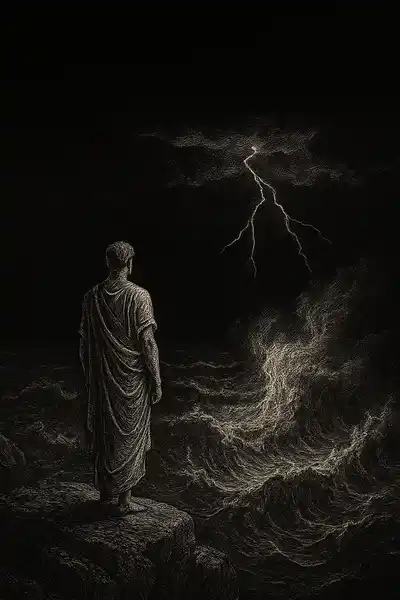
Stoicism
The philosophy that survived two millennia
Description
Walk into any American airport bookstore and you will find a Stoic on the front table. Ryan Holiday's The Obstacle Is the Way has sold more than two million copies. Tim Ferriss tells listeners to read Seneca before bed. Jocko Willink quotes Marcus Aurelius between deadlifts. Stoicism has become, in the last decade, the default operating philosophy of American high-performers — the one that got hired when Buddhism felt too foreign and therapy felt too soft.
The version that won is roughly this: control your reactions, ignore what you can't change, keep calm, grind. It fits on a gym mirror. It bears almost no resemblance to what Zeno of Citium taught on a painted porch in Athens around 300 BC, or to what Chrysippus systematized into an engine of logic, physics, and ethics so intricate antiquity produced nothing else like it. The dichotomy of control has become a productivity hack. Virtue — the entire point — barely gets a mention.
The strange thing is that the real Stoicism is more useful than the self-help version, not less. It is a complete worldview with a physics, a cosmopolitan politics, and an ethics that makes genuine demands. It got Marcus Aurelius through plague and border wars. It got James Stockdale through seven years in a Vietnamese prison. It survived the collapse of the ancient world, was absorbed into Christian monasticism, resurfaced in Montaigne and Descartes, and came back wearing a hoodie in San Francisco. A philosophy that lasts that long has done more than manage anyone's feelings.
● The question we're asking: how did a rigorous philosophy get repackaged, two millennia later, as an airport mindset for calm executives?
● What we'll see: where Stoicism came from, how Rome made it a practice, what its doctrines claim, and what Silicon Valley dropped.
Table of contents
01A shipwreck, a porch, and a system
Stoicism begins with a shipwreck. Around 312 BC, a Cypriot merchant named Zeno lost his cargo off the coast of Attica, walked to Athens, and wandered into a bookseller where he read Xenophon's Memorabilia about Socrates. He asked where one might find a man like that. The bookseller pointed to the Cynic philosopher Crates, walking by. Zeno followed. He would teach for forty years on the Stoa Poikile, the Painted Porch on the Athenian agora — philosophy of the porch, not the academy or the garden.
Zeno's original insight was to fuse Socratic ethics, Cynic austerity, and Heraclitean physics into one system. Philosophy had three inseparable parts: logic, physics, ethics. The Stoics compared these to an orchard — logic the wall, physics the soil and trees, ethics the fruit. To know how to live, you had to know what reality is made of and how reasoning works. The American version has amputated two-thirds of the system and kept only the fruit, which without the tree rots fast.

02Rome turns it into a practice
When people picture a Stoic today, they are almost never picturing Zeno or Chrysippus. They are picturing a Roman. The philosophy migrated west in the second century BC and found in Rome a culture that suited it better than Athens had. Romans liked duty, restraint, action. What three writers gave them was Stoicism as a practice — something you could do on campaign, in the Senate, or while waiting to be killed by your own emperor.
Seneca was the first and most contradictory. Tutor and adviser to Nero, he wrote on friendship, time, anger, and the shortness of life while serving one of the cruelest regimes in Roman memory — and becoming one of the richest men in the empire. He addressed the gap himself: not a sage but a man making progress, writing from the middle of the mess rather than some imaginary summit. When Nero ordered his suicide in AD 65, Seneca cut his veins in the bath and dictated philosophy to his scribes as he died. The death was theatrical on purpose. It was the argument.
03The doctrines that actually do the work
Strip away the Roman biographies and what remains is a small set of claims that stay uncomfortable from every angle. The first is the dichotomy of control. Epictetus opens the Enchiridion with it: some things are up to us, some are not. Opinions, intentions, desires, aversions — ours. Bodies, reputations, property, other people — not ours. This sounds like common sense until you notice how far it goes. Your health is not up to you. Your children's lives are not up to you. Peace comes from treating as indifferent everything outside that tiny circle of actual agency.
The second claim is that virtue is the only good. Not a good among others, the only one. Wealth, health, reputation, pleasure, even the lives of those we love — the Stoics call these preferred indifferents. Reasonable to pursue, foolish to think that having them makes a life good or lacking them makes it bad. A virtuous person tortured to death has a complete happy life. A vicious person in a palace does not. Modern readers hear this as monstrous or naive. The Stoics meant it literally, Stockdale in a Hanoi cell meant it literally, and that is why the philosophy does work optimism cannot.
04Second life, third life, and what got lost
Stoicism did not die with Marcus Aurelius. It went underground. Early Christian monasticism absorbed huge amounts of it — examination of conscience, discipline of attention, the spiritual exercises Pierre Hadot later identified as the real continuity between ancient philosophy and Christian practice. Evagrius Ponticus and John Cassian smuggled the method into the desert tradition. Aquinas rehabilitated parts of the ethics. Justus Lipsius, in the sixteenth century, produced a neo-Stoicism that fed into Montaigne, and from Montaigne into Descartes, whose moral code in the Discourse on Method is transparently Epictetan.
The twentieth-century revival came from two unlikely directions. One was academic — Pierre Hadot on philosophy as a way of life, Martha Nussbaum on the therapy of desire, A. A. Long on Epictetus. The other came through a Navy pilot. James Stockdale was shot down over North Vietnam in 1965, spent seven and a half years as a prisoner of war, four in solitary, and credited his survival to an Epictetus volume he had been assigned at Stanford before deployment. The cut between what was up to him and what was not, he said later, was the only tool that worked.
05Conclusion
Stoicism began on a painted porch in Athens, was formalized by Chrysippus into a three-part system of logic, physics, and ethics, and was translated into Roman practice by Seneca, Epictetus, and Marcus Aurelius. Its claims are more demanding than the bestseller version lets on — that the circle of what is up to us is tiny, that virtue is the only real good, that we are citizens of one cosmos, that the passions are mistaken judgments to correct rather than feelings to suppress. That it survived two thousand years, through monasteries and essays and prison cells, is not an accident of marketing. It is the signature of a working system.
Related books