Stand-up comedy
The art America exported to the world
Description
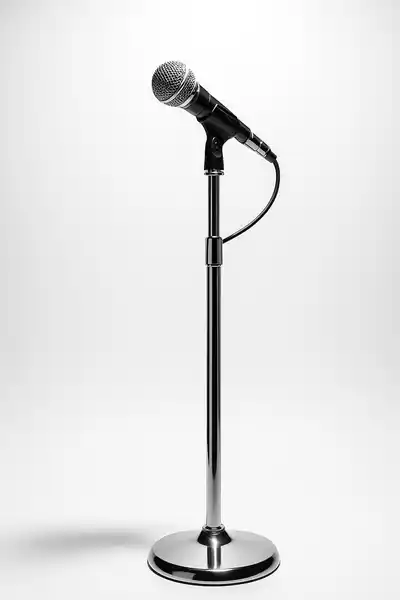
Stand-up comedy is the only American art form in which one person, alone on a stage, with no script they are allowed to read from and no character they are hiding behind, talks directly to a room for an hour and is expected to be funny. Everything else is negotiable the microphone, the brick wall, the stool, the drink on the stool. The core contract is not. One performer, one audience, one continuous exchange in which every sentence is either working or it isn't. Nothing else in the performing arts is built this way.
Because the form looks so minimal, it is easy to underestimate how strange it is. Most cultures do not have a theatrical tradition in which a single comic does extended personal monologues on political and social subjects in front of a paying audience. France has cabaret and one-man shows. Britain has a music-hall tradition and modern stand-up adapted from the American form. Japan has manzai, which is almost always a duo. The specifically American version solo, observational, adversarial when it wants to be, premised on the idea that the comic's individual voice is the product is a twentieth-century invention that the rest of the world has been learning to imitate for sixty years.
The export has accelerated enormously in the last decade. Netflix's multi-billion-dollar investment in stand-up specials starting in 2013 turned the American comedy club into a global delivery system. Comics from Australia, India, Mexico, South Africa, and Brazil now work in the form that was codified in a handful of Manhattan basements between 1958 and 1965. Understanding stand-up means understanding how that handful of basements produced a global genre and what about the form makes it travel so well.
The question we're asking: how did a form invented in New York nightclubs in the late 1950s become the default global vocabulary of verbal comedy?
What we'll see: the break from vaudeville that created modern stand-up, the club era that professionalized it, the cable revolution that scaled it, and the streaming era that globalized it.
Table of contents
01The break from vaudeville
The comedian before stand-up was a vaudeville act tuxedo, one-liners, rimshots, material that had been worked up by a team of writers and was often indistinguishable from the material being performed by the comic two theaters over. The form dominated American comedy from the 1890s into the 1940s, was inherited by radio and early television more or less unchanged, and produced the Jack Bennys and Bob Hopes who defined mainstream comedy through the 1950s. The comic was a delivery system for jokes. The persona was a costume. The content belonged to the genre more than to the individual.
The break came in the late 1950s, in clubs like the hungry i in San Francisco and the Village Vanguard in New York, with a cohort of comics who started doing something vaudeville had not done: performing their own material, in their own voice, about subjects the mainstream did not want discussed. Mort Sahl did the news. He walked onstage with a rolled-up newspaper and delivered political commentary dressed as jokes. Lenny Bruce did religion, race, and sexuality subjects for which he was repeatedly arrested on obscenity charges before dying in 1966 of a heroin overdose, at thirty-nine, effectively martyred by the genre he had helped invent.

02The club era
The 1970s were the decade in which the American comedy club became an institution. The Improv in New York had opened in 1963, originally as a hangout for Broadway performers, before evolving into the first true stand-up venue. Catch a Rising Star opened in 1972, the Comic Strip in 1976, the Comedy Store in Los Angeles in 1972. The clubs functioned simultaneously as performance venues, apprenticeship systems, and casting offices young comics would do five-minute sets on a packed bill, watched by television bookers from The Tonight Show and later Saturday Night Live, whose approval was the pipeline to a career.
The era's two most influential comics pushed the form in different directions. Richard Pryor, working autobiographical material drawn from his upbringing in a Peoria brothel, showed that stand-up could carry confessional weight comparable to literary memoir Live on the Sunset Strip in 1982 remains the masterpiece. George Carlin moved in the opposite direction, using stand-up as a vehicle for linguistic and philosophical argument. His 1972 Seven Dirty Words bit was argued at the Supreme Court. Comics who came of age in the 1970s still divide into Pryor-descended and Carlin-descended lineages.
03Cable, HBO, and the long-form special
The 1990s were the decade stand-up learned to scale. HBO had been producing specials since the 1970s, but the 1990s were when the channel committed to the form as a flagship genre. Chris Rock's Bring the Pain in 1996 is the textbook case an hour that moved Rock from respected journeyman to a generational comic, won the Emmy, and reset audience expectations for what a comedy special could be. Def Comedy Jam, launched on HBO in 1992 by Russell Simmons, simultaneously built a separate pipeline for Black stand-up that eventually produced Martin Lawrence, Bernie Mac, Dave Chappelle, and Kevin Hart.
The cable era also broke stand-up out of its club-hour format. Comedy Central launched in 1991 as a 24-hour stand-up channel before expanding into talk shows and animation. The Daily Show under Jon Stewart, starting in 1999, used the cadences of stand-up to build a new genre of political comedy. Last Week Tonight and The Colbert Report followed. The stand-up sensibility had migrated into the satirical news monologue, one of the defining American political genres of the 2000s.
04The Netflix era and the global form
Netflix moved in 2013. Starting with its acquisition of a handful of specials from established names Aziz Ansari, Bill Burr, Chelsea Handler the service progressively made stand-up one of its flagship content categories, spending what industry estimates place at over a billion dollars on original specials through the late 2010s and 2020s. Chris Rock reportedly received forty million dollars for two specials in 2016. Dave Chappelle received double that for three. The economics of the successful stand-up had changed by an order of magnitude in under five years.
The global consequences were immediate. A Netflix special released in the United States was, the same day, available to subscribers in 190 countries, dubbed or subtitled. Comics whose domestic audience had been Americans watching Comedy Central were suddenly touring Berlin, Mumbai, São Paulo. Non-American comics started producing Netflix specials that followed the American template Hannah Gadsby from Australia, Ricky Gervais from Britain, Hasan Minhaj doing South Asian American material. The American comedy club had become the global template, filled in by voices the original scene had never imagined.
05Conclusion
The standard complaint about American stand-up is that the form is decadent too many specials, too much self-reference, too much discourse about what comedy is allowed to be. The complaint is not wrong on its own terms, and it is also not new. Stand-up has been declared decadent at every peak it has ever hit, going back to the 1980s boom. The form absorbs the criticism and keeps working, because the thing that makes it durable is not the material or the production values. It is the sixty-year-old bet that an hour of one person talking to a room is the most efficient way to compress a point of view into a performance.
Related books