Socrates in the agora
The first philosopher who wrote nothing
Description
If you asked a random educated person to name the founder of Western philosophy, there’s a good chance they’d say Socrates. If you then asked what they’d read of his, they’d be stuck. The answer is: nothing. He didn’t write a single word. Everything we know about him, everything we quote, every argument we attribute to him comes from someone else writing him down — mostly his student Plato, with contributions from Xenophon, Aristophanes, and a handful of later sources that rely on those three.
This wasn’t an oversight or a missing manuscript. Socrates refused to write. He spent his life arguing, in person, in the streets and public spaces of fifth-century Athens, and he thought writing things down was a bad idea. He had a specific argument about why, and the irony that we only know this argument because Plato wrote it down has been amusing philosophers for twenty-four hundred years.
There’s a second irony that sits on top of the first. Because everything we have is Plato — a dazzlingly gifted writer with his own philosophical ambitions — the “Socrates” we know is probably part Socrates and part Plato. Scholars have spent centuries trying to separate them, and the honest answer is that you can’t, not cleanly. The founder of Western philosophy is, at least partly, a character in someone else’s work.
• The question we’re asking: how did a man who refused to write become the most-quoted philosopher in the Western tradition, and what was he actually arguing against when he refused?
• What we’ll see: who Socrates was in the flesh, why he thought writing was bad for thinking, what survives of him and how we got it, and what his refusal tells us about what philosophy is when it’s not stored in books.
Table of contents
01 The man in the marketplace
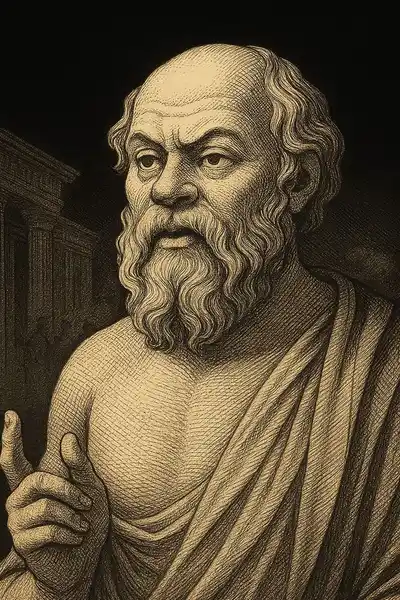
Socrates was born in Athens around 470 BC and died there in 399 BC, executed by the city he’d been arguing with for most of his life. By the time Plato started writing, Socrates had been dead for several years, but the memory of him walking the agora was still fresh. Plato, Xenophon, and Aristophanes all seem to agree on the same physical picture: short, snub-nosed, bulging eyes, an ugly face in a culture that took male beauty seriously. He wore the same simple cloak year-round, went barefoot, and didn’t seem to care what anyone thought of how he looked.
He had a wife, Xanthippe, whose reputation for a sharp tongue survives in anecdotes that almost certainly got sharper in retelling. He had three sons, none of whom made much mark. He’d served as a soldier in the Peloponnesian War and, by most accounts, performed well — cool under fire, resistant to cold, capable of long stretches of standing still, apparently lost in thought, that made his comrades uneasy.

02 Why writing is bad for thinking
The most famous statement of Socrates’ argument against writing comes, appropriately, in a dialogue — Plato’s Phaedrus, written decades after Socrates’ death. In it, Socrates tells a story about an ancient Egyptian god named Theuth, who invented writing and brought it to a pharaoh as a gift. He said it would make the Egyptians wiser, improve their memories. The pharaoh wasn’t impressed.
The pharaoh’s reply, as Plato puts it in Socrates’ mouth, is blunt. Writing, he says, won’t improve memory — it will replace it. People will stop remembering things and start looking them up. They’ll mistake having access to information for actually knowing something. Worse, writing is silent. It can’t answer back. Once an idea is on the page, it’s there for anyone to read in any order, without context, without the ability to push back or be pushed back on. Writing, the pharaoh concludes, is a picture of knowledge, not knowledge itself.
03 The paradox of Plato
Socrates’ refusal to write would have guaranteed his disappearance from history, except that Plato ignored him on this point. Plato started writing dialogues after Socrates’ death, and the main character in almost all of them is Socrates. Plato did this for about forty years, producing roughly thirty-five dialogues, most of which survive.
The result is the founding document of Western philosophy: a body of work that features, as its hero and main speaker, a man who believed writing was bad for philosophy. The irony is sharp enough that Plato himself seems aware of it. In the Seventh Letter, a text generally thought to be authentic, Plato argues that the deepest things can never be put into writing, and that anyone who has written about them has misunderstood them. He wrote this in a letter.
The question scholars have been arguing about since roughly the third century BC is the “Socratic problem.” How much of what Plato writes is Socrates’ thinking, preserved faithfully? How much is Plato using a beloved teacher as a mouthpiece for his own ideas? The honest answer is that there’s no clean way to separate them, and the consensus roughly settles on this: in the early dialogues — the Apology, the Crito, the Euthyphro — we’re probably closer to the historical Socrates, because they focus on his method of questioning without reaching elaborate metaphysical conclusions. In the middle and late dialogues — the Republic, the Symposium, the Phaedrus — Socrates becomes increasingly a vehicle for Plato’s own philosophy, which includes large systems of ideas the historical Socrates probably never held.
04 What gets lost when thinking moves onto the page
Socrates wasn’t wrong about writing, even if history has mostly moved on from his position. The Jesuit scholar Walter Ong spent his career working on the difference between oral cultures and literary ones, and his conclusion was close to Socrates’: the two produce different kinds of thought. Oral cultures are good at memory, repetition, and dialogue. Literary cultures are good at long argument, internal reference, and cumulative knowledge. Most of what we mean by “philosophy” in the Western sense only became possible once thought got stored and cross-referenced in books.
This is probably why Socrates lost the argument historically. The productive gains of writing — the ability to build on what came before, to reason across centuries, to develop systems — outweighed what Socrates thought was being lost. We ended up with Aristotle, Aquinas, Descartes, Kant, an entire tradition that would be unthinkable without the written page.
05 Conclusion
The founder of Western philosophy refused to be a writer, and the whole tradition that bears his name only exists because one of his students ignored him. Every textbook that starts its chapter on ancient Greek philosophy with Socrates is quietly acknowledging this paradox, and every reader who quotes him is participating in it.
We’re left with a figure we can describe but can’t fully reach. We know what he looked like, roughly where he stood in the agora, what he charged (nothing), what he died of, and something of how he argued. We don’t know, and will never know, exactly where Socrates ends and Plato begins. The man himself, like the kind of thinking he preferred, was a live thing, and live things don’t survive preservation intact.
Related books