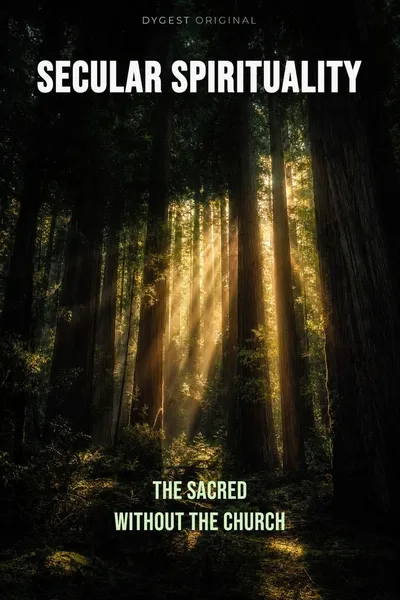
Secular spirituality
The sacred without the church
Description
The phrase secular spirituality used to be considered a contradiction in terms. Spirituality belonged to religion. Secularity meant the absence of religion. People who wanted one took the package, people who wanted the other left it. The fact that this distinction has broken down in the past few decades, and that something like a third of adults in Western countries now describe themselves as spiritual but not religious, is one of the more interesting cultural facts of the period. The category that was supposed to be empty turns out to be one of the most populated categories in the field.
What is happening, in the most direct description, is that the institutions which used to be the carriers of spiritual life are losing members faster than the practices and concerns those institutions were carrying are losing relevance. The church is emptying. The need that filled the church is not. People still want to feel connected to something larger than themselves, still want practices that take them out of ordinary cognition, still want frameworks that give weight to birth, death, and the strange middle of being alive. They no longer want the institutional form in which their grandparents found these things, and they have spent the past half-century looking elsewhere.
The elsewhere, in practice, has included meditation drawn from Buddhist sources, yoga drawn from Hindu sources, contemplative traditions extracted from Christianity and Sufism, psychedelic experience increasingly studied in clinical settings, ayahuasca circles, breathwork retreats, silent meditation courses, plant medicine ceremonies, and an enormous literature of contemporary spiritual writing. The variety is the point. The pattern, if there is one, is that the institutional unity religion used to provide has been replaced by an a la carte logic in which practitioners assemble their own combination from many sources.
The question we're asking: what secular spirituality is, why it has emerged when it has, and what to make of it.
What we'll see: the decline of affiliation, the practices that have replaced it, the psychedelic dimension, and what it suggests.
Table of contents
01The decline of affiliation
The numbers are by now familiar. In the United States, the share of adults identifying with no religion has risen from around five percent in the 1970s to roughly thirty percent today, with the most rapid growth in the past two decades. In the United Kingdom, the 2021 census recorded fewer than half of respondents identifying as Christian for the first time in the country's recorded history. In France, regular church attendance has fallen below five percent of the population. The pattern across the developed West is consistent slow decline through the postwar period, accelerating sharply since the early 2000s, with each successive generation less institutionally affiliated than the one before.
The standard explanations all have something to recommend them. Education and material security correlate with declining religiosity, and the developed West has had more of both than any prior society. The credibility of religious institutions has been damaged by scandal, particularly the Catholic abuse revelations from the 1990s onward. The internet has provided alternative communities of meaning. None of these explanations is sufficient on its own. Together they describe much of the trend.

02The practices
Meditation has been the most successful import. The basic technique came largely from Buddhist sources, with input from Hindu traditions, and arrived first through countercultural channels in the 1960s, then through the clinical apparatus Jon Kabat-Zinn built around mindfulness in the 1980s and 90s, and finally through the apps Headspace launched in 2012, Calm in 2014 that brought daily meditation to tens of millions of users. The clinical evidence for benefits in stress reduction, attention regulation, and certain kinds of depression is now substantial. The deeper claims about insight and liberation are not what the apps are selling.
Yoga underwent a similar transformation. The Hindu tradition out of which it emerged is enormous, with many forms of practice across many centuries. What reached the West, particularly from the late 1960s onward, was largely hatha yoga, the postural discipline, often shorn of its philosophical context. The result is a practice now done by tens of millions of Westerners, mostly framed as physical exercise with light philosophical scaffolding, with the more demanding contemplative dimensions available to those who go looking for them. Whether this counts as yoga in the traditional sense is contested in the same way the secular Buddhism question is contested.
03The psychedelic dimension
Psychedelics have a particular role in this story. After a long moratorium following the legal restrictions of the late 1960s, research into psychedelic substances resumed in the late 1990s and has expanded substantially since. Studies at Johns Hopkins, NYU, Imperial College London, and elsewhere have produced replicated findings on psilocybin's effects on depression, end-of-life anxiety, and addiction, alongside the more philosophically interesting finding that high doses reliably produce experiences participants describe in language indistinguishable from classical mystical reports.
The cultural effects have run ahead of regulatory changes. Even before MDMA-assisted therapy and psilocybin therapy receive final approvals, underground use for spiritual and therapeutic purposes has expanded substantially. Ayahuasca circles, originally a religious practice of indigenous Amazonian communities, have become a feature of urban spiritual life, with retreats in legal jurisdictions and informal ceremonies in private homes. Ketamine clinics have proliferated. Microdosing, whatever the evidence actually shows, has become widespread in certain professional milieus.
04The shape of the moment
Several things follow from this picture that are worth being explicit about. The first is that the secularization thesis the idea that as societies modernize, religion withers has been only half right. Institutional religion has indeed receded across most of the developed world. But the human concerns that institutional religion handled have not, and they have produced new forms that do not look like religion in the old sense but function in some of the same registers. Calling these forms secular is partly accurate and partly misleading. They are secular in being detached from inherited religious institutions. They are not secular in the sense of being cleanly outside the territory religion once occupied.
The second is that the new forms have characteristic strengths and weaknesses. Their strength is openness anyone can participate, the inherited authority structures are minimal, the practices can be tested directly. Their weakness is the lack of accumulated wisdom about how communities sustain themselves, how grief is handled, how transitions are marked, how individual experiences are integrated into a coherent life. The institutions that did this work for centuries were imperfect, but they had centuries of practice. The replacements are being assembled, often by people who do not know what they are replacing.
05Conclusion
Secular spirituality is the contemporary West's working answer to a problem the West did not realize it had what to do with the part of human life that the religious institutions used to manage, once the institutions are no longer where most people go. The answer that has emerged is plural, partial, and improvised. It draws from the world's traditions, often without their full context. It centers on practice rather than belief. It treats personal experience as the working authority. It is doing some of what religion used to do, and not doing other things religion did, and the tradeoffs are still being learned.
Related books