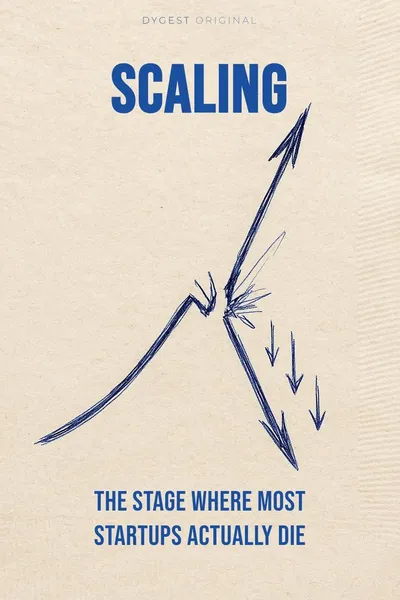
Scaling
The stage where most startups actually die
Description
The canonical startup story ends with product-market fit. The founders have built something people want, users are arriving, revenue is coming in, and the company enters what Silicon Valley calls the growth stage. The narrative pauses here because this is where the happy ending is supposed to begin. The sequel, in most startup biographies, compresses what happens next into a few paragraphs about hiring, expanding geographically, and eventually going public. The compression is misleading. The years between product-market fit and durable scale are where most companies that achieve fit still fail. The specific problems of this period different in kind from the problems of finding fit — have killed far more startups than have died before reaching fit.
Scaling is the moment when a company has to become a company. The ten or twenty people who built the initial product have to become a hundred and then a thousand. The processes that worked by informal coordination have to become systems that work without direct founder involvement. The founder-led network hiring has to become a machine that can onboard dozens per month. The revenue from enthusiastic early customers has to come from a repeatable sales process that new account executives can run. Each transition has specific failure modes, and the aggregate difficulty of getting all of them right simultaneously is what kills most scaling startups.
Understanding scaling as a distinct stage is the prerequisite for navigating it. The founder playbooks that served during the PMF hunt often actively harm companies during scaling. The practices that produce success at scale are often the opposite of practices that produced success at the initial search. The literature — Reed Hastings on culture, Ben Horowitz on management, Elad Gil on hiring agrees that scaling is a fundamentally different kind of work founders have to learn, often badly, often while the company is already struggling.
The question we're asking: why is scaling so hard, and why does it kill startups that have already achieved product-market fit?
What we'll see: the specific transitions that scaling requires, the operational pathologies that emerge, the organizational challenges that compound, and what distinguishes companies that scale well from those that do not.
Table of contents
01The transitions
The first transition is organizational. A company of ten coordinates through conversation. Everyone knows what everyone else is working on, decisions are made informally, culture is set by the specific individuals present. At a hundred, conversation-based coordination fails. Too many people, too many simultaneous decisions, too many subtle handoffs. The company has to develop mechanisms meetings, written communication, planning processes, decision protocols that substitute for informal awareness. Founders who resist this transition, because the informal approach produced the initial success, often preside over the organizational dysfunction scaling requires them to solve.
The second transition is hiring. Early hiring is founder-driven and slow founders personally recruit a handful per year from their network, for roles they understand. Scaling hiring is adversarial and fast dozens or hundreds per year, in roles founders have never performed, in functions the company has never had. The pattern-matching that worked for the first ten hires stops scaling. The company has to build a real recruiting function with dedicated recruiters, structured interviews, hiring committees, calibration processes. Founders who hire by gut feel at scale produce the specific mistakes that compound into operational dysfunction.

02The operational pathologies
The classic operational pathology is the replacement of customer obsession with internal process. Early-stage, every employee knows customer names, talks to customers regularly, makes decisions on specific customer feedback. At scale, specialized roles intermediate the customer relationship. Sales talks to customers but not product. Product works on roadmap items but rarely talks to customers. Engineering implements features with no direct customer visibility. The feedback loops that produced initial fit degrade into telephone across multiple handoffs, and product decisions degrade accordingly. The company is still working on the product, but the product gets progressively less responsive to what customers actually need.
The second pathology is the replacement of experimentation with optimization. Early-stage companies experiment constantly, try many things, expect most to fail. Scaled companies, with larger revenue at stake and more employees depending on stability, become progressively more risk-averse. Experimentation drops, decision-making becomes consensus-driven, bold moves become harder because they would disrupt the organization. The company trades the volatility that produced growth for the stability that allows execution, and the trade-off often goes further than intended, leading to stagnation the company cannot reverse without painful restructuring.
03The organizational challenges that compound
The hardest part of scaling is that the challenges compound. A hiring problem produces performance problems, which produce management problems, which produce culture problems, which produce retention problems, which produce further hiring problems. Challenges do not arrive one at a time; they arrive simultaneously and interact. A company trying to solve hiring while its culture is eroding, its management is new, and its product is slipping is often unable to solve any problem well, because each solution requires attention from executives already stretched across multiple crises. The simultaneity is what makes scaling harder than any single scaling challenge would suggest.
The compounding is especially visible in culture-hiring. A company with strong culture can hire more carefully because the existing team provides context new hires absorb quickly. A company whose culture is eroding original team diluted too fast, values not consistently enforced, outside executives not sharing founding assumptions has a harder time onboarding, which means new hires perform worse, which means more hiring, which further dilutes culture. The feedback loop can produce rapid degradation once started, and companies that fall into it often cannot recover without a substantial leadership change.
04What distinguishes the companies that scale well
Companies that scale successfully share several features in retrospect. A CEO who made the founder-to-CEO transition, often with external mentorship. Senior executives hired from outside to fill functional gaps, rather than promoting internal candidates who are not yet ready. Investment in hiring infrastructure recruiters, interview processes, calibration before it is needed. Specific operating cadences weekly leadership meetings, quarterly planning, annual strategy reviews that align the organization without requiring the CEO in every decision.
Successful scalers protect the cultural core through deliberate practice. They write down what the culture is, reference it in hiring and performance reviews, and discipline or remove senior people who violate it regardless of business performance. Culture discipline prevents the dilution rapid hiring otherwise produces. Companies that treat culture as a soft HR topic watch it erode under scale. Those that treat it as a strategic priority the CEO personally enforces maintain the characteristics that made them successful.
05Conclusion
Scaling matters as a subject because it is the stage where most VC value is actually created, and where most PMF-achieving companies still die. Founders who understand scaling as a distinct challenge are better prepared; those treating it as smooth continuation are overwhelmed when challenges arrive simultaneously. Investors who understand failure modes intervene earlier; those treating scaling as a black-box growth phase watch portfolio companies collapse without being able to help. Scaling mechanics are not optional knowledge for serious participants in the startup industry.
Related books