Rothko's Chapel
When abstraction could make you cry
Description
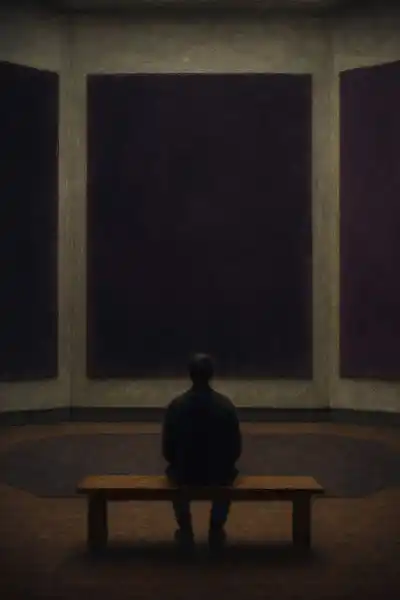
In a quiet part of Houston, at the edge of a leafy residential neighborhood, there’s an octagonal brick building with no signage and no advertised hours. Inside, fourteen huge paintings hang on the walls. They’re not quite black, not quite purple, not quite any single color — dark, almost monochrome surfaces that reward long looking and stay ambiguous even then. There are no pews, no cross, no altar, no statue, no text. A handful of benches in the middle of the room. Sometimes a tissue box by the door.
We call this place a chapel, and that’s what its creator, Mark Rothko, intended. But nothing about it is Catholic, Protestant, Jewish, or any other religion the word usually refers to. The official designation is “nondenominational sacred space.” When we step inside and stay long enough, something happens that’s hard to describe — a slow settling, a quieting down, sometimes tears that arrive without an obvious cause. Rothko spent the last years of his life building a room designed to do this. He succeeded more than he probably hoped. He also didn’t live to see it open.
The Rothko Chapel opened in 1971. Since then, millions of visitors have described versions of the same experience. For a generation of art theorists, the Chapel is the clearest case of a modern puzzle: can a secular object, stripped of all religious symbols, produce something that looks and feels like a religious experience? If yes, what does that tell us about color, about art, and about what a “religious” feeling was in the first place?
• The question we’re asking: how can a room full of dark, abstract paintings reliably move people to tears — including people who don’t believe in anything the word “sacred” traditionally refers to?
• What we’ll see: what’s actually in the Chapel, how it works on visitors, what Rothko was trying to do when he built it, and what it tells us about the function art inherits when religion pulls back.
Table of contents
01Fourteen panels, one room
The Chapel is built on a simple plan. Octagonal exterior, octagonal interior. Light comes through a single skylight in the ceiling, treated so that direct sun never hits the canvases. Cream-colored walls, gray stone floor, a handful of benches arranged in the middle. The architecture, designed by Philip Johnson with Howard Barnstone and Eugene Aubry, was explicitly subordinated to the paintings — Rothko wanted the room to serve the work, not to assert itself.
The fourteen paintings hang on the walls: seven triptychs and seven single panels, painted on oversized canvases that rise from just above floor level to nearly the ceiling. They’re grouped around the room in a rhythm that isn’t quite regular. Some visitors don’t even register how many paintings there are on a first visit.

02How a painting makes someone cry
Visitors cry in the Rothko Chapel. Not all of them, not even most of them, but enough that the docents keep tissues near the door and the staff has stopped being surprised by it. People who arrive skeptical often describe the strongest reactions. People who come expecting a religious experience often report the lightest ones. The effect resists the usual categories.
Part of what’s happening is scale. The paintings are big enough that a standing adult sees mostly painting and barely any wall. The eye stops having anywhere else to go. Part of it is monochrome ambiguity. Because the colors aren’t stable — because the paintings seem to breathe and shift the longer you look — the brain keeps searching for an image that doesn’t resolve. That searching, carried on for several minutes in a quiet room, tends to loosen whatever the visitor walked in with.
03What Rothko was actually trying to do
Mark Rothko was born Markus Rothkowitz in Dvinsk, in what was then the Russian Empire, in 1903, and arrived in the United States as a child. He spent the first twenty years of his career painting more or less figuratively, and then in the late 1940s he did something almost every serious painter of his generation did: he abandoned representation.
What he didn’t abandon was ambition. Rothko was one of the loudest voices in American painting against the idea that abstraction meant decoration. In letters, lectures, and studio arguments, he insisted that his paintings were about something — something hard to name, but serious. He compared his goal to what Aeschylus was doing in Greek tragedy. He thought a painting, like a play, could produce a direct encounter with grief, terror, awe, the things he called “the tragic sense.” He wanted viewers to be wrecked by his work, not charmed by it.
04When art takes over the job of the sacred
The Rothko Chapel isn’t the only example of a modern building trying to do what chapels used to do without the theology attached. The Turrell Skyspaces, the Matisse Chapel in Vence, the Barnett Newman Stations of the Cross at the National Gallery in Washington, the Menil Collection’s Byzantine Fresco Chapel before it closed — twentieth-century art is full of rooms designed to produce the kind of attention and quiet people used to seek in churches.
This isn’t an accident. In most of Europe and North America, religious attendance has been declining for decades, while attendance at museums, concert halls, and designed contemplative spaces has gone up. The philosopher Charles Taylor, writing about what he calls a secular age, argues that the functions religion used to cover — the need for ritual, for shared silence, for an encounter with something larger than daily life — don’t disappear when belief recedes. They migrate. Art is one of the places they migrate to.
05Conclusion
Fourteen near-black panels in an octagonal room in Houston. No altar, no cross, no scripture. A few benches in the middle and a tissue box by the door. What Rothko built is a piece of architecture disguised as a set of paintings, or a set of paintings disguised as a piece of architecture — it’s not obvious which way the weight falls, and that ambiguity may be part of why the room works as well as it does.
What we know is that it moves people who don’t expect to be moved, and that the effect doesn’t require any particular belief to kick in. What Rothko seems to have discovered, almost by accident, is that color and scale and silence, assembled in the right proportions, can produce the kind of experience human beings used to associate with the sacred. Whether that means art has taken over a job religion used to do, or whether the job was always really about color and scale and silence, is a question the room doesn’t answer.
Related books