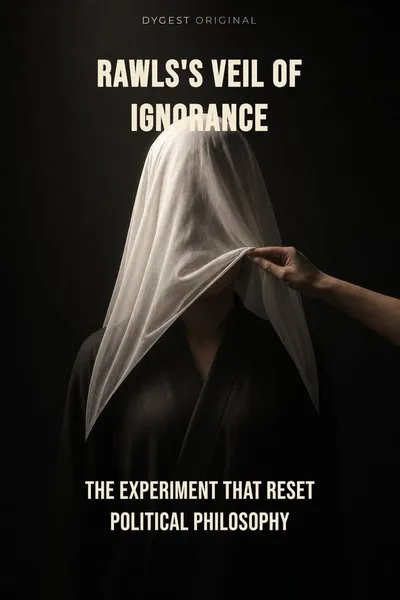
Rawls’s veil of ignorance
The experiment that reset political philosophy
Description
In 1971, a fifty-year-old philosopher at Harvard named John Rawls published a six-hundred-page book called A Theory of Justice. The book had been written in stages over more than two decades, drafted and redrafted across teaching positions at Cornell, MIT, and finally Harvard, where Rawls had arrived in 1962 and would remain for the rest of his career. The discipline of political philosophy, by the late 1960s, was in a state that several of its practitioners had been describing as moribund. Anglo-American philosophy in the postwar period had largely turned away from substantive political theory in favor of conceptual analysis. The big questions of the tradition what makes a society just, what citizens owe each other, how political institutions should be designed were not being asked in serious philosophical journals with the kind of systematic rigor that earlier generations had brought to them.
A Theory of Justice was meant to bring those questions back. The book’s central argument was built around a thought experiment that Rawls called the original position, in which rational agents would choose the principles of justice for their society from behind what he called a veil of ignorance a hypothetical condition in which they did not know which position in society they would occupy, what talents they would have, what their gender or race or religion would be. The idea was that fair principles would be principles that rational people would choose under those conditions of ignorance, because they would have no way to bias the rules in favor of their own anticipated circumstances. The thought experiment was elegant and the implications were substantial. Rawls argued that rational people behind the veil would choose two specific principles: equal basic liberties for all, and social and economic inequalities arranged so that they benefited the least advantaged members of society.
The book was the most discussed work of Anglo-American political philosophy of the second half of the twentieth century. Within five years of publication, it had generated a substantial secondary literature, had been translated into multiple languages, and had reorganized the way universities taught political theory. Within a decade, the position Rawls had developed was the default reference point for liberal political philosophy in the United States, and the opposing positions libertarianism, communitarianism, conservative critiques were defined largely by their relationship to him. The argument has continued to be central to political philosophy for over fifty years, even as the specific institutional implications Rawls drew from the framework have been contested from multiple directions.
The question we’re asking: what is the veil of ignorance actually meant to do, what did Rawls argue rational agents would choose behind it, and how has the framework aged after half a century?
What we’ll see: the philosophical context that produced the book, the structure of the original-position argument, the two principles of justice, and the long career of the framework.
Table of contents
01 A philosophy department in trouble
John Rawls had grown up in Baltimore, served in the Pacific during the Second World War, and taken a doctorate at Princeton in 1950. His early career was at Cornell and MIT before Harvard hired him in 1962. He was an unusually reserved man uncomfortable with publicity, slow to publish, indifferent to academic politics. His writing was painstaking, revised across many years before reaching publication.
The state of political philosophy in the postwar period was, in Rawls’s own description, one of accumulated drift. The tradition from Hobbes through Locke through Kant through Mill had not been seriously extended in the twentieth century. Anglo-American philosophy had turned to language, logic, and conceptual analysis. Continental philosophy had moved the political questions into registers the Anglo-American tradition found difficult to engage with. Political philosophy had become a historical subject rather than a live discipline.

02 The original position and the veil of ignorance
The core thought experiment of the book is the original position, and the central feature of the original position is the veil of ignorance. Rawls asks the reader to imagine a hypothetical situation in which rational agents are choosing the basic principles that will govern the society they will live in. The agents know everything that can be known about how societies work, about psychology, about economics, about politics. What they do not know is anything specific about themselves. They do not know whether they will be born wealthy or poor, what race or gender they will be, what natural talents they will have, what religious convictions they will hold, what generation they will live in, what specific life plans they will pursue.
The point of the veil is to filter out the kinds of considerations that ordinarily corrupt deliberation about justice. A person who knows that she will be wealthy is likely to prefer principles of justice that protect inherited wealth. A person who knows that he will be working-class is likely to prefer principles that redistribute. A society’s actual deliberations about justice are always conducted by people who know their own positions and reason accordingly. The veil of ignorance is meant to model the kind of deliberation that would be fair, in the sense that the people doing the deliberating would have no information that could bias the outcome in their favor.
03 The difference principle and the politics it implies
The difference principle was the part of the book that produced the most argument when the book appeared and that has continued to produce the most argument since. The principle is not egalitarian in the strict sense. It does not say that inequalities must be eliminated. It says that inequalities are permitted, but only if they improve the position of the worst-off. The argument is that some inequalities can do this incentive structures that produce more efficient economic outcomes, for example, can generate gains that flow to the bottom of the distribution, and to that extent the inequalities are justified. Other inequalities cannot do this, and to that extent they are not justified.
The institutional implications are substantial. A society organized on Rawlsian principles would have strong protections for basic liberties, a robust commitment to fair equality of opportunity (which Rawls reads as more demanding than the standard liberal version), and a tax-and-transfer system designed to ensure that economic inequalities continued to work to the benefit of the least advantaged. The combination is roughly the position of a social-democratic welfare state, though Rawls is careful to argue that the specific institutional design is not entailed by the principles. Different societies could implement the principles in different ways, depending on local conditions.
04 Half a century on, and what survives
A Theory of Justice has remained the central reference point of Anglo-American political philosophy for over five decades. The veil of ignorance has become standard intellectual furniture, used in arguments well beyond philosophy departments. The two principles of justice have shaped how political philosophers across the spectrum frame their positions, even when they disagree.
The political implications have been more mixed. The Rawlsian framework has been most influential in academic discussion. Its influence on actual political institutions has been smaller. The trajectory of American politics since the 1980s has moved progressively away from the institutional implications of the framework. The gap between most-cited theorist and most-influential-on-practice has become part of the long discussion about what political philosophy is for.
05 Conclusion
John Rawls died in 2002 at the age of eighty-one, having spent the last decades of his life in declining health and in continuous philosophical work. His later books Political Liberalism, The Law of Peoples, Justice as Fairness extended the framework in directions the original work had only sketched, and the corpus he left behind is one of the few sustained philosophical achievements of the postwar period. He had been a famously private man, gave few interviews, and produced almost no public commentary on contemporary politics. The work spoke for itself.
Related books