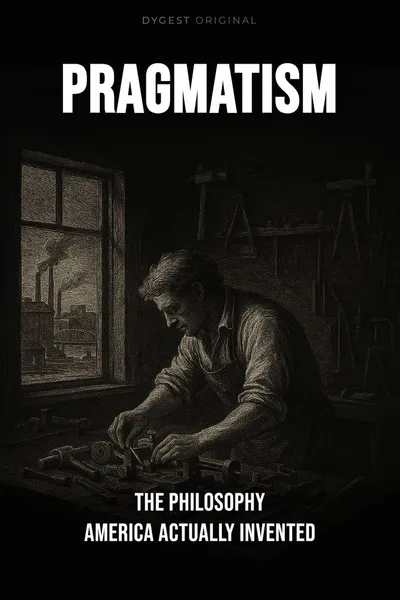
Pragmatism
The philosophy America actually invented
Description
Introduction :
Ask an educated American to name a philosopher their country produced, and you will usually get a pause and a reach toward Emerson. Emerson was an essayist. Thoreau was a nature writer with a political edge. Ayn Rand was a novelist with a system. The United States has exported jazz, film, and the internet, but its relationship to philosophy has been that of a borrower Locke for the founders, Hegel for the reformers, Heidegger and the French postmoderns for the universities. The standard line is that America makes money and technology, and Europe makes ideas.
The standard line is wrong on one specific point, and that point matters. There is exactly one philosophical tradition that began in the United States, remained identifiably American for a century, and produced world-class work recognized as such by European philosophers who otherwise look down on the continent. It is called pragmatism, and it was invented in Cambridge, Massachusetts, in the years just after the Civil War, by a small group of men who met to argue about science, law, and belief. They called it the Metaphysical Club.
The common confusion is that pragmatism means being practical, settling for what works, compromising on principle. The everyday English word has drifted far from the philosophical one. The doctrine is sharper and stranger. It says that the meaning of an idea is nothing more than the sum of its practical consequences — that truth is not a mirror held up to reality but a tool that either helps us cope or fails to. It rejects the search for eternal foundations and replaces it with experiment. Once you see it, you notice it everywhere in American life.
The question we're asking: what did a handful of men in post-Civil War Cambridge invent, and how did it become invisible by winning?What we'll see: the Metaphysical Club, Peirce's severe doctrine and James's popular rewrite, Dewey's democratic program, and the revival from Rorty to Silicon Valley.
Table of contents
01The Metaphysical Club
The Metaphysical Club met in Cambridge in 1872, probably in the rooms of William James or Charles Sanders Peirce. There were no minutes, no dues, no publications. The membership was tiny: Peirce, the scientist and logician; James, the young Harvard physiologist who would become the country's most famous psychologist; Oliver Wendell Holmes Jr., future Supreme Court justice; Chauncey Wright, a mathematician who died young. They met for perhaps nine months, then dispersed. Everything important that came out of the club was written afterward, over the next fifty years, by members working separately.
What these men had in common was a war. All of them had lived through the Civil War as young adults, and several had fought in it. Holmes was wounded three times. The war had been waged by Americans who believed, on both sides, that their cause was grounded in eternal truth divine will, natural law, the moral order of the universe. Six hundred thousand men died. The generation that came out of that conflict had a permanent allergy to the kind of absolute conviction that had sent them to Antietam and Cold Harbor. They wanted a way of thinking that did not require certainty to function.

02Peirce vs James
The name was supplied by Peirce, in a paper published in 1878 in Popular Science Monthly under the title How to Make Our Ideas Clear. His proposal later called the pragmatic maxim was severe and technical. To grasp the meaning of any concept, he wrote, consider what practical effects the object of the concept might conceivably have. The sum of those effects is the entire meaning of the concept. Nothing more belongs to it. This was not a theory of truth. It was a tool for clarifying thought, aimed at flushing out the empty verbal disputes metaphysicians had been staging for centuries.
Peirce was a brilliant and impossible man. He lost his Johns Hopkins position over a scandal, alienated nearly every colleague, and died in poverty in 1914. But his pragmatism was rigorous. A scientific community converging on a belief through long, self-correcting inquiry was how truth got approximated never possessed, only pursued. Truth was what a sufficiently extended investigation would ultimately agree on. It was a regulative ideal, not something you could hold. The pragmatic maxim was meant to keep thinking honest, not to make it comforting.
03Dewey and the democratic turn
The third founder arrived trained in Hegel and outlived the other two by decades. John Dewey was born in Vermont in 1859, the year of The Origin of Species. He taught at Michigan, Chicago, and Columbia, and kept writing until he died in 1952 at ninety-two. His output was enormous: more than forty books in a prose style charitably described as gray. But Dewey took pragmatism out of the seminar room and made it a program for how a modern society should think, learn, and govern itself.
Dewey's central move was to treat intelligence as a social activity, not a private mental event. Inquiry was what a community did when a shared practice broke down and had to be repaired. Schools, laboratories, newspapers, courts, legislatures these were the sites where thinking actually happened, and the quality of a democracy was measured by how well they worked. He founded the Laboratory School at the University of Chicago in 1896 to test the idea that children learn by doing, by running into problems and figuring them out together. American progressive education, for better and worse, traces its DNA to that building.
04The revival and the present
For a long stretch after Dewey's death, pragmatism went quiet. The analytic philosophy imported from Vienna and Oxford took over American departments, and the pragmatists were treated as a provincial embarrassment. Then, in 1979, Richard Rorty published Philosophy and the Mirror of Nature, and the argument reopened. Rorty claimed that the whole project of modern philosophy the search for a method that would let the mind accurately represent reality had been a mistake from Descartes onward, and that Dewey had seen why before anyone else. The book detonated in the profession.
Rorty became, through the 1980s and 1990s, something unusual for an American philosopher: famous. He wrote for magazines and debated political theorists, describing himself as a bourgeois liberal ironist and arguing that we should stop asking whether our beliefs corresponded to reality and start asking whether they helped us build the society we wanted to live in. The left accused him of selling out to capitalism; the right accused him of dissolving truth into preference. He kept writing until his death in 2007, by which point pragmatism was again a live tradition.
05Conclusion
Pragmatism is the philosophy America actually invented, and calling it that is not a patriotic flourish. It is a historical observation about a specific group in a specific city, working out the implications of a civil war and a new biology in real time. Peirce gave it rigor, James gave it reach, Dewey gave it a politics. Rorty and Menand gave it, a century later, a second life. The doctrine's central claim that an idea's meaning is the sum of its practical consequences, and that truth is what sustained inquiry converges on remains genuinely American in a way few other national traditions remain genuinely anything.
Related books