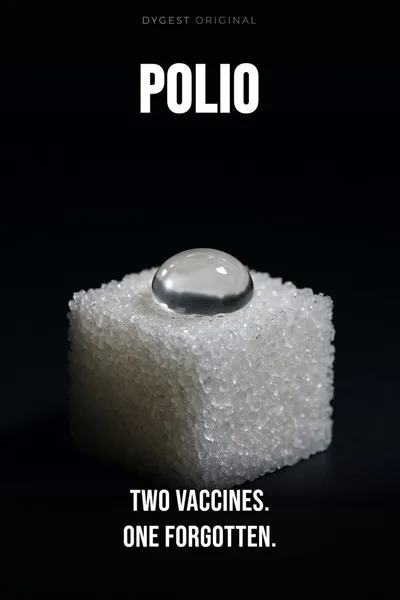
Polio
Two vaccines. One forgotten
Description
On April 12, 1955, at a press conference at the University of Michigan, Thomas Francis Jr. announced that the polio vaccine developed by Jonas Salk had been tested on 1.8 million American children in the previous year and found to be safe, effective, and potent. Within minutes, church bells rang across the country. Schools dismissed early. Truck drivers honked horns. A nation that had spent a decade terrified of a disease that paralyzed children had, by the account of that announcement, just been given the solution. Salk became a national hero that afternoon.
The vaccine that actually eliminated polio from most of the world was not Salk's. It was developed by a man named Albert Sabin and licensed for use in the United States in 1961, six years later. Sabin's vaccine is orally administered rather than injected. It uses live attenuated virus rather than killed virus. It produces stronger and longer-lasting immunity, it interrupts transmission through the community rather than only protecting the recipient, and it is simpler and cheaper to deliver. Between 1962 and roughly 2000, it was the standard polio vaccine in the United States and around the world.
Salk is remembered by Americans as the man who solved polio. Sabin is mostly not. The gap between the two men, and between the two moments their vaccines were introduced, is a useful test case for how scientific credit actually gets distributed. The first public announcement of a working approach almost always captures the cultural memory, even when subsequent work does the harder job of making the approach actually eliminate the disease. Understanding the Salk-Sabin story is a way of understanding why that happens.
● The question we're asking: why is Jonas Salk remembered as the man who solved polio when Albert Sabin's vaccine — the one tested in the Soviet Union during the Cold War — is what actually eradicated the disease?
● What we'll see: the fear of polio in mid-century America, Salk's 1955 announcement, Sabin's very different approach and Soviet trials, and why the cultural memory gave the story to the first vaccine instead of the second.
Table of contents
01 The disease that defined post-war American anxiety
Poliomyelitis is a viral disease that spreads through contaminated water and person-to-person contact. It can cause paralysis of the legs, arms, or respiratory muscles. It existed for thousands of years at low levels but became a major public health problem in the early 20th century, as improving sanitation paradoxically made populations more vulnerable — children who didn't encounter the virus young and develop immunity through subclinical infection became vulnerable to serious infection as adults. The largest American epidemic on record was in 1952, when roughly 58,000 cases were reported.
Polio was particularly frightening because it struck children in summer. Swimming pools, summer camps, and crowded urban neighborhoods became associated with transmission. The iron lung — a large mechanical respirator that enclosed most of a patient's body — became a haunting image of the disease. President Franklin Roosevelt, himself paralyzed by what was almost certainly polio at age 39 in 1921, founded the National Foundation for Infantile Paralysis in 1938, which ran the March of Dimes campaign and funded most American polio research through the 1940s and 1950s.

02 Salk and the annoucement
Salk's approach used killed virus. The polio virus was grown in laboratory culture, then chemically inactivated with formaldehyde so that it could no longer reproduce or cause disease. The inactivated virus was injected into a patient; the patient's immune system produced antibodies against it, and those antibodies would prevent infection if the patient later encountered live virus. The method was straightforward, predictable, and comparatively safe, because a killed vaccine cannot revert to active virus under any circumstances.
The 1954 field trial of Salk's vaccine was the largest medical trial in American history to that point. Roughly 1.8 million children were enrolled, divided among three groups — vaccinated, placebo, and observed. The logistics were extraordinary. Roughly 20,000 doctors, 64,000 school personnel, and 220,000 volunteers participated. The trial ran for most of 1954. Results were analyzed by Thomas Francis Jr., Salk's former mentor, at the University of Michigan. The April 1955 announcement was the public release of Francis's analysis.
03 Sabin and the Soviet trials
Albert Sabin, working at the University of Cincinnati, pursued a different strategy. He argued that a live attenuated virus — a weakened strain of polio that could still replicate but couldn't cause disease — would produce stronger, longer-lasting immunity than the killed-virus approach. It would also, critically, spread through the community as vaccinated individuals shed the attenuated virus, passively immunizing others around them. This community effect, what epidemiologists call herd immunity through transmission, was what Salk's killed-virus vaccine could not provide.
Sabin developed his oral polio vaccine through the mid-1950s. Like Salk, he refused to patent it. By 1957 he had a candidate vaccine ready for large-scale trials. But by that point the Salk vaccine was already deployed in the United States, and American public health authorities were unwilling to run a large trial of a competing vaccine for a disease whose incidence was already dropping. Sabin couldn't get the trial done at home.
04 Why the cultural memory went to Salk
The global eradication effort launched by the World Health Organization in 1988 was built entirely on the Sabin vaccine. Polio cases worldwide dropped from an estimated 350,000 in 1988 to fewer than 200 in 2023. Only Afghanistan and Pakistan still report endemic polio transmission. The campaign has been, by any serious metric, one of the most successful public health interventions in history. It was possible because the Sabin vaccine could be delivered cheaply and orally by community health workers, at scale, in environments where cold-chain injection logistics would have been impossible.
Salk himself remained a prominent figure in American science until his death in 1995. He founded the Salk Institute for Biological Studies in La Jolla, California, in 1960. His name is on commemorative stamps, hospitals, schools, and prizes. He is the figure most Americans under seventy associate with the defeat of polio. Sabin, by contrast, died in 1993 without comparable public recognition. His name is on a few Cincinnati institutions. He never received the Nobel Prize, despite being nominated multiple times. His vaccine is what eradicated the disease. The cultural memory didn't accommodate both of them.
05 Conclusion
In April 1955, Jonas Salk's inactivated-virus polio vaccine was announced as safe and effective, and church bells rang across America. In 1961, Albert Sabin's live-attenuated oral polio vaccine was approved for use in the United States after being trialed on 77 million children in the Soviet Union. The Sabin vaccine replaced the Salk vaccine in the US by 1965 and became the foundation of the global eradication campaign that has nearly eliminated polio. The Salk vaccine triggered individual immunity. The Sabin vaccine interrupted community transmission. Both worked. Only one eradicated.
Related books