Penicillin
The accident Fleming never finished
Description
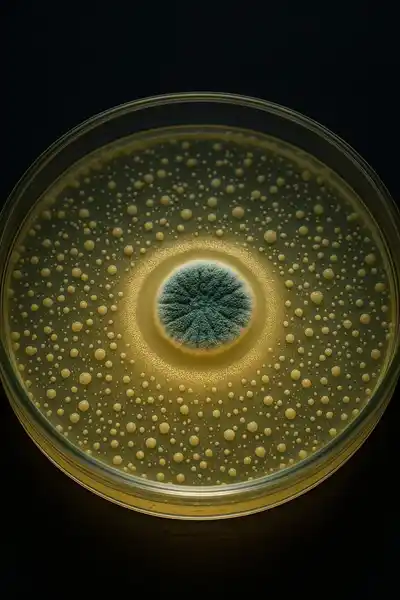
The story most people know goes like this. In 1928, a Scottish bacteriologist named Alexander Fleming returned from vacation to his London lab and found that one of his Petri dishes had been contaminated. A mold had drifted onto his bacterial culture and killed the bacteria in a clean halo around itself. Fleming had discovered the first antibiotic. The world was saved. The rest was engineering.
That version is true in the way a trailer is true — the elements are accurate, but the actual movie is longer, stranger, and has different protagonists. Fleming discovered the mold in 1928 and published his findings in 1929. The medical world mostly shrugged. The paper was cited a few times. The substance, which Fleming called penicillin, was unstable, hard to extract, and commercially uninteresting. It sat in a test tube for twelve years. During those twelve years, people kept dying of infections that penicillin would have cured.
The drug that saved hundreds of millions of lives during and after World War II was not really Fleming's discovery. It was the work of a team at Oxford that nobody named a hospital after, and the work of a government lab in Peoria, Illinois, that has been almost entirely forgotten. Understanding how Fleming's accident became an industry — and what the accident itself didn't deliver — is a useful corrective to the way scientific breakthroughs get told.
● The question we're asking: how did a discovery made in 1928 sit unused for twelve years, and what did it take to turn Fleming's mold into a drug that saved hundreds of millions of lives?
● What we'll see: Fleming's accidental observation and why he couldn't finish it, the Oxford team that stabilized the molecule, the Peoria laboratory and the cantaloupe that made industrial production possible, and what the real history says about scientific credit.
Table of contents
01 The accident and the long silence
In September 1928, Fleming was working on the properties of staphylococci at St. Mary's Hospital in London. He had left several Petri dishes on a bench before going on a three-week vacation. When he returned, one of them had been contaminated by a mold that had drifted in through an open window. Fleming noticed that the staphylococci immediately around the mold had been destroyed. This was the first observation.
Fleming identified the mold as a Penicillium species and named the substance it produced penicillin. Over the following months, he tested penicillin against a range of bacteria and found it was effective against many of the most dangerous pathogens of the era — streptococci, pneumococci, meningococci, gonococci. He also found that it was non-toxic to animals at the concentrations he could achieve. This was an extraordinary profile for an antimicrobial substance.

02 The Oxford team that finished the chemistry
The engineering problem got taken up in 1939 at Oxford by two researchers who found Fleming's old paper while surveying the antimicrobial literature. Howard Florey, an Australian pathologist, and Ernst Chain, a Jewish German biochemist who had fled the Nazis, were not looking to finish Fleming's work specifically. They were looking for interesting antimicrobial substances that hadn't been fully explored. Penicillin, sitting unused for a decade, fit the description.
Florey and Chain assembled a small team and began the chemistry Fleming had been unable to do. By 1940, they had produced enough partially purified penicillin to test on mice. The result was dramatic. Eight mice were infected with lethal doses of streptococci. Four were treated with penicillin. Within a day, the untreated mice were dead and the treated mice were fine. Florey wrote in his notebook that the substance looked like a miracle.
03 The Peoria lab and the cantaloupe
Florey's American counterpart turned out to be an obscure agricultural research laboratory. The Northern Regional Research Laboratory in Peoria, Illinois — a federal facility originally set up to find new uses for surplus agricultural products — had built unusual expertise in large-scale fermentation. They had been working on corn steep liquor, a sticky byproduct of corn processing that the laboratory was trying to find commercial uses for.
The Peoria team made two discoveries that transformed the project. First, they found that penicillin yields increased enormously when the mold was grown in a medium containing corn steep liquor. The yield went up roughly tenfold. Second, one of the lab assistants, Mary Hunt, was assigned to collect moldy fruit from local markets in case any of the molds turned out to produce penicillin better than the strain Fleming had isolated. She brought back a cantaloupe melon from a Peoria grocer.
04 What discovery actually requires
The pattern of what happened is worth pausing on. Fleming observed. Florey and Chain showed that the observation could be turned into a drug. The Peoria lab and the American pharmaceutical industry showed that the drug could be produced at scale. Three distinct scientific communities, in three countries, across twelve years, did three different kinds of work. None of them alone would have produced the outcome.
The prize committee didn't quite see it that way. In 1945, Fleming, Florey, and Chain were awarded the Nobel Prize in Physiology or Medicine. Fleming was by far the most famous of the three, largely because the British press had turned his discovery into a national hero story during the war. Florey, a more reserved figure, was mostly uninterested in publicity. The Peoria team received no Nobel. Mary Hunt received no Nobel. The thousands of chemists and engineers who scaled the production process received no Nobel.
05 Conclusion
In September 1928, Alexander Fleming found a contaminated Petri dish and noticed something interesting. Twelve years later, a team at Oxford picked up his paper and figured out how to stabilize the substance. One year after that, an agricultural lab in Illinois and a cantaloupe from a Peoria grocer made it possible to produce the substance at industrial scale. One year after that, American pharmaceutical companies were shipping penicillin by the trillion units for the Allied invasion of Europe.
Related books