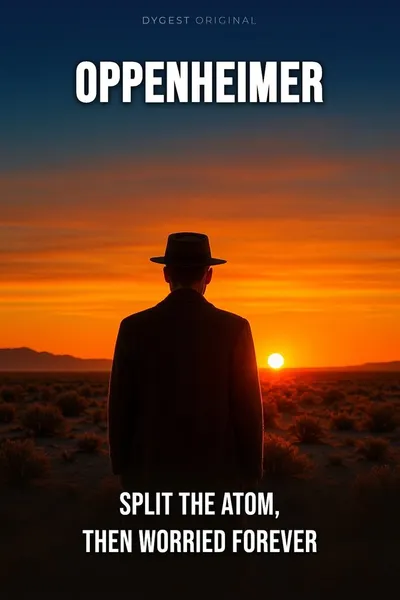
Oppenheimer
Split the atom, then worried forever
Description
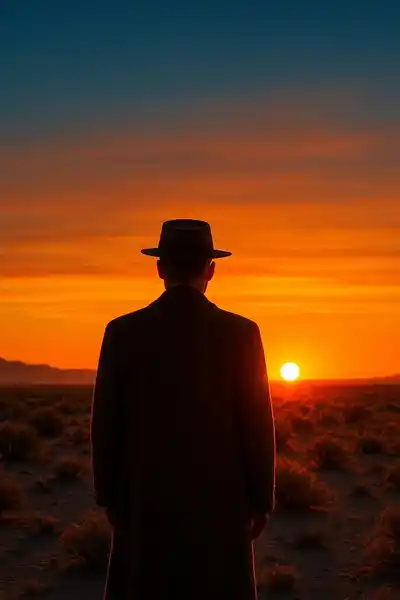
In July 1945, a few hundred scientists, engineers, and military observers in the New Mexico desert watched the first atomic explosion. The bomb worked. The sky went white for a fraction of a second, then red, then a mushroom cloud rose about forty thousand feet into the air. The man in charge of the project that had produced the device was J. Robert Oppenheimer, a forty-one-year-old theoretical physicist who had spent the previous three years assembling what was probably the densest concentration of scientific talent ever brought together on a single problem. He watched the test from a bunker about six miles away. Three weeks later, two more versions of the same device were dropped on Japan, and the war ended.
Oppenheimer was, at that moment, the most celebrated scientist in America. Life magazine put him on its cover. He was consulted by presidents. The Manhattan Project had worked. The bomb had ended the war, by most accounts, and saved American lives. Everything about the arc of his career suggested the next decade would be a triumphal one.
The next decade was, in fact, the hardest of his life. Oppenheimer spent the years after 1945 trying to slow down the thing he’d built, got into a long public fight with the hydrogen bomb program, was subjected to a security hearing designed to humiliate him, lost his clearance, and was effectively exiled from the world of government science. He died in 1967, four years after a partial rehabilitation that came too late to matter. His story is the cleanest case of a particular kind of tragedy: the scientist who wins the argument, and then realizes he was on the wrong side.
• The question we’re asking: what happens to the person who builds a weapon everyone agrees changes the world, and then decides the world shouldn’t have it?
• What we’ll see: who Oppenheimer was before the bomb, how he ended up running the program, what changed after Trinity, and what the security hearing of 1954 tells us about how a country treats the people who make it powerful.
Table of contents
01Before the bomb
Julius Robert Oppenheimer was born in New York in 1904, the son of a wealthy German-Jewish textile importer. His family lived on the Upper West Side in an apartment full of original Van Goghs. He was a precocious, sickly child, sheltered to the point of oddness, and didn’t learn how to handle himself around normal people until he was well into his twenties.
He went to Harvard, finished in three years, and then to Cambridge for graduate work, which did not go well. He was good at mathematics but clumsy in the laboratory, and he apparently left a poisoned apple on his tutor’s desk — a story his friends later dismissed as impossible, though it survived because it fit his personality. He moved to Göttingen, at that time the center of theoretical physics in Europe, and completed his PhD there in 1927 under Max Born. He was twenty-three.

02Los Alamos
The Manhattan Project had many sites. Los Alamos, the laboratory that designed the bomb, was the one Oppenheimer ran. It was built on a mesa in northern New Mexico, in a place he’d known since his Harvard days, when he’d spent summers on a nearby ranch. By the end of the war it had several thousand people on it, most of them scientists, engineers, and their families. It had been an empty boys’ school in 1942. In 1945 it was the densest scientific site in the world.
Oppenheimer’s job was to turn a theoretical question — is it possible to build a weapon that releases energy by splitting atoms on a large scale — into a working device. The theoretical question was interesting. The engineering problems were staggering. Two fissile materials had to be manufactured, purified, and machined; a method had to be found to assemble a critical mass fast enough to detonate before it fizzled; the whole thing had to be made small enough to fit in an airplane. The timeline was set by the war.
03The turn
Oppenheimer began changing his mind before the surrender was signed. He’d opposed the use of the bomb on Nagasaki, arguing that the Hiroshima demonstration was enough. He watched the casualty numbers come in from Japan and was visibly shaken. In October 1945, at a meeting in the Oval Office, he told President Truman, “Mr. President, I feel I have blood on my hands.” Truman, according to aides, was disgusted. He later called Oppenheimer a “crybaby scientist” and said he never wanted to see him again.
But Oppenheimer had too much public stature to push aside. From 1947 onward, he chaired the General Advisory Committee to the Atomic Energy Commission — the body that shaped American nuclear policy. He used that platform to argue for international control of atomic weapons, cooperation with the Soviets on nuclear research, and restraint in the size of the American arsenal. He argued against secrecy when he could. He gave public lectures about the meaning of what had been done at Los Alamos.
04The hearing
In December 1953, Oppenheimer’s security clearance was suspended. The charges were drawn mostly from his 1930s leftist connections and from one particular episode — the “Chevalier affair,” in which a friend had sounded him out, a decade earlier, about passing information to the Soviets. Oppenheimer had reported the approach to security officers, eventually, though he had mangled the story in several different retellings. The episode had been known to the government since 1943. In 1953, dusted off, it became the center of a case against him.
The hearing ran for four weeks in April and May 1954, in secret, at the Atomic Energy Commission headquarters. Oppenheimer was represented by a private lawyer without a security clearance, which meant the lawyer couldn’t see most of the classified evidence. Lewis Strauss, the AEC chairman who had pushed for the hearing, had personal animus toward Oppenheimer and had stacked the panel. The government’s lawyer, Roger Robb, had access to FBI surveillance transcripts Oppenheimer’s team couldn’t see. It was a hearing in the technical sense. It wasn’t a fair one.
05Conclusion
Oppenheimer built the bomb in three years. He spent the next twenty trying to slow what he’d started. He got the first part right and was destroyed for the second. The country that had put him on the cover of Life in 1945 put him through a rigged hearing in 1954 and took his clearance away.
The lesson isn’t that he was a tragic hero or a moral genius. Oppenheimer had real faults — vanity, evasiveness, a habit of saying whatever sounded most impressive in the moment — that his critics exploited and his biographers eventually admitted. The lesson is more technical. Some technologies change faster than the moral conversation around them, and the people who invent them don’t always get to decide what happens next. Oppenheimer learned this the hard way, in public, over the course of a long unraveling.
Related books