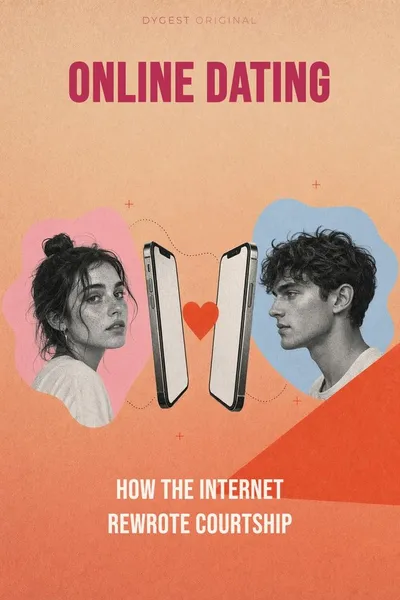
Online dating
How the internet rewrote courtship
Description
In 1995, Match.com launched as one of the first commercial online dating websites. The premise was simple: people who wanted to meet romantic partners could post profiles, browse other users, and initiate contact through the site. The initial take-up was modest, and online dating had a faint stigma through its first decade. Using the internet to find a partner suggested that you could not find one the normal way — through friends, at parties, at work. By 2010, the stigma had largely dissolved as the technology matured and user bases expanded. By 2020, online dating had become the single most common way American adults met new romantic partners, surpassing every offline method combined. The transformation took twenty-five years and has been nearly total.
The specific technology of online dating has iterated substantially across its history. Early sites emphasized long-form profiles and compatibility matching algorithms. eHarmony in 2000 claimed to match people on twenty-nine dimensions of compatibility. OkCupid in 2004 used user-generated questions to build personality profiles. The shift to mobile apps starting around 2010 — Grindr in 2009, Tinder in 2012, Bumble in 2014 — prioritized location-based matching, photo-first profiles, and swipe-based interfaces that dramatically changed how matching happened. The current dominant model is swipe-based, photo-centric, and heavily gamified, which produces specific behavioral patterns that the earlier systems did not produce.
Whether online dating has been net positive for romantic outcomes is contested. It has unambiguously expanded the pool of potential partners available to individuals, particularly for members of demographic minorities (gay men, interracial couples, older single adults) for whom offline dating pools were limited. It has also produced specific problems — decision paralysis, gamified engagement patterns, misrepresentation, ghosting — that offline dating did not have at the same scale. Understanding what online dating has actually done, both the expansions and the distortions, is prerequisite to using it well and to evaluating the specific critiques that have accumulated around it.
● The question we're asking: how has online dating changed how people meet and choose partners, and what are its specific effects?
● What we'll see: the evolution of the technology, the behavioral changes, the outcome research, and the current tensions.
Table of contents
01The evolution
The first-generation sites were essentially personal-ads infrastructure moved online. Match.com, Yahoo Personals, and similar platforms offered long-form profiles where users described themselves in text, listed their preferences in partners, and browsed other users' profiles. Interaction happened through email-style messages, typically initiated by men, with women selecting among the approaches they received. The experience was slow, deliberate, and resembled traditional correspondence more than modern social media. Matching was primarily geographic and based on user-specified preferences; the algorithms were simple filters rather than recommendation engines.
The second generation — eHarmony, OkCupid, Chemistry.com — emphasized algorithmic matching based on psychological compatibility. Users completed lengthy questionnaires about personality, values, and preferences. The systems matched users based on predicted compatibility. The premise was that algorithms could identify patterns predictive of successful relationships more reliably than users could. The empirical evidence has been weak; studies consistently find algorithmic compatibility scores predict relationship outcomes only marginally better than chance. But the sites attracted users by offering something that felt more sophisticated than simple filtering.

02The behavioral changes
Online dating has produced specific behavioral changes that distinguish it from traditional courtship. The first is the volume of early-stage interactions. An active user on a dating app might swipe through hundreds of profiles per day and match with dozens, producing many more early interactions than any offline pattern produced. The volume creates specific attentional and emotional economics — each individual match matters less because many matches are available, and each potential partner receives less sustained attention than they would in a context with fewer alternatives. The apps have essentially expanded the initial-evaluation phase to an industrial scale that human psychology was not evolved to handle.
The second change is the specific visibility of rejection. Offline dating involved rejection, but the rejections were typically ambiguous (the person did not call back) and rare (each attempted connection was costly enough that few were initiated). Online dating produces explicit, frequent, rapid rejection through the swipe mechanism. Users experience hundreds of rejections per week, which produces specific psychological adaptations. Some users become desensitized to the point of disengaging emotionally from the process entirely. Others become sensitized in ways that produce specific anxieties about self-presentation, attractiveness, and worth. The volume of micro-rejections is a genuinely new feature of the modern dating landscape.
03The outcome research
Research on online dating outcomes has accumulated enough to draw some conclusions. Relationships initiated through online dating are now the majority of new relationships among demographic groups with high app usage. The share has risen steadily for two decades and appears to be stabilizing. On specific measures of relationship quality — duration, reported satisfaction, divorce risk — online-initiated relationships appear comparable to or slightly better than offline-initiated ones in most studies. The initial concern that the quick-matching pattern would produce worse relationships has not been strongly supported by the evidence, though the specific effects depend on which apps and which populations are studied.
The expansion of partner pools has produced specific benefits for demographic minorities. Research by Ortega and Hergovich shows that interracial marriages rose substantially with online dating adoption, probably because the apps expose users to partners they would not have met offline. Same-sex couples were early adopters and remain heavy users of specialized apps, which solved the specific problem of small offline populations limiting partner availability. Older adults seeking new partners after divorce or widowhood have also benefited from expanded pools. Each of these groups found something in online dating that offline dating could not provide.
04The current tensions
The industry has matured into a concentrated market dominated by Match Group, which owns Match.com, Tinder, Hinge, OkCupid, and other properties. The concentration has implications. The company's incentives align with keeping users engaged rather than helping them find partners — a user who leaves because they found their partner is no longer a paying user. Critics argue the design choices (notifications, boosted visibility, subscription features) reflect engagement-maximization rather than match-optimization. The business model has become a topic of public criticism and regulatory scrutiny.
The paid-features tier has expanded substantially. Premium subscriptions, one-time boosts, super-likes, and other paid interactions monetize users. Paid features have effects on the dating ecology — users who pay get more visibility, producing biases in who succeeds on the apps. Whether this is a feature (market preferences aligned with willingness to pay) or a problem (organic matching reduced in favor of purchased prominence) depends on perspective. Monetization has increased substantially over the past five years, producing user fatigue.
05Conclusion
Online dating has substantially transformed how adults meet romantic partners, and the transformation is now essentially complete in developed Western societies. The technology has produced specific benefits — expanded partner pools, opportunities for demographic minorities, increased information about potential matches — and specific costs — decision paralysis, the volume of shallow interactions, behavioral pathologies like ghosting. The net effect depends on the specific users, apps, and use patterns involved, and the aggregate effect is genuinely ambiguous in ways that polemical coverage often obscures.
Related books