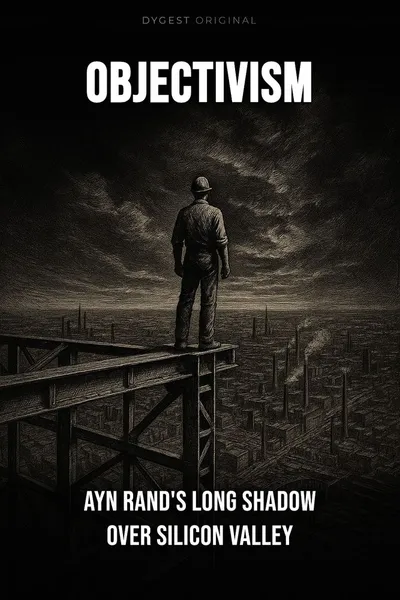
Objectivism
Ayn Rand's long shadow over Silicon Valley
Description
No philosophy department in the United States teaches Ayn Rand. You can earn a PhD at Harvard or Berkeley without encountering her name in a single seminar. Academic journals do not publish her. The major histories of twentieth-century philosophy ignore her or dispatch her in a footnote. By the standards of the profession, Objectivism is not a serious philosophical position — it is a curiosity that escaped from literature and refused to go back.
And yet. A 1991 Library of Congress survey asked Americans which book had most influenced their lives. The Bible came first. Atlas Shrugged came second. Alan Greenspan, who chaired the Federal Reserve for nineteen years, sat in Rand's living room every Saturday night through the 1950s and 1960s as a member of her inner circle. Paul Ryan, speaker of the House, required his staff to read her. Peter Thiel cites her. By the standards of cultural influence, Rand is one of the most consequential American thinkers of the last century.
The gap between those two facts is the interesting thing. A philosophy professional philosophers will not dignify with a response has shaped the worldview of the people running American capital, politics, and technology. To understand Silicon Valley, Wall Street, and a strand of Republican politics, you have to take Rand more seriously than her critics, and more critically than her fans. This is what Objectivism actually claims, why the academy walked away, and why the people building the twenty-first century did not.
The question we're asking: how did a philosophy that academic departments refuse to teach end up shaping the worldview of the people running American finance, politics, and technology?
What we'll see: who Rand was and how a Russian escape became a novelistic system, what Objectivism actually claims in its four layers, why the academy walked away, and how the shadow fell on Silicon Valley and Washington.
Table of contents
01From a Petrograd pharmacy to American bestseller
Alisa Rosenbaum was born in Saint Petersburg in 1905, the daughter of a prosperous Jewish pharmacist. In 1917, when she was twelve, the Bolsheviks stormed her father's shop and nationalized it on the spot. The family watched its livelihood dismantled in an afternoon by men who considered the act a moral improvement. Everything she would later write about collectivism, theft dressed up as virtue, and the envy of the parasite toward the producer traces back to that pharmacy counter.
She reached Chicago in February 1926 on a six-month visa and never went back. Renamed Ayn Rand, she moved to Hollywood, worked as an extra on a Cecil B. DeMille film, and married an actor named Frank O'Connor who would remain her husband for fifty years. She wrote screenplays, then novels. We the Living in 1936 was a Russian love story set against Soviet collectivization. Anthem in 1938 was a dystopian novella in which the word I has been abolished. Both were commercial disappointments. She spent the early 1940s broke, chain-smoking, writing a book publishers kept rejecting.

02The system in four layers
Rand insisted Objectivism was a complete system in four layers. Metaphysics: reality exists independently of consciousness, and wishing does not alter it. Epistemology: reason, applied to the evidence of the senses, is the only valid means of knowing anything. Ethics: each person's own life is the ultimate value, and rational self-interest is the proper standard of morality. Politics: the only social system consistent with the first three is laissez-faire capitalism, with a minimal state confined to police, courts, and defense. Every layer is supposed to derive from the one beneath it.
The metaphysical claim sounds banal until you notice what it rules out. For Rand, existence is primary and consciousness is secondary. There is no God, no Platonic realm, no Kantian noumenon behind appearances. Aristotle's A is A becomes a rhetorical club, wielded against every philosophy she considered mystical Christianity, Hegelianism, existentialism, Kant above all. She called Kant the most evil man in mankind's history, because she believed his separation of appearance from reality had opened the door to every subsequent irrationalism.
03Why the academy walked away
The academy's reasons for ignoring Rand are not all snobbery. The most persistent objection targets the ethics. Rand tries to derive ought from is to prove that because a living organism must act to sustain its life, it therefore ought to value its life as the ultimate good. This move, a direct hit on the naturalistic fallacy Hume identified and Moore formalized, is the hinge of her system. Professional philosophers have judged it a failure. That life requires certain actions does not establish that any particular life is morally obligated to continue, nor that self-interest follows from biology.
A second charge is circularity. Rand defines the rational as what serves one's life, and one's life as what rational action sustains. John Rawls, working on A Theory of Justice in the same period, built a rival system in which rationality and moral concern for others are both derived from a thought experiment. Rand has no thought experiment, no reflective equilibrium, no argument addressed to someone who does not already share her premises. She addresses the reader as a prosecutor, not an interlocutor. The system is airtight if you grant the axioms, collapses if you don't.
04The shadow on American capital
The cultural influence kept compounding. Alan Greenspan wrote essays for Rand's newsletter in the 1960s, including one defending the gold standard he would spend his career at the Fed quietly contradicting. When he was sworn in as chairman of the Council of Economic Advisers in 1974, Rand stood behind him in the Oval Office. Whatever one thinks of the decisions he made between 1987 and 2006 the Greenspan put, the dot-com bubble, the housing bubble they were made by a man formed by the argument that markets are moral and intervention is theft.
In politics, the Rand line runs through the American right but never fully fuses with it. Clarence Thomas required his clerks to watch The Fountainhead. Paul Ryan, speaker of the House from 2015 to 2019, gave copies of Atlas Shrugged to his staff, called Rand the reason he got into public service, and built his budgets on premises she would have recognized. The tension — Rand was an atheist who despised religion while the Republican base is evangelical is handled by quiet omission. The ethics of self-interest gets translated into free enterprise, and the metaphysics is left at the door.
05Conclusion
Objectivism tried to derive laissez-faire capitalism from metaphysics, made a bid to stand alongside Aristotle and Kant, and was shown the door by professional philosophy for reasons that are, on balance, sound. The derivation of ought from is does not work. The refusal of peer review did not help. The cult-shaped inner circle in Manhattan closed off the self-correction that might have produced a more defensible version of the argument. By any internal standard of academic philosophy, Rand lost the fight largely because she refused to enter the ring on its terms.
Related books