Nihilism
What Nietzsche actually meant
Description
In The Big Lebowski, three leather-clad Germans burst into the Dude's bungalow and announce: We are nihilists. Walter, a few scenes later, delivers the verdict that sealed the word's American career: Nihilists. Nothing to be afraid of. The joke is that these nihilists still want the money. The deeper joke is that this is what nihilism has come to mean in English — a pose of elegant indifference, usually adopted by people who want something very badly.
The same shorthand runs through Rick and Morty, True Detective season one, and the internet subculture that formed around Rust Cohle's line about being the thing that labors under the illusion of having a self. Nothing matters, everyone is cosmic dust, pass the whiskey. The word that gets attached to this mood is Nietzsche. He said God is dead, therefore he must have said anything goes, therefore nihilism is a Nietzschean lifestyle. The problem with this chain of reasoning is that Nietzsche spent his entire working life arguing against it.
He didn't invent nihilism and he didn't celebrate it. He diagnosed it. He saw it coming the way a cardiologist sees a heart attack coming in a patient who still feels fine, and he wrote twenty years of books describing what the European patient was going to go through once the anesthetic wore off. The version that ended up on the t-shirt is almost exactly the condition he was warning against. Separating the concept, the diagnosis, and the pop afterlife is the point of this episode.
● The question we're asking: what did Nietzsche actually mean by nihilism, and how did his diagnosis of a civilizational crisis become, in pop culture, a mood and a meme?
● What we'll see: the Russian political origins of the word, the diagnosis behind the death of God, the distinction between passive and active nihilism, and the pop afterlife that flattened it.
Table of contents
01Before Nietzsche, a Russian word
The word arrives in European intellectual life through Russia, not Germany. Ivan Turgenev gives it mass currency in his 1862 novel Fathers and Sons, where the young medical student Bazarov declares that a nihilist is a man who does not bow down before any authority, who does not take any principle on faith. Turgenev's nihilist is not a brooding loner. He is a generation of Russian students who have stopped believing in the tsar, the Orthodox Church, the gentry, and the sentimental liberalism of their fathers. They intend to clear the ground.
This is nihilism as a political program, not a mood. By the 1870s, Russian nihilism has become a loose movement of populists, revolutionaries, and eventual terrorists; in 1881, nihilist-adjacent militants assassinate Tsar Alexander II with a bomb on a St. Petersburg canal. Dostoevsky, watching from the other end of the spectrum, writes Demons in 1872 as a horrified response. His nihilists are not philosophical minimalists. They are men in whom belief has collapsed, and the collapse has left them dangerous. His central intuition, which Nietzsche would develop from the opposite direction, is that once the Christian moral architecture is gone, human beings don't become free. They become unmoored.

02The death of God and the hollow horizon
The most quoted sentence Nietzsche ever wrote is God is dead, and it is almost always quoted wrong. It appears in The Gay Science in 1882, in a parable about a madman who runs into a marketplace with a lantern, looking for God. The crowd laughs at him. He turns on them and tells them God is dead, and we have killed him — and adds, crucially, that he has come too early, that the news hasn't reached them yet even though they are the ones who did it. The madman is not celebrating; he is horrified. The people in the market are not atheists delivering a press release. They are Europeans who have, without noticing, stopped believing the thing their entire moral life is built on.
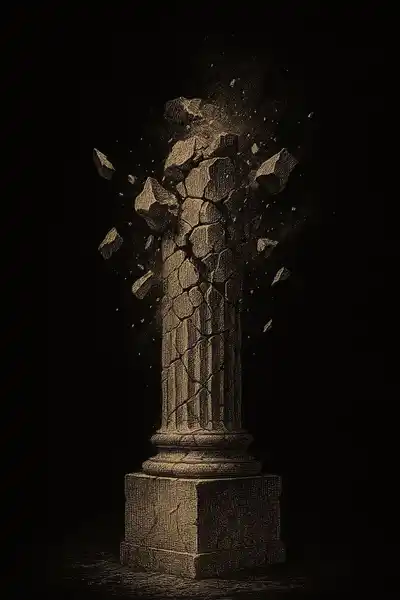
What Nietzsche means by the death of God is historically specific. The Christian horizon — a universe with a creator, a purpose, an afterlife, and a guarantor of moral meaning — had organized European thought for fifteen centuries. The Enlightenment, the scientific revolution, and nineteenth-century Bible scholarship had, by the 1880s, gutted that horizon for the educated classes. Most of them hadn't caught up with what they already knew. Nietzsche's argument is that once you remove the keystone of a cathedral, the building doesn't stay standing just because you're used to the view.
03Passive versus active, the distinction everyone misses
The distinction that gets lost in every pop citation of Nietzsche is between two kinds of nihilism, and his whole project hinges on it. The first is what he calls passive nihilism, and this is what most people think nihilism just is: the exhausted shrug, the recognition that the old values are empty followed by the refusal to do anything about it. A kind of cultural tiredness. His name for it in the late notebooks is weariness, and he is savage about it. He considers it the dominant European mood of his time and the mood that will define the coming century.
Passive nihilism is the Dude's Germans. It is also the teenager who has read three quotes from Schopenhauer and announces that life is meaningless while still demanding dinner. Nietzsche doesn't mistake this posture for clarity; he treats it as depletion, the response of a culture that has lost its sources of meaning and lacks the strength to create new ones. The people who claim nothing matters are, for him, usually people whose capacity to affirm anything has collapsed. They are not seeing the abyss clearly. They are too tired to look.
04The pop afterlife, or weariness in leather pants
Which brings us to the marketplace Nietzsche predicted, now streaming on HBO. Rust Cohle in True Detective explaining that human consciousness is a tragic misstep in evolution isn't doing philosophy; he's performing mood. The show is honest enough to undercut him by the end of season one, where he admits, staring at the stars, that the light is winning. That ending infuriated viewers who had taken the early monologues as scripture. What the show dramatized, in spite of itself, was the arc Nietzsche sketched: the passive nihilist talking his way around a wound he cannot bring himself to dress.
Rick and Morty plays the same game in a different register. Rick's catchphrase — nobody exists on purpose, nobody belongs anywhere, come watch TV — is the passive position crystallized into a sitcom beat. Several of the show's strongest episodes turn on Rick's inability to live with his own premise: the alcoholism, the isolation, the serial breakdowns. The cosmic-insignificance shtick is portrayed, eventually, as a defense mechanism rather than a worldview. That nuance gets stripped out the moment the quote reaches a message board. What survives into meme form is the posture, not the critique of the posture.
05Conclusion
Nihilism, before Nietzsche, was a Russian political word. With him, it becomes the diagnosis of a civilization that had hollowed out its foundations and not yet admitted it. He distinguished the exhausted shrug from the creative pivot, called the first weariness and the second the work still to be done, and spent his sanity trying to get Europe to hear the difference. A century and a half later, the word has mostly traveled through pop culture in the form he considered the disease, quoted under the name of the doctor.
Related books