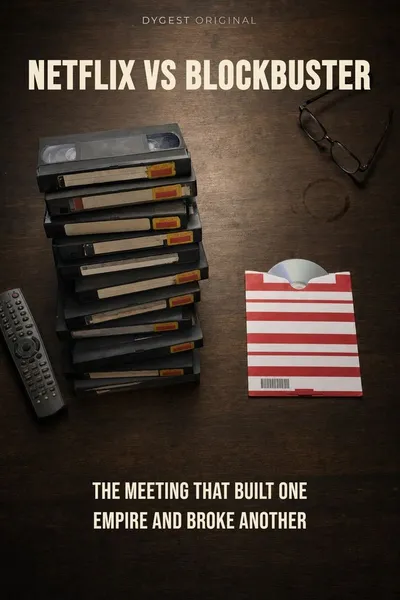
Netflix vs Blockbuster
The meeting that built one empire and broke another
Description
In the spring of 2000, a thirty-eight-year-old technology entrepreneur named Reed Hastings and his Netflix co-founder Marc Randolph flew from Silicon Valley to Dallas to meet with John Antioco, the CEO of Blockbuster Video. Netflix at that point was a small operation. It had been founded in 1997 around the idea of renting DVDs by mail, was burning through venture-capital money at substantial speed, and had been hit hard by the dot-com bust that was just beginning to unfold. Hastings and Randolph went to the meeting prepared to offer Netflix to Blockbuster for fifty million dollars. The plan, as they described it, was that Blockbuster would acquire Netflix, run it as the online division of the larger company, and combine the strengths of physical-store distribution with the new mail-order model that Netflix had been developing. Antioco listened. Antioco passed. The Netflix team flew back to California.
The decision Blockbuster made that afternoon in Dallas would become, over the following decade, one of the most quoted examples of corporate strategic failure in modern American business. By 2010, Blockbuster had filed for bankruptcy. By 2014, the last corporate-owned Blockbuster stores in the United States had closed. The company that had dominated video rental for two decades, with thousands of stores and a market capitalization that had peaked in the billions, was gone. Netflix, the small company Antioco had declined to buy, had grown into a publicly traded streaming company with a market value that, by the mid-2010s, exceeded what Blockbuster had been worth at its peak by an order of magnitude. By 2025, Netflix had a market capitalization north of two hundred billion dollars and three hundred million paying subscribers worldwide.
The standard reading of the story, which has circulated in business-school case studies and management books for fifteen years, is that Blockbuster failed because it could not adapt to a new technology, and that Netflix succeeded because it was willing to disrupt its own business model. The standard reading is partly right and partly misleading. The decision Antioco made in 2000 was not as stupid as the retrospective makes it sound. The transformation Netflix accomplished was not as clean as the retrospective makes it look. The actual story involves a longer set of choices, on both sides, that the simple disruption narrative tends to flatten.
The question we’re asking: what actually happened between Netflix and Blockbuster between 2000 and 2010, why did the established player lose, and what did the disruptor have to do to win?
What we’ll see: the Dallas meeting, the strategic situation each company faced, the streaming transition, and what the case actually shows about competition between incumbents and challengers.
Table of contents
01 A small DVD mailer and a national video chain
Netflix had been founded in 1997 by Reed Hastings and Marc Randolph in Scotts Valley, California. The founding myth, which Hastings has repeated in interviews, was that he had been charged forty dollars in late fees by Blockbuster for a copy of Apollo 13 he had returned past the due date. The myth is partly true. The actual founding involved a longer process of experimenting with mail-order DVD distribution, which became technically viable around 1997 as DVD began to replace VHS.
The DVD format was the technical opening Netflix exploited. DVDs were small enough to mail efficiently; VHS tapes were too bulky and expensive. Netflix’s original pay-per-rental business model required the new format to work. The shift from VHS to DVD gave Netflix a window in which it could build a mail-order rental operation the existing industry could not easily replicate.

02 Why Antioco passed on Netflix in 2000
The Dallas meeting was, by the standard accounts, brief and dismissive. Hastings and Randolph pitched the Netflix acquisition. Antioco asked about the company’s financials and growth projections. Netflix was losing money about $57 million in 1999 and was projecting continued losses for several years. The customer base was small, around 300,000 subscribers, against Blockbuster’s tens of millions of customers. The fifty-million-dollar asking price was, on the financial metrics Antioco was using, a substantial premium over what Netflix appeared to be worth as a pure financial asset. The strategic value Hastings was claiming — that mail-order DVD rental was the future of the industry was not obvious from Blockbuster’s vantage point in 2000.
The reasoning Antioco gave was defensible in context. Blockbuster had its own online experiment, Blockbuster.com, launched in 1998. The online business was small and unprofitable, but Blockbuster treated it as a strategic option rather than a core operation. The acquisition would have required committing to a mail-order model that would have cannibalized store revenue. The stores were profitable; the online business was not. The acquisition looked, from Antioco’s seat, like a substantial investment in a business that would damage the larger one.
03 The streaming transition and the Blockbuster collapse
The decade between 2000 and 2010 was when the strategic positions hardened. Netflix continued to grow its subscriber base through the early 2000s, reaching about a million subscribers by 2002 and going public that year at $15 per share. The DVD-by-mail business was profitable by 2003. The technology that would matter most, however, was not DVD-by-mail. It was streaming, which Netflix launched as a free supplement to the DVD service in 2007. The shift to streaming would, over the following five years, transform Netflix into a substantially different company from the one that had pitched itself to Blockbuster in Dallas.
Streaming had two structural advantages over DVD-by-mail. The first was unit economics: a streaming customer did not require physical distribution infrastructure, which meant the marginal cost of an additional customer was substantially lower than for DVD-by-mail. The second was content control: as Netflix’s streaming library grew, the company could negotiate licensing deals directly with studios and eventually produce its own content, reducing dependency on physical-media releases. By 2013, when Netflix released House of Cards as its first major original production, the company had become a producer of premium television rather than a distributor of physical discs.
04 What the case actually shows
The standard reading of the Netflix-Blockbuster story is that incumbents fail when they cannot adapt to disruptive technology. The reading is broadly correct but flattens some of what actually happened. Blockbuster did attempt to adapt. The Blockbuster Online service was a real attempt at DVD-by-mail. The Total Access program in the mid-2000s was a serious effort to combine online and in-store distribution in ways that Netflix could not match. The problem was not that Blockbuster failed to recognize the threat. The problem was that the corporate structure and the incentive system the company had inherited could not support the kind of commitment that competing with Netflix would have required.
The Netflix side of the case is also more complicated than the disruption narrative suggests. The transition from DVD-by-mail to streaming was not smooth. The 2011 attempt to split the two businesses into separate brands, with the DVD operation renamed Qwikster, was a near-disaster; the company lost roughly 800,000 subscribers in a quarter and had to reverse the split within weeks. The streaming transition required substantial capital investment, repeated strategic bets, and a continuous willingness to cannibalize the existing business model that Netflix itself only barely managed. Hastings’s later memoir No Rules Rules described the Qwikster episode and several other near-misses with unusual honesty.
05 Conclusion
John Antioco left Blockbuster in 2007, before the bankruptcy. He has occasionally commented on the Netflix decision in subsequent interviews, generally defending the strategic logic while acknowledging that the outcome was the wrong one. Reed Hastings stepped down as Netflix CEO in 2023, having built the company over twenty-five years into one of the most valuable media operations in the world. Marc Randolph, the Netflix co-founder, left the company in 2003 and has spent the years since giving talks about the founding and writing his memoir.
Related books