

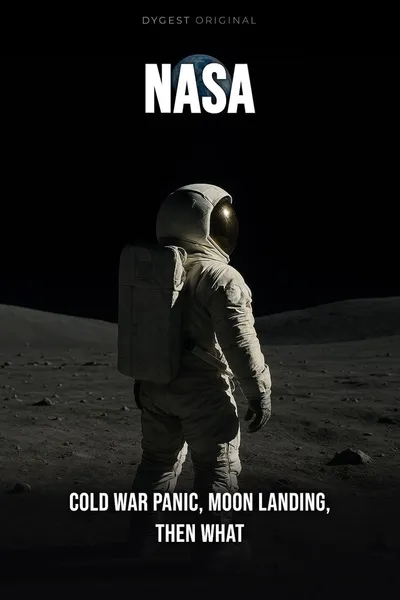
NASA
Cold War panic, Moon landing, then what
Description
Introduction
On October 4, 1957, a Soviet rocket placed a metal sphere about the size of a beach ball into low Earth orbit. Sputnik 1 weighed 84 kilograms, broadcast a radio beep on two frequencies, and completed a full orbit of the Earth every 96 minutes. It did nothing else. But for the United States government and public, the beep was a demonstration that the Soviet Union could put objects including, presumably, nuclear warheads into space above American cities. The reaction in Washington was somewhere between alarm and panic.
Less than a year later, in July 1958, Congress passed the National Aeronautics and Space Act, creating the National Aeronautics and Space Administration (NASA). The agency absorbed the existing National Advisory Committee for Aeronautics and several military research programs. It had a budget, a mandate, and an urgency that had nothing to do with scientific curiosity and everything to do with Cold War prestige. Within three years, President John F. Kennedy would commit the country to landing a man on the Moon before the end of the decade a goal so ambitious that the technology to achieve it did not yet exist.
What followed was one of the most concentrated feats of institutional engineering in history. NASA went from having no astronauts to landing two of them on the Moon in eight years. Then the finish line disappeared. The question of what NASA is, what it is for, and why it has never quite recaptured the clarity of the Apollo era is one that the agency and the country has been working through ever since.
The question we're asking: how did a civilian agency built around a single impossible goal become one of the most complex institutions in American government and what happens to an organization when its defining mission is complete?What we'll see: the political logic behind the Moon race, the engineering achievement that made it real, and the fifty years of institutional drift that followed.
Table of contents
01Sputnik changes the terms
Sputnik shocked the American political establishment not because anyone had thought space was uncontested, but because the Soviet achievement came earlier and looked more capable than American intelligence had expected. The Eisenhower administration had its own satellite program Vanguard but it was a civilian project, deliberately kept separate from military rockets, and it was running behind schedule. When Vanguard attempted its first launch in December 1957, two months after Sputnik, the rocket rose four feet off the pad and exploded. The footage played on television around the world.
The political pressure on Eisenhower was considerable. Congressional hearings generated alarming language about a "missile gap" the claim, promoted by Democratic senators including the young John Kennedy, that the Soviet Union had surpassed the United States in ballistic missile capability. The gap was largely fictional: U-2 spy plane overflights had given the CIA a reasonably accurate picture of Soviet missile programs, and the picture was not as threatening as the headlines suggested. But classified intelligence did not circulate in Senate chambers, and the narrative of American vulnerability had taken hold.

02The decade the US decided to go to the Moon
The Apollo program's engineering challenge was not one problem but several thousand, nested inside each other. The Saturn V rocket that would carry the Apollo spacecraft to the Moon was, at launch, the most powerful machine ever built — 363 feet tall, generating 7.6 million pounds of thrust at liftoff. It had been designed by a team led by Wernher von Braun, a German engineer who had designed the V-2 ballistic missile during World War II and was brought to the United States afterward under Operation Paperclip.
At its peak in the mid-1960s, the Apollo program employed roughly 400,000 people across NASA and its contractors. The budget reached $4.4 billion in fiscal year 1966 — about 4.4 percent of total federal spending that year, a proportion that has never been approached since. NASA had to invent or refine technologies across materials science, computer systems, life support, navigation, and propulsion simultaneously, under a deadline imposed by a presidential speech rather than by engineering readiness.
03July 20, 1969, and the morning after
Between July 1969 and December 1972, twelve American astronauts walked on the Moon across six missions. Apollo 13, in April 1970, suffered an oxygen tank explosion en route and returned safely through improvised engineering that became one of NASA's most celebrated episodes. The remaining missions carried increasingly sophisticated equipment: rovers, geology tools, seismometers. The program ultimately returned 842 pounds of lunar samples and changed the scientific understanding of the Moon's formation.
Apollo 17, in December 1972, was the last. Nixon had already cancelled Apollos 18, 19, and 20 in 1970, redirecting resources toward the Space Shuttle, which his administration had approved in 1972. The Shuttle was conceived as a reusable, cost-efficient successor to Apollo a workhorse rather than a monument. It would fly to low Earth orbit, deploy satellites, support a space station. The economics were supposed to make access to space routine. They did not: the Shuttle cost far more per flight than its designers had projected, and the reusability savings never materialized at the predicted scale.
04What happens when the finish line disappears
NASA's post-Apollo history is sometimes read as a story of decline of an agency that peaked in 1969 and has been managing its legacy ever since. That reading underestimates what NASA has done: the Voyager probes, launched in 1977, are still transmitting data from interstellar space. The Mars rovers have rewritten the understanding of that planet's geology. The James Webb Space Telescope, deployed in December 2021, is producing images of galaxies formed 200 million years after the Big Bang. The science has continued at a high level.
What NASA lost after Apollo was not capability but clarity. The Moon was a finish line visible to everyone, including people who had no particular interest in space. It was legible as a goal in a way that "expand scientific knowledge of the outer solar system" is not. The political coalition that funded Apollo Cold War urgency, presidential commitment, bipartisan competition with the Soviet Union dissolved when the Soviets lost the Moon race and the Vietnam War consumed the country's attention and budget. What remained was an agency looking for an equivalent organizing purpose and not finding one.
05Conclusion
The metal sphere that started everything, Sputnik 1, stayed in orbit for three months before atmospheric drag pulled it back and it burned up on reentry in January 1958. It had done exactly what it was designed to do: demonstrate that the Soviet Union could put something into space. It did not anticipate what that demonstration would set in motion the agency it would create, the Moon it would compel Americans to reach, the half-century of institutional history that would follow from a beach ball beeping over American cities.