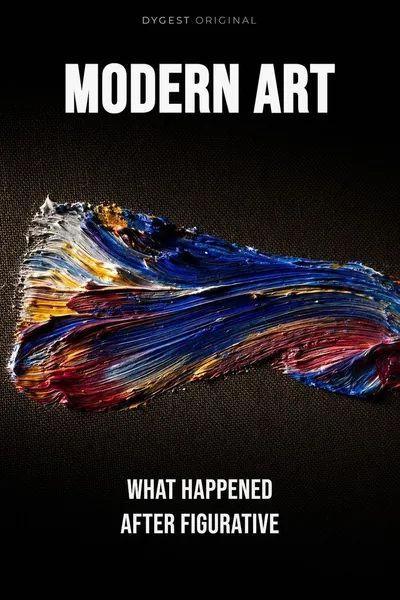
Modern art
What happened after figurative
Description
For most of European art history, a serious painting was expected to do roughly the same thing: render a recognisable scene with technical skill, organise the composition according to a set of conventions inherited from the Renaissance, and convey a subject religious, mythological, historical, occasionally portrait or still life that justified the work being made. The institution that maintained these expectations was the Academy, in Paris and similar bodies elsewhere, which trained painters, ran the major exhibitions, and decided which work was acceptable. From roughly 1860 onward, that whole system started coming apart.
The story of modern art is the story of what happened after. It is not, despite some popular accounts, a story of artists abandoning skill or refusing to make pictures of things. Most of the painters in the early modern movements could draw a face better than most working illustrators today. They had decided, for reasons internal to the art and for reasons connected to a changing society, that the conventions they had been trained in were no longer the conventions worth defending. What replaced them was not a single new style but a long sequence of movements, each one reacting to the last.
By the 1960s the sequence had reached a place where the question of what counted as art had become itself the central artistic question. From there, the contemporary art world emerged as something that runs less like an aesthetic field and more like a financial market with curators attached. That trajectory is worth tracing without either the my-kid-could-do-that dismissal or the gallery-statement reverence. What actually happened is interesting enough.
The question we're asking: what modern art was reacting against, and how it became what it is now.
What we'll see: Manet's break, the early movements, Duchamp's turn, and the contemporary market.
Table of contents
01Manet and the break
The conventional starting point for modern painting is Édouard Manet, and specifically two paintings he made in the early 1860s. Le Déjeuner sur l'herbe in 1863 showed a naked woman picnicking in a Paris park with two clothed men. Olympia in 1865 showed a contemporary Parisian prostitute reclining on a bed, looking directly at the viewer. Both were rejected by the Salon or hung in places where they would be ridiculed, and both produced a level of public outrage that is hard to imagine now. The paintings were treated as scandalous, ugly, technically incompetent, and morally degraded.
What was actually scandalous about them was harder to say. Nudes had been a staple of Salon painting for centuries. The complaint was that Manet had painted contemporary women, in contemporary settings, without the mythological or historical framing that gave traditional nudes their respectability. Olympia was a real woman, on a real bed, looking like she knew what kind of transaction she was in. The painting offered none of the smoothing distance that classical nudes provided. It also had a flat, unmodulated treatment of skin and shadow that the Academy took as evidence the artist could not paint properly.

02From Cubism to abstraction
The decades around 1900 produced a series of movements that pushed further away from what the Academy had taught. Cézanne, working largely in isolation in the south of France, was building paintings out of small planes of colour that suggested form without representing it conventionally. Van Gogh and Gauguin were using colour as an emotional rather than descriptive element. The Fauves around 1905 Matisse, Derain pushed colour to a point where it had detached almost entirely from the local colour of objects. Each of these moves was a step further from the assumption that a painting should look like the thing it depicted.
Cubism, developed by Picasso and Braque in Paris between 1907 and roughly 1914, was the decisive break. The Cubists took the implications of Cézanne's late work and asked what would happen if a painting tried to show an object from several perspectives simultaneously, on a flat canvas, without the illusion of three-dimensional space the Renaissance had developed. The early Cubist paintings are recognisably representational guitars, bottles, faces but the perspective is fragmented and the surface insists on its flatness. By the late phase of analytic Cubism, the subject is sometimes nearly indecipherable. The grammar of European painting had been rewritten in about seven years.
03Duchamp and the conceptual turn
Marcel Duchamp belongs in his own chapter because what he did was different in kind from what the painters around him were doing. In 1917 he submitted a porcelain urinal, signed R. Mutt, to an open-submission exhibition in New York under the title Fountain. The work was rejected. Duchamp's point was that the rejection itself, and the question of why the rejection was justified, was the artistic content. He had taken an industrial object, declared it art, and forced the institution to decide what it would do.
The category Duchamp invented was the readymade the artwork made by an act of selection rather than an act of fabrication. The bicycle wheel mounted on a stool, the bottle rack, the snow shovel hung from the ceiling. None of these required any of the skills the Academy had been training painters to acquire. What they required was the artist's decision that this object, in this context, was art. The implications of this move were not fully absorbed in Duchamp's lifetime. They became central to art half a century later.
04The art world as market
The contemporary art world, from roughly the 1980s to now, operates under conditions that are different from any earlier period of art history. The major institutions the museums, the international biennials, the auction houses, the mega-galleries, the art fairs handle volumes of money that put the field closer to luxury goods or finance than to the small-scale dealer system that supported the early modernists. A single Basquiat can sell for over a hundred million dollars. The sums involved have aesthetic consequences.
The market does several things to the work. It rewards artists whose output is recognisable enough to be branded a Koons is a Koons, a Hirst is a Hirst and the recognisability becomes part of the value. It concentrates attention on a small number of names whose prices keep rising, while the larger field of working artists is mostly invisible to it. It treats art as an asset class, suitable for storage in freeports and movement between tax jurisdictions, which is a use of art that previous centuries did not have a category for. None of this is necessarily a crisis but it is a structural fact about how the field now works.
05Conclusion
Modern art is sometimes described as a long retreat from skill, or a hoax the market sustains for its own reasons. Both descriptions miss what actually happened. The form was reacting to a specific institutional structure the Academy and its conventions and once that structure lost its authority, the field had to work out what it was for. The answer was not a new orthodoxy but an open territory in which the question of what art could be became part of what art did.
Related books