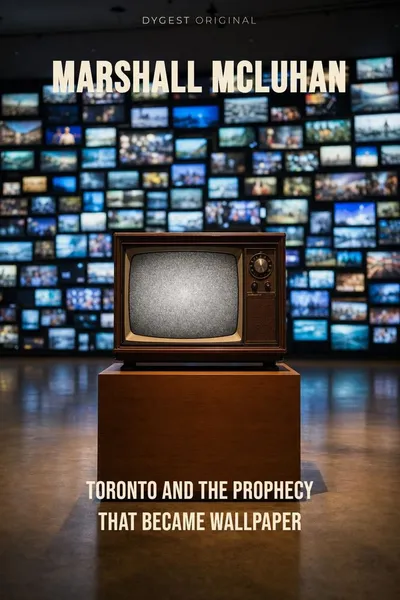
Marshall McLuhan
Toronto and the prophecy that became wallpaper
Description
In 1964, a fifty-three-year-old English professor at the University of Toronto named Marshall McLuhan published Understanding Media: The Extensions of Man. He had spent most of his career teaching Renaissance literature at Canadian universities. The book ran to over three hundred pages of dense, deliberately disorienting prose and proposed a theory of communication technology that would transform how an entire generation thought about media. Within three years, McLuhan was on the cover of Newsweek and had become to the bewilderment of his colleagues the most quoted intellectual of the late 1960s.
The book’s most famous claim, the medium is the message, became one of the most repeated and least understood phrases of the postwar period. The argument was that the specific technology that delivered a message the printed page, the radio broadcast, the television screen, the telephone wire shaped what could be communicated and what could be received, in ways that operated below the level of content. The reader who consumed a novel was being shaped by the form of the novel itself, not just by what the novel said. The viewer who watched television was being shaped by the structure of television, regardless of what particular program was on the screen. The argument was simple in outline and difficult to internalize, and the difficulty was part of what gave it its long career.
McLuhan’s reputation rose and fell sharply across the late 1960s and 1970s. By 1968 he was the most discussed media theorist in North America. By 1980, the year of his death, he had been declared a fraud, an outdated showman, a man whose ideas had not survived their decade. The reversal was almost complete. The phrase the medium is the message remained in the language, but it had become wallpaper — a cliché whose origin few users could place and whose meaning fewer could articulate. The internet revival of the 1990s rehabilitated McLuhan in ways that nobody had predicted. The argument he had been making about how technologies shape consciousness turned out to fit the digital era with surprising precision, and the figure who had been declared obsolete became, in a different idiom, one of the most cited theorists of the platform age.
The question we’re asking: what did McLuhan actually argue in Understanding Media, how did the argument get reduced to a slogan, and what is left of the framework after the digital revival?
What we’ll see: the Toronto context, the argument the book made, the rise and fall of the public McLuhan, and the unexpected return.
Table of contents
01 A Renaissance scholar in postwar Toronto
Herbert Marshall McLuhan had been born in Edmonton in 1911 and had taken a PhD from Cambridge in 1943 on the Elizabethan rhetorician Thomas Nashe. His early career was in Catholic universities, focused on Renaissance literature and the history of rhetoric. He had converted to Catholicism in 1937 and remained devout, a fact that shaped his thinking in ways his secular readers often missed.
The intellectual turn that produced Understanding Media began in the late 1940s, when McLuhan became interested in advertising as a cultural form. His first book, The Mechanical Bride (1951), analyzed magazine ads as if they were Renaissance emblems assembling visual elements to produce affective responses below the level of conscious reading. The book was a commercial failure but laid the groundwork for what followed.

02 The argument the book actually made
Understanding Media organized its argument around a distinction between hot and cold media. Hot media, in McLuhan’s terminology, were those that filled the senses with high-definition information and required little participation from the receiver: film, radio, the printed book. Cold media required active participation to complete: television, the telephone, the comic strip. The distinction was meant to identify a specific feature of each medium that operated independently of what the medium was used to say, and the feature shaped what kinds of consciousness the medium produced in its users.
The famous phrase, the medium is the message, was the compressed statement of the broader argument. Each medium of communication, McLuhan argued, has a specific effect on the people who use it, an effect that operates regardless of the content the medium is carrying. Television produces certain habits of attention, regardless of whether the programming is news or game shows. The newspaper produces a different set of habits, regardless of whether the articles are political or sports. The printed book produces still others. The content of any given medium is, in this framing, a kind of distraction that prevents the user from seeing the real effects of the medium itself.
03 The rise, the fall, and the rediscovery
The years between 1965 and 1970 were McLuhan’s public peak. He was profiled in Newsweek, interviewed at length by Playboy, brought to New York to advise media companies, and consulted by the Nixon and Trudeau governments. The phrase the medium is the message appeared on bumper stickers, in advertising copy, in college courses across North America. McLuhan developed a public performance style combining Catholic conservatism, paradoxical pronouncements, and a deliberately oracular delivery. Tom Wolfe wrote an essay asking “What if he is right?”
The decline began almost as suddenly. By the early 1970s, McLuhan’s appearances had become repetitive. The next book, The Medium is the Massage, was a collage of images and aphorisms produced with Quentin Fiore. Critics began to point out that McLuhan’s empirical claims often did not hold up, that his hot/cold distinction was inconsistently applied, and that the broader argument tended to dissolve into aphorism. By the time he died in 1980, the standard verdict was that he had been a brilliant performer whose ideas had not aged well.
04 What survives in the digital era
The contemporary applications have come from unexpected directions. The argument that the structure of social media — the feed, the like, the rapid context-switching — shapes attention regardless of content has become foundational to the current critique of digital platforms. The observation that television produces a different consciousness than print, which seemed grandiose in 1964, has been replaced by the observation that smartphones produce a different consciousness than television, which seems straightforward in 2025.
The specific concept of the global village, which McLuhan introduced in The Gutenberg Galaxy, has been used and misused continuously since the rise of the internet. McLuhan had used the phrase to describe the conditions of electronic immediacy that he saw forming around him, in which events on the other side of the world could be experienced almost as if they were local. The phrase has been repurposed to celebrate the connectivity of the digital age and to lament the polarization of the digital age, often by the same commentators. The original argument was more ambivalent than either use; McLuhan thought the global village would produce closer connections and more violent conflict, and he was largely correct on both counts.
05 Conclusion
Marshall McLuhan died in Toronto on the last day of 1980, at the age of sixty-nine. He had spent his last decade in declining health and in declining public attention, watching the framework he had developed pass out of fashion. He did not live to see the digital revival of his work, which would begin a little over a decade after his death and which would restore him, in modified form, to the canon of communication theory.
Related books