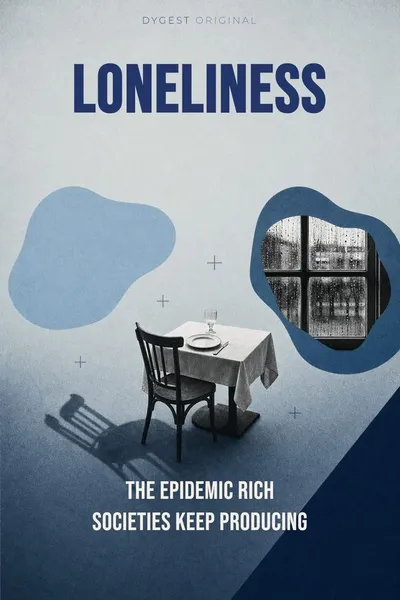
Lonelisness
The epidemic rich societies keep producing
Description
In 2023, the US Surgeon General Vivek Murthy issued an advisory declaring loneliness a public health crisis. Roughly half of American adults reported regular feelings of loneliness, with rates highest among young adults (aged 18-24) and older adults (65+). The UK had already appointed a Minister for Loneliness in 2018 in response to similar findings. Japan followed in 2021. Loneliness has become one of the few public-health issues that multiple developed countries have elevated to the level of formal state response, and the response reflects accumulating evidence that persistent loneliness produces measurable harm — higher mortality, more cardiovascular disease, more dementia, worse mental-health outcomes — at scales comparable to major medical risk factors.
The paradox is that these are the wealthiest societies in human history, with the most advanced communication technology ever available, more hours of free time than previous generations enjoyed, and more explicit cultural emphasis on individual fulfillment. Yet the populations within them report escalating loneliness, weaker social connections, and declining social trust. The specific combination of material abundance and relational poverty is not unique to contemporary America, but it is particularly pronounced there, and the pattern suggests that economic development and social connection are not automatically positively correlated. At some level of prosperity, wealth appears to undermine the conditions under which close connections naturally form.
Understanding loneliness — what it is, why it has risen, what effects it produces, and what might reverse the trend — is among the more important social questions of the current moment. The research has accumulated enough to support specific conclusions, and the conclusions are strong enough that policy responses have begun. Whether the responses will be adequate to the scale of the problem, or whether loneliness will continue to rise as the structural features producing it continue to deepen, is the specific question the next few decades will answer.
● The question we're asking: what is loneliness, why has it risen in wealthy societies, and what would reversing the trend require?
● What we'll see: the clinical definition, the scale of the problem, the specific causes, and the health and social consequences.
Table of contents
01What loneliness is
Loneliness is defined in the research literature as the subjective experience of having fewer or less satisfying social connections than one wants. It is distinct from objective social isolation (actually having few social contacts) in that a person can feel lonely while surrounded by people, or feel connected while largely alone. The subjective and objective measures correlate but are not identical; what matters for most psychological and health outcomes is the subjective experience rather than the raw count of social contacts. This distinction has practical implications for interventions — simply increasing the number of social contacts does not reliably reduce loneliness if the new contacts do not feel meaningful.
Loneliness has multiple dimensions. Emotional loneliness is the lack of a close attachment relationship — a best friend, romantic partner, or confidant. Social loneliness is the lack of a broader social network — friends, colleagues, community. Existential loneliness is the sense of fundamental separateness from others regardless of specific relationships. The three dimensions are partially independent. A person can have a strong primary attachment but feel socially isolated, or be well-integrated into a community while lacking close intimate connections. Each dimension produces somewhat different effects and responds to somewhat different interventions.

02The scale
Surveys across developed countries show substantial loneliness rates. In the US, roughly half of adults report feeling lonely at least sometimes. The Cigna Loneliness Index in 2018 found that younger generations were lonelier than older ones — Generation Z (at that time aged 18-22) reported the highest loneliness scores of any age group, reversing the traditional pattern in which older adults were assumed to be the loneliest population. The pandemic amplified the pattern; post-2020 surveys found further increases, particularly among young adults and those with limited pre-existing social networks.
The United Kingdom has been measuring loneliness systematically since the 2010s. The Campaign to End Loneliness reports that roughly 45% of UK adults occasionally, sometimes, or often feel lonely, and that approximately 7% feel lonely often or always. The Jo Cox Commission on Loneliness, established after the MP's murder in 2016, documented the specific harms and produced the policy response that became the Loneliness Ministry. Similar patterns exist in most developed Western countries. Northern European countries tend to have somewhat lower loneliness rates than the US, but the differences are modest.
03The specific causes
Several specific structural changes have contributed to the loneliness increase. Household composition has shifted dramatically — single-person households have roughly doubled since the 1960s in most developed countries, reflecting later marriage, higher divorce, lower fertility, and longer lifespans. Living alone does not automatically produce loneliness, but it removes the automatic daily contact that multi-person households provide. Urbanization has separated many adults from the families and communities they grew up in, often substituting weak-tie urban relationships for the strong-tie kinship relationships earlier generations had. Geographic mobility for work has accelerated this pattern.
Workplace changes have affected the pattern as well. Remote work, accelerated by the pandemic and continuing at substantial rates since, has removed the office-based social connections that were a major source of adult friendship for previous generations. Gig and contractor work increases income flexibility but reduces the specific workplace relationships that produce sustained connections. Longer working hours for high-income professionals reduce the time available for non-work social connection. The specific employment arrangements of the past two decades have, on average, reduced workplace-based social integration for many workers.
04The consequences
The health consequences of chronic loneliness are substantial. Meta-analyses consistently find that loneliness increases mortality risk by roughly 25-30%, comparable to smoking fifteen cigarettes per day. Cardiovascular disease risk rises substantially among lonely individuals. Dementia risk is elevated. Depression, anxiety, and suicidal ideation are more common. The immune system function is compromised, making infections more likely and more severe. The specific mechanisms linking loneliness to these outcomes involve chronic stress physiology, reduced sleep quality, poorer health behaviors (lonely individuals exercise less and eat worse), and reduced access to the practical support that partners and friends provide in health crises.
The economic costs are substantial enough to have been calculated. UK estimates suggest loneliness costs employers billions of pounds annually in reduced productivity, absenteeism, and turnover. Healthcare costs for lonely adults exceed costs for similarly-healthy connected adults. The aggregate economic burden is hard to estimate precisely but is clearly substantial — comparable to costs associated with major physical-health risk factors. This dimension is part of why governments now treat loneliness as a policy issue rather than a purely personal one.
05Conclusion
Loneliness has emerged as a major public-health and social issue in developed Western societies, with rates that have risen substantially over recent decades and health consequences comparable to major medical risk factors. The specific combination of structural changes — smaller households, geographic mobility, declining civic institutions, remote work, smartphone-mediated social time — has produced an environment in which loneliness is harder to avoid than it was in previous generations. The policy and cultural responses have begun but remain substantially smaller than the scale of the problem, and it is not yet clear whether the current trajectory will reverse or continue.
Related books