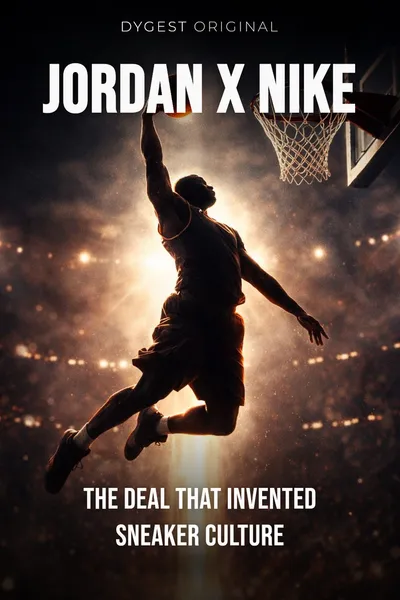
Jordan x Nike
The deal that invented sneaker culture
Description
In the fall of 1984, a twenty-one-year-old guard out of North Carolina walked into a meeting he did not want to attend. Michael Jordan had just been drafted third by the Chicago Bulls, and his heart was set on Adidas — the brand he actually wore, the one he'd grown up on. Nike, at the time, was a running-shoe company in trouble. It had missed the aerobics boom, laid off staff, and watched its stock slide. Basketball was an afterthought. Jordan's own agent, David Falk, had to push him into the room, and the story goes that his parents more or less made him go. He listened, unconvinced, to a pitch from a company he considered a distant third choice.
What came out of that room was a five-year deal worth roughly $2.5 million, plus something almost nobody in sports had been offered before: a signature shoe with the athlete's own name on it, and a royalty on every pair sold. Nike bet the basketball line on one rookie who had not yet played a professional game. Within its first year on the market, the Air Jordan line reportedly brought in over $100 million. The company that was supposed to be dying instead found the thing that would define it for the next forty years.
The deal is remembered as a great business decision, which it was. But it did more than sell shoes. It changed what an endorsement could be, what a player was worth off the court, and eventually how athletes think about the difference between being paid and owning a piece of what they build. Sneakers stopped being footwear and became identity, collectibles, culture — a market that now moves tens of billions of dollars a year, traced back to one reluctant meeting.
The question we’re asking : How did a rejected pitch to a reluctant rookie end up rewriting the relationship between athletes, brands, and the value they generate?What we’ll see : We follow the deal from the room Jordan didn't want to enter to the moment the model flipped — when the athlete stopped renting his name and started owning the line.
Table of contents
01Chapter 1 — A rookie who wanted Adidas
The Nike of 1984 was not the Nike of the imagination. It had gone public in 1980, ridden the running craze, and then stumbled badly when Reebok read the aerobics market better and left it behind. Revenue was sliding, morale was low, and the company that would later seem invincible was quietly worried about its future. Basketball, in particular, was a category Nike barely competed in. Converse owned the sport's history, Adidas owned its cool, and Nike owned neither.
Michael Jordan wanted no part of the pitch. He was an Adidas loyalist, and he'd told anyone who asked that he'd take a smaller check to wear the three stripes. Adidas, for reasons that still look baffling in hindsight, never made a serious counteroffer — the company was in disarray after the death of its founder and unable to move. Converse, the other logical suitor, treated Jordan as one more talented rookie to slot behind Magic Johnson and Larry Bird. Nobody with the obvious advantage seemed hungry for him.

02Chapter 2 — The banned shoe that Nike couldn't lose with
The first Air Jordan hit the market in 1985, and it broke one of basketball's quiet rules. NBA shoes at the time were mostly white, and the league had a uniformity policy about on-court footwear. The Jordan design came in bold black and red — the Bulls' colors — and looked nothing like what players were supposed to wear. The NBA reportedly told Jordan the shoes violated its rules and could not be worn in games.
Nike understood, almost immediately, what it had been handed. It kept putting Jordan in the shoes, absorbed the fines the league levied, and built an entire advertising campaign around the controversy. The commercials showed the shoe with black bars slamming across the screen and a voice explaining that the NBA had banned it — so, the ad implied, you should buy a pair. A prohibition had been turned into the best marketing copy money couldn't buy. There is some debate about which exact model was actually banned, but the campaign made the distinction irrelevant; the story sold the shoe.
03Chapter 3 — From product to persona
The genius of what came next was that Nike stopped selling a shoe and started selling a character. Air Jordan wasn't a model number that got replaced each season and forgotten. It became a persona with its own logo — the Jumpman silhouette, lifted from a photograph of Jordan mid-leap — that could outlive any single design and any single game. Each year brought a new numbered edition, and each edition became an event, treated less like a purchase than a release.
Advertising built the world around it. The pairing of Jordan with the filmmaker Spike Lee, playing his character Mars Blackmon, gave the brand a voice and a wink — 'It's gotta be the shoes.' The ads didn't argue that the sneakers made you a better player. They suggested that they connected you to something: to Jordan, to a certain idea of style, to a scene. That was a shift in what an endorsement did. It no longer said 'a great player uses this.' It said 'this is who you could be near.'
04Chapter 4 — When the athlete owns the upside
Step back from the shoes and the deal starts to look like a hinge in the history of sports money. Before Jordan, the standard endorsement was a flat fee: a brand paid an athlete a set sum to wear its logo, and whatever value that generated flowed almost entirely to the brand. The athlete rented out his name for a season or two and moved on. What Nike offered instead — a royalty on every pair — quietly reframed the athlete not as a paid spokesman but as a stakeholder in the thing being sold.
That distinction turned out to matter enormously. Because Jordan earns a cut of Jordan Brand's sales, his income from Nike has continued long past his playing days and now reportedly runs into hundreds of millions of dollars a year — dwarfing anything he made shooting a basketball. The lesson wasn't lost on the athletes who came after. The most valuable thing a superstar can negotiate is not the size of the check but a share of the value his name creates over time.
05Conclusion
The whole thing began with a rookie who didn't want to be in the room, pitched by a company that was afraid of going under. Nike bet everything it had in basketball on Michael Jordan, dressed him in a shoe the league tried to ban, and turned a footwear line into a persona that outgrew the sport. Forty years on, the Jordan Brand still sells billions of dollars a year, long after the player retired, carrying a logo taken from a single leap.
Related books