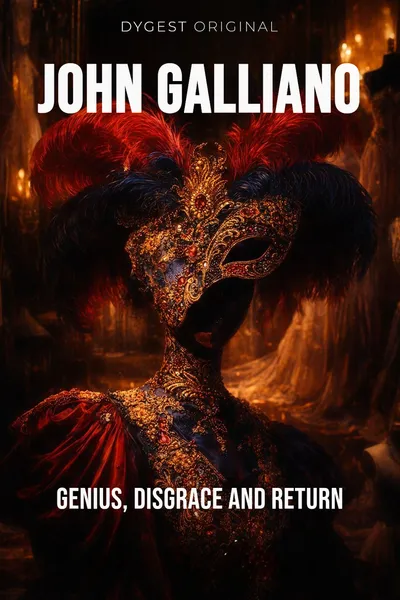
John Galliano
Genius, disgrace and return
Description
On a February night in 2011, at a bar called La Perle in the Marais district of Paris, John Galliano — then the creative director of Christian Dior and one of the most celebrated designers alive — was filmed by another patron leaning across a table and slurring an antisemitic tirade. The clip was short and ugly. Within days it had crossed the planet, dragging up an earlier complaint from the same bar. Dior suspended him almost immediately, then fired him. Natalie Portman, who had just won an Oscar as the face of a Dior fragrance, publicly distanced herself. A man at the very top of couture was, within a week, professionally finished.
That would be a simple story of disgrace, except that it isn't where the story ends. Galliano stood trial in Paris in 2011, was convicted of making public insults on the grounds of religion and origin, and paid a symbolic fine. He disappeared. He talked about the alcohol and the pills, about the collapse he had been carrying for years. And then, slowly, fashion began to wonder aloud whether he might come back — and, more quietly, whether it wanted him to.
He did come back. In 2014 he took over the small, cerebral house of Maison Margiela, and over the following decade rebuilt a reputation that most people assumed was gone for good. The arc — Gibraltar boy to Dior king to pariah to redeemed craftsman — is one of the strangest career shapes modern fashion has produced, and it keeps raising a question the industry has never quite answered out loud.
The question we’re asking : How does a talent get destroyed by his own words and then be handed one of the most prestigious jobs in the business a few years later?What we’ll see : A rise built on pure theatrical invention, a public unravelling, and a rehabilitation that says as much about the industry as about the man.
Table of contents
01Chapter 1 — The boy from Gibraltar who redrew the runway
Juan Carlos Antonio Galliano Guillén was born in Gibraltar in 1960, the son of a Spanish mother and a Gibraltarian plumber, and moved to south London as a child. He grew up Catholic, working-class, and — by his own account — an outsider twice over, a Mediterranean kid in Battersea who learned early that clothes could be armour and performance at once. He enrolled at Central Saint Martins, then already the most feared design school in Britain, and in 1984 presented a graduate collection called Les Incroyables, inspired by the dandies of the French Revolution.
That graduation show did something graduation shows almost never do: it sold out. Browns, the influential London boutique, bought the entire collection and put it in the window. Overnight, Galliano went from student to the name every fashion editor wanted to watch. What set him apart was not restraint but its opposite — a historical imagination that ransacked the past for bias-cut gowns, tricorne hats, and slashed eighteenth-century silhouettes, then staged them like theatre rather than merely showing them.

02Chapter 2 — The house that couture built around him
The person who bet on Galliano was Anna Wintour, the editor of American Vogue, who used her considerable pull to help find him backing and a platform. In 1995 the luxury conglomerate LVMH, run by Bernard Arnault, appointed him head of Givenchy — the first British designer to lead a French couture house. It was a startling promotion for a designer who had spent a decade nearly broke. A year later, Arnault moved him to the crown jewel: Christian Dior.
At Dior, Galliano had, for the first time, the resources to match his imagination, and the results were extraordinary. His couture shows became the most anticipated events on the calendar — spectacles staged in circus tents and abandoned stations, models transformed into geishas, empresses, and figures from Klimt paintings. He mined the house archive for its founder's New Look and then blew it up into something operatic. For a stretch of the late 1990s and 2000s, a Galliano show was the closest fashion came to opera.
03Chapter 3 — Twenty minutes on camera, thirty years erased
The eruption came at La Perle in February 2011. In footage recorded on a phone, a visibly intoxicated Galliano told the people at the next table that he loved Hitler and that people like them would be gassed. It was grotesque, and there was no ambiguity in it. An earlier complaint from the same bar surfaced alongside the video. Whatever context his defenders would later reach for — the addiction, the collapse — none of it softened the words themselves, which were as plain as they were vile.
Dior acted with a speed that reflected exactly how much was at stake. The house suspended him within a day and dismissed him within a week, stripping his name from a role he had defined for fifteen years. Sidney Toledano, then Dior's chief executive, condemned the remarks unequivocally. The timing sharpened everything: it was couture season and Oscar season at once, and Natalie Portman, the Dior perfume face who won her Academy Award days later, said she was deeply shocked and would not be associated with him.
04Chapter 4 — The long road back through Margiela
The first tentative signal came from Oscar de la Renta, the American designer, who in 2013 quietly gave Galliano a residency in his New York atelier — a gesture of rehabilitation from a man widely respected and, notably, Jewish, which many read as a deliberate act of forgiveness with weight behind it. It tested the water. The water held. A year later, in 2014, the OTB group appointed Galliano creative director of Maison Margiela, the Belgian-founded house known for its intellectual, deconstructed anonymity — about as far from Dior's spectacle as fashion gets.
The choice was shrewd. Margiela was small, artful, and self-serious; it offered Galliano a place to work rather than a stage to perform on, and it let him prove the craft was still there without the glare. Over the following decade he rebuilt slowly, and in January 2024 his Artisanal couture show for Margiela — a haunting, porcelain-skinned collection staged under a Paris bridge — was received as one of the great shows of the era, the kind of unanimous acclaim that effectively closed the loop on his exile.
05Conclusion
The man filmed slurring at La Perle in 2011 and the man who staged the acclaimed Margiela couture show in 2024 are the same person, and the distance between those two nights is the whole story. Galliano got sober, stayed largely out of public argument, and let the collections speak — first from the quiet of an atelier, then from the top of a house again. The path back ran precisely through the thing that had made him famous before it made him untouchable: the work itself.
Related books