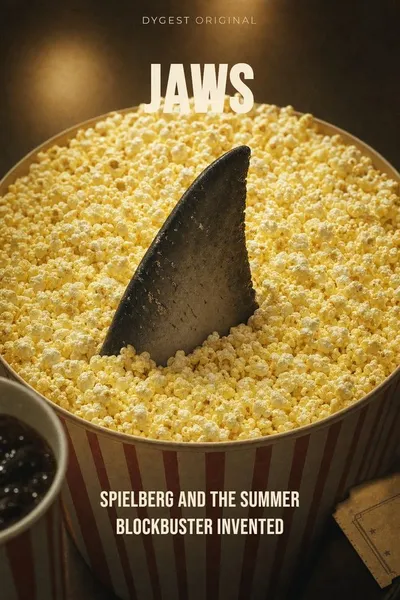
Jaws
Spielberg and the summer blockbuster invented
Description
In the summer of 1974, a twenty-six-year-old director named Steven Spielberg arrived on Martha’s Vineyard with three mechanical sharks named Bruce and a budget Universal Pictures had already begun to regret. The shoot was scheduled for fifty-five days. It ran for one hundred and fifty-nine. The mechanical sharks broke constantly. The salt water corroded the equipment. By the middle of the shoot, the production was being called “Flaws” within the studio. Spielberg later said he was convinced for most of 1974 that the film would end his career.
What was filmed at Martha’s Vineyard, against the schedule and against the limitations of the broken equipment, became one of the most consequential films in the history of American cinema. Jaws opened on June 20, 1975, in 464 theaters across the United States, and within seventy-eight days it had become the highest-grossing film ever made. The performance did more than reset box-office records. It changed how studios distributed films, when films were released, what kinds of films were prioritized for production, and how cinema would be financed for the next fifty years. The summer blockbuster, as a category of American entertainment, did not exist before Jaws. After Jaws, it was the dominant commercial form of the medium.
The cultural reading of the film has had two phases. The early reading celebrated Jaws as the high point of a young director’s craft, an unusually well-made suspense film that the marketing department had successfully launched. The later reading, particularly since the 1990s, has identified the film as the founding moment of a structural shift in Hollywood that has produced both its biggest commercial successes and most of its current institutional problems. The argument worth tracking is that Jaws did not just succeed; it taught the studios a lesson about how to succeed that the studios then applied for the next half-century.
The question we’re asking: what happened on Martha’s Vineyard in 1974, what did the film actually invent, and what did the success teach the industry?What we’ll see: the broken production, the formal craft Spielberg developed under constraint, the release strategy that changed Hollywood, and the legacy.
Table of contents
01A production that almost failed
The Benchley novel had been a bestseller in 1974, and Universal had bought the rights before publication. Spielberg, who had directed one feature The Sugarland Express and was best known for the made-for-television movie Duel, was hired on a modest salary. The script was unfinished when shooting began. The mechanical shark, designed by Bob Mattey, had been built in a Hollywood pool and had never been tested in salt water.
The shoot began on May 2, 1974, and immediately encountered problems that no one had quite anticipated. The shark sank on its first day in the water at Martha’s Vineyard. The hydraulic system, which had worked in a controlled pool environment, corroded almost immediately in the open ocean. Salt water flooded the internal electronics. The shark’s mouth would not open and close on cue. Its skin began to peel. The technicians had to spend hours each day repairing equipment that would break again within minutes of being deployed. The shooting schedule, designed around the shark being a reliable on-set actor, collapsed by mid-summer.

02What the broken shark forced Spielberg to invent
The formal craft Spielberg developed under the production’s constraints became the model for tension-building in mainstream American cinema for the next fifty years. The structural device that the audience hears the shark, sees the wake, sees the consequences, but does not see the shark itself for over an hour produced a film that worked through the audience’s imagination rather than through visual demonstration. The effect was more frightening than the visible shark could have been. The technique was older than Jaws Hitchcock had used something similar in Psycho but the application to a creature-feature was new, and the application worked.
The other formal innovation was John Williams’s score. Spielberg had hired Williams, with whom he had worked on The Sugarland Express, to write music for the film. Williams produced a two-note ostinato E and F, alternating, played on the contrabasses — that became one of the most recognized musical figures in the history of cinema. The motif did the work the visible shark could not do. When the music appeared, the shark was present; when the music stopped, the shark was gone. The score gave Spielberg a way to control the audience’s experience of the shark without showing it, and the partnership between director and composer that began with Jaws became one of the longest and most productive collaborations in American filmmaking.
03The release strategy that changed everything
The marketing campaign Universal designed for Jaws was as innovative as the film itself. Before 1975, Hollywood films were typically released in a small number of theaters and expanded gradually based on early box-office returns. The strategy assumed that audiences would discover films over weeks and months through word of mouth and reviews. Universal had been experimenting with a different model — wide release, supported by heavy television advertising on smaller films, and decided to apply it to Jaws at unprecedented scale. The film opened in 464 theaters simultaneously. The studio spent $1.8 million on television advertising in the week before the opening, an unheard-of figure at the time.
The release date was the other strategic choice. American studios had traditionally treated summer as a fallow period, releasing prestige films in the fall for Oscar consideration and lighter fare during the warmer months. Jaws was released in June, when audiences were on vacation and theaters were air-conditioned, into a market that the studios had been undervaluing. The combination of wide release, heavy television marketing, and summer scheduling produced a result that no one had quite predicted. The film grossed $7 million in its opening weekend, $60 million in its first month, and $260 million in its first year. The numbers were so far outside the existing distribution model that the studios spent the next several years trying to figure out what had happened.
04What survives, fifty years on
Jaws has held up unusually well as a film. The pacing is patient. The performances are unaffected. The score remains, by any standard measure, one of the most effective in cinema. The shark, when it finally appears, looks like a mechanical shark, but the long buildup gives the appearance enough weight that the limitation does not damage the film. The craft is intact in a way that many of the blockbusters that followed cannot quite match, partly because the limitations Spielberg worked under forced a more careful film than an unlimited budget would have produced.
The cultural legacy is more complicated. The blockbuster model the film inaugurated has reshaped what kinds of films get made. The major studios now allocate the majority of their budgets to a small number of franchise films, marketed at massive scale and supported by sequels and merchandise. The model has been extraordinarily profitable. It has also crowded out the mid-budget films the 1970s produced in volume, and the displacement is one of the structural complaints directors and critics have made about Hollywood for the past three decades.
05Conclusion
Steven Spielberg went on to direct most of the highest-grossing films of the next thirty years and to build, with George Lucas and others, the modern studio system that the success of Jaws had made possible. Peter Benchley died in 2006, having spent the last decades of his life trying to undo the cultural damage his novel had done to shark populations. John Williams continued to score Spielberg’s films for the next half-century.
Related books