Hamilton
Lin-Manuel Miranda and the founding fathers on Broadway
Description
In May 2009, at a White House poetry evening hosted by Barack and Michelle Obama, a twenty-nine-year-old composer named Lin-Manuel Miranda performed what he described, half-apologetically, as the opening number of a hip-hop concept album about Alexander Hamilton. He explained that he had been reading Ron Chernow’s 2004 biography on vacation and had become convinced that Hamilton’s life — immigrant orphan, prolific writer, founding figure, killed at forty-nine in a duel — was the story of an early-American hip-hop artist. The Obamas laughed politely. The video, which the White House later released, generated a few weeks of curiosity among musical theater followers and then receded.
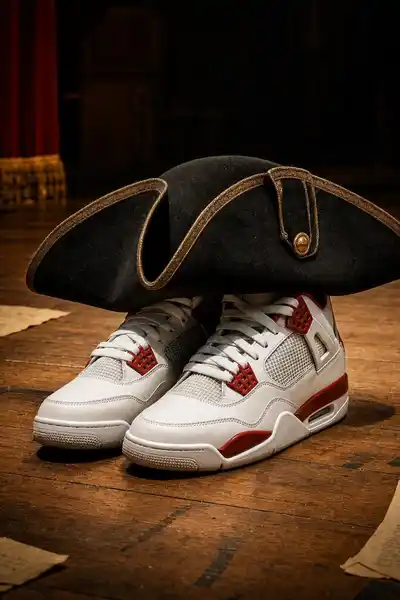
Six years later, on August 6, 2015, Hamilton opened on Broadway at the Richard Rodgers Theatre after a successful off-Broadway run earlier that year. The show had Miranda playing Alexander Hamilton and a cast of Black, Latino, and Asian-American performers playing the rest of the founding generation. The music combined hip-hop, R&B, Broadway show tunes, and traditional musical theater into a continuous score that ran almost three hours. The reviews were rapturous. The tickets were impossible to get within a month of opening. By the end of its first year, the show had become the most discussed cultural event in American theater in at least a generation, and the cast recording, released on Atlantic Records, had become the highest-charting hip-hop album in Broadway’s history.
What Hamilton actually did, beneath the commercial success and the awards, was more interesting than the standard summary captured. The show took the most ideologically loaded material in American history the founding myth, the constitutional moment, the lineage of national virtue — and reframed it through casting and musical form so that the audience experiencing the founding was not the audience the founders had imagined. The reframing was not a critique of the founding. It was an argument that the founding belonged to a country much larger than the one that had been written into the original story. The argument was unusually generous, unusually accessible, and unusually consequential for a piece of American culture made in the 2010s.
The question we’re asking: what did Miranda actually build on Broadway, what cultural argument did the show make, and how has Hamilton aged in the years since the original cast left?
What we’ll see: the development arc from the Obama performance to the Broadway opening, the formal innovations of the score, the politics of the casting choice, and the legacy.
Table of contents
01Six years from the White House to Broadway
Miranda had been a known quantity in musical theater since 2008, when his first show, In the Heights, won the Tony for Best Musical. The show, about a few days in a Washington Heights neighborhood Miranda had grown up in, introduced the formal innovation he would return to: hip-hop and salsa as legitimate musical-theater vocabularies, integrated rather than presented as exotic effects.
The Hamilton idea took shape during a 2008 vacation in Mexico, when Miranda picked up the Chernow biography at an airport bookstore. Hamilton’s biography, he later said, had the structure of a hip-hop narrative the kid from nothing, the prolific output, the public feuds, the early death. The first song he wrote, the one he performed at the White House, became the opening number. He spent the next six years writing the rest, with continuous research, consultation with Chernow and the historian Joanne Freeman, and dozens of workshops at the Public Theater in New York.

02A score that refused the genre divisions
The musical innovation of Hamilton was not, as the popular description had it, that the show was hip-hop. The show was hip-hop in some songs, R&B in others, traditional Broadway in others, and chamber music in still others, often within the same number. The composer’s argument was that the genres American music had spent fifty years sorting into separate categories could be treated as a single continuous vocabulary, and that the founding generation fast talkers, rivals, writers of long persuasive documents — was best served by a score that moved freely across the categories.
The structural device was rhythmic density. The score uses an unusually high word count per measure compared to most musical theater, with the lead character delivering verses that approach the rate of hip-hop lyrical delivery. The reason is partly historical. Hamilton wrote at extraordinary volume — his collected papers run to twenty-seven volumes and the show’s structural argument was that the speed of his thought required a musical form that could match. The slower characters, Aaron Burr in particular, have a different rhythmic register; the contrast between Hamilton’s verbal density and Burr’s measured restraint becomes one of the structural engines of the show.
03Casting and the argument the show was making
The casting choice, which Miranda has called color-conscious rather than colorblind, was the part of the show that carried its central cultural argument. Hamilton, Burr, Washington, Jefferson, Madison, the entire Schuyler family, and most of the other major characters were played by Black, Latino, and Asian-American performers. The few white roles King George III, primarily were played as comic interlude characters. The casting was not incidental. It was structural. The show’s argument was that the founding belonged, by inheritance, to all Americans, and that the most accurate way to dramatize that inheritance was to have the founders portrayed by people who looked like the country the founders had eventually produced.
The argument was unusually generous in its politics. The show did not portray the founders as villains or hypocrites, although it acknowledged their failures, particularly on slavery. Hamilton in the show is presented as broadly heroic, his abolitionist sympathies are emphasized, and his flaws are tragic rather than damning. The casting did the political work that a more direct critique would have had to do verbally, and it did so without requiring the show to break the audience’s sympathy with the founding figures. The audience watched Black and brown actors playing white founders and absorbed, through the experience itself, an argument about who inherited the founding that the show never had to argue in the dialogue.
04Ten years on, and what survives
Hamilton has continued to run on Broadway since 2015. The show has produced multiple touring companies, regional productions, and a 2020 Disney+ film of the original cast performance that became one of the most-watched streaming events of the early pandemic. The cast recording has remained in continuous circulation, with streaming numbers that compare to major pop releases rather than to typical Broadway albums. The commercial footprint of the show, measured against any standard musical theater benchmark, is exceptional.
The cultural footprint has been more uneven. The show arrived in 2015 during the Obama presidency, and the political moment it spoke to multicultural patriotism, the project of expanding the American narrative to include the audiences the original story had left out was a particular moment that has not been continuous. The Trump election in 2016, the cultural polarization that followed, the reckoning with American history that 2020 produced, and the rightward shift in political discourse since have all changed the context in which the show is heard. The optimistic civic argument that Hamilton made has not become wrong, but it has become harder to make without qualification, and the show now reads partly as a record of a moment that the country has been working through ever since.
05Conclusion
Lin-Manuel Miranda has spent the years since Hamilton expanding his work across film and animation. Ron Chernow has continued to write biographies. Several members of the original cast Leslie Odom Jr., Daveed Diggs, Phillipa Soo have become significant figures in their own right. The show has settled into the unusual position of being both a continuing commercial success and a finished cultural object that scholars have begun to study at length.
Related books