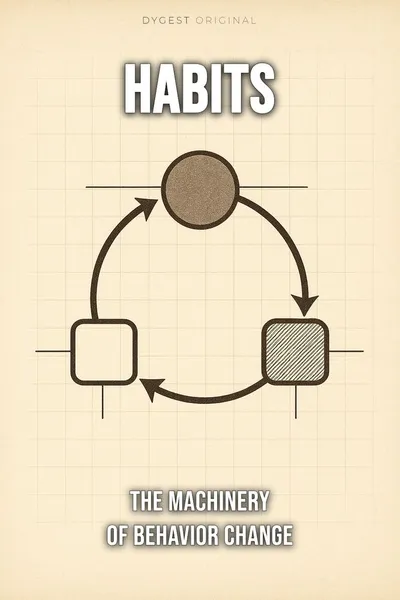
Habits
The machinery of behavior change
Description
Somewhere between forty and seventy percent of what an adult does during the course of a day is habit rather than decision. The precise number depends on how you count, and researchers argue about the methodology, but the magnitude is not really in dispute. We like to think of ourselves as making choices all day what to eat, whether to check the phone, whether to open the laptop one more time before bed but most of what looks like choice is actually pattern. The brain runs the patterns in the background. Consciousness shows up, takes credit, and moves on.
This is the first important fact about habits, and it reframes everything about self-improvement that preceded the twenty-first century's behavioral-science turn. For most of the twentieth century, the dominant model of personal change was about willpower — decide what you want, apply discipline, push through resistance. The model is emotionally satisfying and almost entirely wrong about how human behavior actually works. People who successfully change their diet, their exercise routine, their drinking, their work habits are rarely running on willpower. They are running on redesigned defaults new cues, new routines, new reward structures that do the work automatically.
The practical question, then, is not how to want something more. It is how to rearrange the machinery that runs when you are not paying attention. That is a solvable problem, and the last thirty years of research has produced a reasonably good map of the solution. The map is not quite what the best-selling advice books make it sound like, and it is not quite what the older moralistic tradition of self-improvement pretends either. The habit is a specific neurological structure, and its structure has implications.
The question we're asking: how does behavior change actually work when willpower isn't the operative variable?
What we'll see: the habit loop, the century of science behind it, the commercial wave that popularized it, and the gap between what the research shows and what self-help claims.
Table of contents
01The habit loop
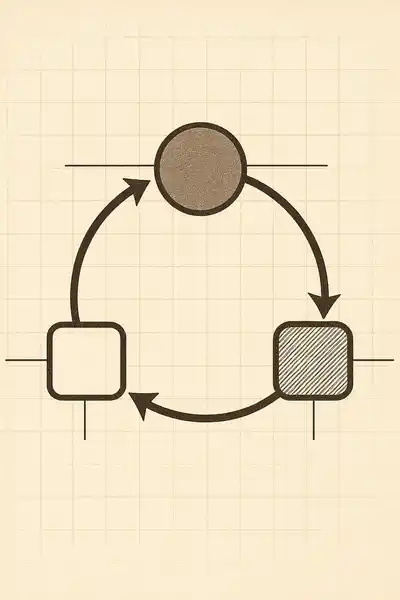
The basic neurological unit of a habit is a loop with three components, and a fourth that the first generation of popularizers left out. A cue triggers a routine, the routine produces a reward, and the repetition of the cycle strengthens the association. The loop lives primarily in the basal ganglia, a set of structures near the base of the brain that handle automatic motor sequences. Damage to the basal ganglia destroys the ability to form new habits without necessarily destroying conscious decision-making. The two systems deliberate choice and habitual execution are physically separate inside the skull.
The fourth component, added by more recent research, is craving. A habit is not just a learned sequence of cue and response. It is a sequence in which the brain begins, over time, to anticipate the reward at the moment of the cue to pre-release a small dose of dopamine when the cue is detected, before the routine has even been performed. This anticipatory craving is what makes a habit feel pulled rather than pushed. You do not walk to the coffee machine because you consciously decided to; you walk because the cue (the specific time, the specific sensation of drowsiness) has already triggered the craving, and the craving pulls you. The routine is downstream of the anticipation.

02A century of thinking about habits
William James wrote about habit in 1887 and got most of the basic structure right without the benefit of neuroscience. His essay, later republished in the Principles of Psychology, argued that habits are the fundamental unit of character, that they are formed through repetition, and that the moral life consists of being careful about which habits you allow to form. His advice was practical: never allow an exception until the new habit is rooted, launch yourself with a strong initiative, seize every opportunity to act on the resolution. The advice is still recognizable in contemporary popularizations.
The behaviorist tradition of the early twentieth century Thorndike, Watson, Skinner turned the study of habit into a research program. Their insight was that behavior is shaped by consequences, and that the pattern of reinforcement matters more than the content of any specific reinforcer. Skinner's operant conditioning framework became the scientific ground for the later cognitive revolution's habit research. The behaviorists were wrong about a lot, but they got the fundamental point: habit is shaped behavior, and the shaping happens at the level of consequence.
03The commercial wave
The popular breakthrough came in 2012 with Charles Duhigg's The Power of Habit, a book that translated the cue-routine-reward framework into accessible prose and sold millions of copies. Duhigg was a journalist rather than a researcher, and his book is best understood as a bridge between the academic literature and the general reader rather than as primary science. But the bridge was effective, and it set the template for a wave of habit-focused self-help that has now been running for over a decade.
James Clear's Atomic Habits, published in 2018, is the most successful book in the wave, with global sales over fifteen million copies. Clear's contribution was practical: a set of design rules for structuring the cue and reward environment to make desired behaviors easier and undesired behaviors harder. Make it obvious, make it attractive, make it easy, make it satisfying with each principle matched to concrete environmental interventions. Clear's framework is not original science but it is an unusually clean operationalization of the science, and the commercial response has vindicated the clarity of the framing.
04What the research shows versus what self-help claims
The self-help literature on habits is broadly consistent with the research, but it simplifies the picture in ways worth knowing about. The most famous claim that it takes twenty-one days to form a habit is almost entirely wrong. The figure originated with a 1960 book by a cosmetic surgeon, not with any study of habit formation. A 2009 University College London study found that the actual time varies enormously, from about eighteen days for simple habits to over two hundred and fifty for more complex behaviors.
The self-help literature also underemphasizes the role of identity and context. Changing a habit in a new environment is often easier than changing it in the environment where the old habit was formed which is why people who quit smoking after a move have dramatically higher success rates than people who quit in place. The cue-reward environment is doing most of the work, and a change of location amounts to a wholesale reset of the environment. This is not a mysterious failure of willpower. It is the physics of how habits are anchored.
05Conclusion
The reason habits matter as a subject of serious attention is that the alternative framing willpower, discipline, character was the dominant twentieth-century answer to the question of how people change, and it has been empirically falsified in ways most of the discourse has not caught up with. Willpower is a real psychological phenomenon but a weak and unreliable one. The people who appear to have superhuman willpower are almost always people who have redesigned their environment so willpower is not required. Knowing this is the beginning of being able to act on it.
Related books