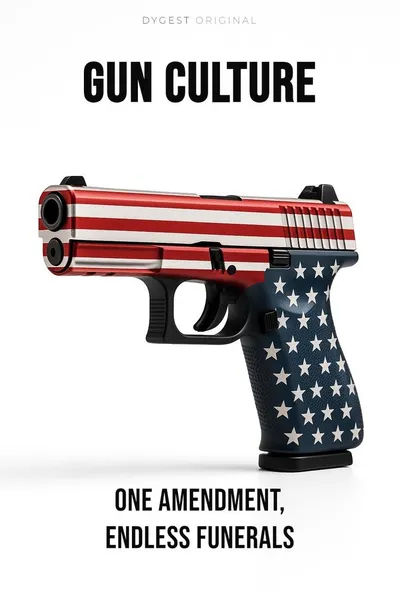
Gun Culture
One amendment, endless funerals
Description
Introduction
On December 14, 2012, a gunman entered Sandy Hook Elementary School in Newtown, Connecticut, and killed twenty children between the ages of six and seven, and six adult staff members. It was the deadliest mass shooting at a school in American history. In the days that followed, the President wept at a press conference, Congress promised action, and polls showed that roughly 90 percent of Americans supported universal background checks for gun purchases. Within four months, a bipartisan bill to expand background checks had failed in the Senate, blocked by a procedural vote that required sixty votes to proceed. The legislation was not controversial. It simply did not pass.
The United States has more guns per capita than any other country in the world roughly 120 firearms per 100 residents, according to the Small Arms Survey. It also has a firearm death rate far higher than any other wealthy nation: roughly four times that of Canada, eight times that of France, nearly twenty times that of Germany. The gap is not explained by higher rates of mental illness, which are broadly comparable across wealthy countries. It is explained, in very large part, by the availability of guns.
And yet the political system has proved nearly incapable of restricting that availability in any meaningful way. The reasons are not simply about the power of lobbying groups or the stubbornness of rural voters. They run deeper into history, into constitutional interpretation, into the specific ways that guns have been woven into American identity for two centuries. Understanding the gun debate requires understanding why it is not, in any straightforward sense, a debate about guns.
The question we're asking: why does the United States keep having the same conversation about gun violence without changing the conditions that produce it?What we'll see: the history that made guns central to American identity, the legal architecture that protects them, the politics that prevent reform, and what the evidence says about what would actually work.
Table of contents
01A right written into the founding
Guns were central to American life long before the Second Amendment codified a right to bear them. Frontier settlement, the Revolutionary War, the slave patrols that policed Southern plantations, the militias that substituted for standing armies in a republic suspicious of centralized military power all depended on an armed citizenry in ways that shaped both practice and mythology. By the time the Bill of Rights was ratified in 1791, the Second Amendment's guarantee of the right to bear arms reflected an existing reality as much as it created a new one.
For most of American history, the Second Amendment was interpreted as a collective right the right of states to maintain militias rather than an individual right to own firearms. Federal courts upheld gun regulations consistently under this reading. That changed in 2008, when the Supreme Court ruled in District of Columbia v. Heller that the Second Amendment protects an individual right to possess a firearm for traditionally lawful purposes, including self-defense in the home. The 5-4 decision transformed the constitutional landscape, making previously permissible gun regulations newly vulnerable to legal challenge.

02Why the politics don't follow the polls
The National Rifle Association (NRA) is the organization most associated with blocking gun legislation, and it has been genuinely influential but its power is more complicated than its reputation suggests. The NRA's lobbying budget is substantial but not exceptional by Washington standards. What the organization provides that money cannot simply buy is political mobilization: gun owners who will vote on this issue alone, who will show up to town halls, who will remember a vote years later. The asymmetry between motivated gun rights voters and less activated gun control supporters has shaped legislative math for decades.
The geography of American politics amplifies this asymmetry. The Senate gives equal representation to Wyoming, population roughly 580,000, and California, population roughly 39 million. Rural states where gun ownership rates are high and gun culture is politically salient have disproportionate Senate representation relative to their populations. Gun control legislation that could pass in a legislature apportioned purely by population faces a structural obstacle in the Senate that reflects the country's geographic distribution as much as its opinion distribution.
03What the evidence says, and what gets ignored
The evidence on what reduces gun violence is more robust than the political debate suggests. Countries that have implemented comprehensive licensing requirements, waiting periods, safe storage mandates, and restrictions on high-capacity magazines have lower rates of gun death. Australia's 1996 gun buyback program, implemented after a mass shooting in Port Arthur, Tasmania, that killed 35 people, removed roughly 650,000 firearms from circulation and was followed by a significant decline in firearm homicides and suicides. The Australian experience is frequently cited in American gun debates and just as frequently dismissed on the grounds that Australia is not America.
Within the United States, state-level variation provides evidence that is harder to dismiss on cultural grounds. States with stricter gun laws California, Massachusetts, New York, Connecticut have lower rates of gun death than states with permissive regimes. The relationship is not perfectly clean: urban density, poverty rates, and other variables matter too. But the pattern is consistent enough that researchers have concluded that gun laws, specifically, have measurable effects on gun mortality. The evidence exists. It is not, in American politics, what is driving the debate.
04Two debates that will never resolve each other
The gun debate in the United States is structurally resistant to resolution because it is not primarily a debate about public safety. It is a debate about identity, about constitutional rights, about the relationship between the individual and the state, and about which communities' experiences of violence are treated as political priorities. Gun control advocates and gun rights defenders are largely arguing past each other because they are answering different questions.
For gun control advocates, the question is empirical: given the evidence, what policies would reduce gun deaths? The answer points toward licensing, restrictions on weapon types and magazine capacity, waiting periods, and red flag laws that allow courts to temporarily remove firearms from individuals deemed dangerous. For gun rights advocates, the question is constitutional and cultural: does the government have the authority to restrict a fundamental right, and what is lost when it does? These are not questions that share a common framework, which is why the same facts produce such different conclusions.
05Conclusion
After Sandy Hook, after Parkland, after Uvalde after each massacre that produces a moment of apparent political consensus the conversation resets. The polls showing majority support for gun reform remain. The Senate arithmetic remains. The cultural attachment to firearms in the communities that determine that arithmetic remains. What changes, slowly, is the accumulation of grief: the growing number of Americans who have lost someone to gun violence, practiced active shooter drills with their children, or stopped sitting near windows in public spaces.
Related books