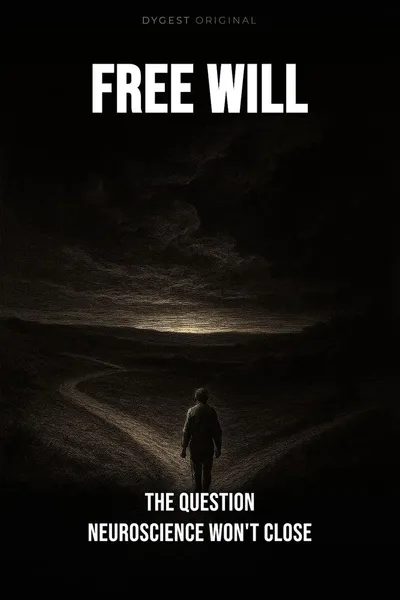
Free will
The question neuroscience won't close
Description
Every year or so, a new paper or a new podcast announces that science has finally disproved free will. A neuroscientist watches brain activity predict a decision before the subject feels herself deciding. A primatologist argues for six hundred pages that nobody is ever responsible for anything. A Silicon Valley podcaster builds an audience around the claim that the self is an illusion and so is its freedom. Each time, the argument lands as if it were new. It isn't.
The trouble is that the people arguing about free will are usually not arguing about the same thing. When Sam Harris says it's an illusion, he means one thing. When Daniel Dennett says it's real and worth wanting, he means another. When a criminal court rules a defendant responsible, it means a third thing neither is strictly discussing. The debate has run for two and a half millennia, and most of its participants have talked past each other, because the phrase packages three separate questions: is the universe deterministic, is there a self that chooses, and what do we owe each other as a consequence.
Neuroscience entered this debate in the 1980s with experiments that seemed to tip the scales. Benjamin Libet showed that the brain starts preparing a voluntary movement hundreds of milliseconds before the subject consciously decides to move. Later studies pushed the window to ten seconds. The data replicates, and yet the philosophical argument has not moved. The people who thought free will was an illusion before Libet still think so, and the people who thought it was real still think so. The experiments didn't settle anything because they weren't measuring what the argument is about.
The question we're asking: if neuroscience can predict a decision before the decider feels it, what's left of free will and which version are we even arguing about?
What we'll see: the four camps that divide the debate, the philosophical history behind them, what the Libet experiments actually show, and why the answer reshapes criminal justice, addiction, and AI accountability.
Table of contents
01The four camps you need to know
Four positions organize every serious argument about free will, and before looking at any experiment it's worth knowing which camp a claim belongs to. The first is hard determinism. Every event in the universe, including every thought and every choice, is the inevitable product of prior causes stretching back to the Big Bang. You didn't choose to read this sentence particles moving according to physical law did. Robert Sapolsky's 2023 book Determined states the position and accepts the consequence most find unbearable: nobody ever deserves anything, including blame.
The second is libertarian free will no relation to the political party. Libertarians argue that human beings genuinely originate their choices in a way physics does not capture. Some appeal to quantum indeterminacy, some to dualist souls, some to emergent mental causation. The position has fewer academic defenders today than a century ago, but it remains the default intuition of most people most of the time. When someone says my choice was really mine, they speak like a libertarian, whether they know the vocabulary or not.

02Twenty-five centuries of trying to dodge the problem
The argument didn't start with neuroscience. It started in Western thought with Augustine, in the late fourth century, wrestling with a theological puzzle that never went away. If God is omniscient, He knows what you'll do tomorrow. If He knows, it's fixed. If it's fixed, how can you be blamed for it? Augustine's answer that God's foreknowledge doesn't cause your choice, it registers it kept Christian moral theology running for a thousand years. It's the same problem physics raises today, with causation replacing omniscience.
Hume, in 1748, cut the knot in a way that still defines the modern debate. He argued the whole dispute between necessity and liberty was verbal. Human actions have causes character, motive, circumstance and we remain free when our actions flow from those causes rather than from external compulsion. A man who gives to charity because he is generous acts freely even if his generosity was shaped by his upbringing. Hume's compatibilism is Dennett's ancestor, and it set a template still in use: when the metaphysics gets impossible, redefine the terms.
03The neuroscience act
In 1983, Benjamin Libet ran an experiment at UC San Francisco that would define the next forty years of this argument. He asked subjects to flex a wrist whenever they felt like it, to report the moment they felt the conscious urge to move, and he recorded their scalp activity throughout. The readiness potential, a specific signal, appeared in motor cortex about three hundred and fifty milliseconds before subjects reported the conscious decision. The brain, it seemed, had decided before the self noticed.
In 2008, a team led by John-Dylan Haynes in Berlin extended the finding dramatically. Using fMRI and pattern classification, Soon, Brass, Heinze and Haynes predicted which of two buttons a subject would press up to ten seconds before awareness of choosing. The prediction was imperfect sixty percent accuracy but robust, and the lag was orders of magnitude larger than Libet's. For many readers, the case seemed closed. If the brain commits ten seconds before you know you're choosing, in what sense are you choosing.
04What actually hangs on it
The debate matters outside seminar rooms because the answer changes how you treat people. American criminal law, since M'Naghten in 1843, has tied culpability to the defendant's capacity for rational self-control. When that capacity is impaired by psychosis, severe brain injury, developmental damage the law reduces punishment. In the Dzhokhar Tsarnaev sentencing phase after the Boston Marathon bombing, defense experts argued from neuroscience that his brain, dominated by an older brother, had not developed the executive function for independent moral judgment. The jury heard it, found it insufficient, and returned a death sentence. The fight plays out in courtrooms exactly as in journals.
Addiction is the cleanest test case. The disease model, dominant in American medicine, says chronic use alters brain circuitry in ways that degrade voluntary control. The moral model, still dominant in criminal justice for most drugs other than alcohol, says the user chose and can be punished. Neither is simply right. Addiction compromises choice without eliminating it addicts respond to incentives, treatment, and changed circumstances, which is not what fully compelled behavior looks like. The compatibilist frame handles this better than either extreme: free will comes in degrees, and so does responsibility.
05Conclusion
The Libet experiments are real, the determinism may be real, and none of it settles the argument, because the argument has two layers neuroscience cannot tell apart. One is metaphysical: are human actions caused by prior states of the universe. Probably yes. The other is moral and practical: does it still make sense to treat people as agents who reason, deliberate, and can be held to account. Also yes and the compatibilist tradition from Hume to Dennett has spent three centuries showing why the two answers don't contradict each other. The fight between Harris and Dennett is not science versus ignorance. It is about which definition of freedom is worth using.
Related books