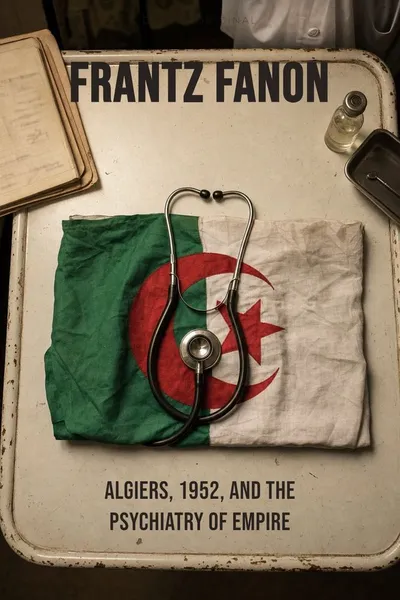
Frantz Fanon
Algiers, 1952, and the psychiatry of empire
Description
In 1952, a twenty-seven-year-old psychiatrist from Martinique named Frantz Fanon published a book in Paris called Peau noire, masques blancs, which would be translated into English in 1967 as Black Skin, White Masks. Fanon had been born in Fort-de-France in 1925, served with the Free French Forces in the Second World War, and trained as a medical doctor at the University of Lyon. The book that appeared in 1952 was, on its surface, a clinical investigation of the psychological effects of colonialism on the colonized. It drew on Fanon’s training in psychiatry, on his reading in phenomenology and existentialism, and on his own experience as a Black man in postwar France. What it argued was that the conditions of colonial life produced specific psychological disorders that the available diagnostic frameworks could not adequately describe, and that any serious psychiatric practice in a colonial context had to grapple with the political conditions that produced its patients.
Three years after the book appeared, Fanon took a posting at the Blida-Joinville psychiatric hospital in Algeria, where he would spend the central period of his short life. The Algerian War of Independence began in November 1954, less than a year after his arrival. Fanon’s work at Blida exposed him to two patient populations he had to treat in the same wards: Algerian fighters who had been tortured by French security forces, and French officers who had been the ones doing the torturing. The clinical experience radicalized him in ways he would later describe carefully in The Wretched of the Earth, the book he wrote in the final months of his life and that appeared in 1961 with a preface by Jean-Paul Sartre. Fanon would die of leukemia in a Bethesda hospital in December 1961, six weeks before Algeria won its independence. He was thirty-six.
The intellectual legacy he left behind has been one of the most argued-over of the second half of the twentieth century. Fanon was simultaneously a clinician, a participant in a national liberation struggle, and a theorist of decolonization whose framework would shape revolutionary movements across Africa, Asia, and Latin America. The argument worth tracking is what was distinctive about the position he developed — how the combination of clinical psychiatry and anticolonial politics produced a body of work that has continued to do philosophical work in conditions Fanon could not have predicted.
The question we’re asking: what did Fanon actually see at Blida and write in his two major books, and how has his framework aged across sixty years of post-colonial politics?
What we’ll see: the Martinique-Paris-Algiers trajectory, the clinical observations, the political theory, and the legacy.
Table of contents
01 A Caribbean intellectual in postwar France
Frantz Fanon had grown up in a middle-class Black family in Fort-de-France, where his father was a customs inspector. The Martinique of his childhood was a French colonial society in which racial hierarchy was the organizing fact of daily life, but in which the formal status of the inhabitants as French citizens produced a particular dissonance. The Martinicans were French. They were also, in the colonial gaze, Black. Fanon’s literature teacher at the Lycée Schoelcher was Aimé Césaire, who would become the central figure of his generation working out the relationship between the two identities.

02 The clinical observations of Black Skin, White Masks
The central claim of Fanon’s first book was that the experience of being Black in a white-dominated colonial society produced a specific psychological structure that could not be reduced to ordinary psychiatric categories. The Black subject in colonial society was not simply oppressed in a political or economic sense. He was also, in a way that Fanon argued was clinically significant, alienated at the level of the self. The colonial gaze produced a kind of doubling. The colonized subject saw himself as a self with his own purposes and history, but also saw himself as the colonizer saw him as an object, as a racial type, as a representative of a category rather than as an individual. The two perspectives could not be reconciled, and the failure to reconcile them produced the symptoms Fanon was observing in his patients and in himself.
The most famous passage of the book describes the experience of being identified by a small white child on a train in Lyon — “Look, a Negro!” — and what the identification did to Fanon’s own sense of self in the moments that followed. The passage is short, but it contains the central observation of the book in compressed form. The subject who is identified racially in this way is not simply named; he is fixed into a particular schema, made visible in a way he cannot fully control, and required to operate from that point forward in a position the schema has already prepared for him. The work the subject then has to do to maintain himself — psychologically, socially, philosophically is the work Fanon’s book is about.
03 Blida, the war, and The Wretched of the Earth
In 1953, Fanon accepted a posting to Blida-Joinville Psychiatric Hospital, one of the largest psychiatric facilities in French North Africa, about thirty miles south of Algiers. Patients included Algerian civilians, Algerian colonial subjects arrested for political offenses, and French settlers and security forces. The reforms Fanon attempted therapeutic communities, separating wards along cultural rather than racial lines, working with Algerian patients in Arabic-translated frameworks were partially successful and partially blocked by the colonial administration.
The Algerian War of Independence began in November 1954 and changed the conditions of Fanon’s work fundamentally. The patients arriving at Blida from 1955 onward included an increasing number of Algerian fighters who had been tortured by French security forces. The trauma symptoms they presented insomnia, dissociation, panic, suicidal ideation were not abstract clinical observations. Fanon could trace them directly to specific French military practices that were being deployed against the Algerian resistance. He could also see French soldiers and officers who had been the ones administering the torture, and whose own psychiatric difficulties guilt, dissociation, alcohol dependence, panic Fanon was now expected to treat in the same hospital.
04 What survives, sixty years on
Fanon’s intellectual legacy has had three distinct careers. The first is in postcolonial theory, where Black Skin, White Masks has been read as foundational by Stuart Hall, Homi Bhabha, and Edward Said. The argument that colonial structures produce specific psychological effects has become a standard position in the field.
The second career is in the revolutionary politics of the 1960s and 1970s. The Wretched of the Earth was a foundational text for the Black Panthers, for liberation movements across Africa, and for the radical wings of the American civil rights movement. Fanon’s defense of revolutionary violence has been criticized as both inadequately specific and as having licensed forms of violence he himself would not have endorsed.
05 Conclusion
Frantz Fanon died in Bethesda in December 1961, having lived just long enough to finish dictating The Wretched of the Earth and to see Sartre’s preface in proof. Algeria became independent in March 1962. The Wretched was banned in France that same year. Fanon was buried in the village of Aïn Kerma in eastern Algeria, in territory the FLN had controlled during the war.
Related books